

Vyombo vya Kuabudu
Muhtasari wa Ibada 1
Maandiko ya Ziada
Psalm 118:1–2, 14–24; Isaiah 25:6-9; 1 Corinthians 15:1–11
Utangulizi
Karibu
Morning at the Empty Tomb Reflection
Play “morning sounds” in the background to help the participants visualize the scene. Suggestions: “Sounds of the Earth: Morning Birds,” or “Dawn Chorus” available on iTunes. Morning sounds can also be found on YouTube or other websites. As the soundtrack is playing, invite people into the following reflection.
Morning sounds begin to play.
Reader 1: Early on the first day of the week, while it was still dark, Mary Magdalene came to the tomb and saw that the stone had been removed from the tomb (John 20:1).
Reader 2: Close your eyes and imagine for a moment the walk to the tomb. Breathe in the scent of fresh morning, listen for the sounds of dawn, and see the darkness of night beginning to fade in the growing light of the new day. Imagine walking through the morning and arriving at the empty tomb. How are you experiencing the hope and promise of new life this day?
Pause for a few moments of silent reflection then fade out the morning sounds.
Wimbo wa Ufunguzi
"Dunia, Dunia, Amkeni!" CCS 472
A soloist sings the first three verses. The community joins for last verse.
AU “Msherehekee Yesu” CCS 474
Participants sing or they can sing along with the vocal recording found on Community of Christ Sings Audio Recordings, available from Herald House.
AU “Paza Sauti Zako za Furaha” CCS 475
Confessional Prayer for Peace
Washa mshumaa wa amani
Maombi
Mtakatifu,
We pray to you this Easter morning to open our eyes so we might recognize you in the breaking of the bread and be prepared to follow wherever you lead. Breathe on us your peace.
We confess our fear and shortcomings. We ignore the poor and the hungry and overlook those who mourn. We abuse the earth you made for us. We are deaf to the cries of the burdened and indifferent to calls for peace.
Forgive us.
Help us to trust in you to change our lives and make us new that we may know the joy and peace of Jesus Christ, our Risen Lord.
We give thanks for your steadfast love that endures forever! Amen.
—Psalm 118:1–2, adapted
Jibu
Wakati wa Kuzingatia
Read The Easter Story by Carol Heyer (Scholastic, Inc., 2006, ISBN 9780439855358). Begin reading with the women at Jesus’s tomb.
OR Tell the Easter story in your own words.
OR Read the Easter story from a children’s story Bible
Wimbo
“Siyahamb’ Ekukhanyen’ Kwenkhos’/We Are Marching in the Light of God” CCS 95
OR “Amen, Siakudumisa!/Amen, Sing Praises to the Lord!” CCS 109
Invite participants to stand, clap, dance, and praise, singing the hymn multiple times. You may consider adding other instruments, such as drums and shakers.
Wahimize washiriki kuimba kwa lugha nyinginezo ambazo si zao.
Mwitikio wa Ukarimu wa Wanafunzi
Kusoma
Read the lyrics to “Sometimes We Wait, Expecting God,” CCS 304.
Maombi
We celebrate the Living Christ but also pray for sharpened attention to see him everywhere he dwells in the world around us. The Living Christ will show up sometimes where we least expect—on the street corner, in the grocery store, at the dinner table with our own families. When we see him, may we have the courage also to be him—to be the Living Christ who redeems, restores, and reconciles to everyone we meet, in every place we are in. May our offerings—of awareness, resources, time, and advocacy—continue to make way for the peace of Christ to be present in our world. Amen.
Baraka na Kupokea Zaka za Misheni za Eneo na Ulimwenguni Pote
Scripture Reading: John 20:1-18 OR Mark 16:1-8
Choral Anthem
“Alleluia, He Lives!” (SATB) Joel Raney, Hope Publishing Company
OR “Christ Is Risen, Alleluia!” (SATB) Jay L. Althouse, Hope Publishing Company
OR Community Hymn
“Christ Is Alive!” CCS 473
OR “The Risen Christ” CCS 477
OR “Mfurahini, Haleluya/Christ Has Arisen, Alleluia” sing twice CCS 471
Wahimize washiriki kuimba kwa lugha nyinginezo ambazo si zao.
Mahubiri ya Pasaka
Based on Mark 16:1–8 and John 20:1–18 OR choose one as the focus
Sala ya Kichungaji
Wimbo wa Kufunga
“Jesus Christ Is Risen Today” CCS 476
OR “Now the Green Blade Rises” CCS 482
OR “Good Christians All, Rejoice” CCS 479
Kutuma
Go in peace!
Ujumbe wa baada ya wimbo
Muhtasari wa Ibada 2
Maandiko ya Ziada
Psalm 118:1-2, 14-24; Isaiah 25:6-9; 1 Corinthians 15:1-11
Maandalizi
Arrange a worship setting with a white cloth draped on a cross. If candles were part of the worship setting during a Good Friday service, light all those candles for the Easter service. The purple cloth used during the season of Lent will be needed during the Focus Moment.
Utangulizi
Karibu
Wito wa Kuabudu Usomaji Msikivu
Leader: Let Israel say,
People: “God’s steadfast love endures forever.”
Leader: Let those who fear the Lord say,
People: “God’s steadfast love endures forever.”
Leader: The Lord is our strength and might.
People: God has become our salvation.
Leader: We shall not die, but we shall live,
People: and recount the deeds of the Lord.
Leader: Open the gates of righteousness,
People: that we may enter through them and give thanks to the Lord.
Leader: This is the day that the Lord has made;
All: Let us rejoice and be glad in it.
—based on Psalm 118:2-24
Wimbo wa Sifa
“Good Christians All, Rejoice” CCS 479
OR “Christ Leads!” CCS 28
AU “Paza Sauti Zako za Furaha” CCS 475
Sala ya Kufungua
Jibu
Mwitikio wa Ukarimu wa Wanafunzi
Scripture Reading: Doctrine and Covenants 165:1a,b
Taarifa
Stewardship is how we support Christ’s mission – not just financial stewardship but whole-life stewardship. Our whole-life response in living Christ’s mission is how we create God’s vision of shalom. Discipleship is the hard and messy work of living Christ’s mission, and whole-life stewardship is the framework within which we give in support of this mission.
When we fully receive God’s grace and generosity, every breath of our lives expresses gratitude to God, and we respond by living Christ’s mission.
—Choose Generosity: Discovering Whole-life Stewardship, Herald House, 2019, pp.13
Let us express our gratitude this day!
Baraka na Kupokea Zaka za Misheni za Eneo na Ulimwenguni Pote
Focus Moment: What Color Is Easter?
Find a discussion of liturgical colors and the Easter season at: Sermons4Kids
Hymn of Easter Joy
“Celebrate Jesus” CCS 474
Sing along with the vocal recording found on Community of Christ Sings Audio Recordings, available from Herald House. This song works especially well with children and youth. Encourage their leadership of the sing-along.
OR “Woman, Weeping in the Garden” CCS 478
OR “I Danced in the Morning” CCS 23
Easter Message
Based on Mark 16:1-8 and John 20:1-18 OR choose one on which to focus
Maombi ya Amani
Wimbo wa Amani
“My Peace” CCS 149
AU “Dona Nobis Pacem” CCS 155
Divide into 3 parts; sing as a round.
Statement of Peace
As the disciples were radically changed, empowered, emboldened, and filled with hope and peace as a result of their encounter with the resurrected Christ, may we also choose to be changed and to share that peace, knowing the assurance of God’s love.
Washa mshumaa wa amani
Maombi
Loving God, as we light the candle of Peace, help us to remember those who are experiencing moments so difficult that they have lost sight of your existence. On this Easter morning as we meditate on the hope your resurrection brings, that even in the face of evil, tragedy and death, we need not fear. Let your glory be revealed in our lives in such a way as to help restore their faith and reflect the peace that you have to give. Amen.
—Lois Hillman
Wizara ya Muziki
“O Risen Christ, Still Wounded” CCS 41
OR “Jesus, Promise of an Angel” CCS 32
Wimbo wa Kufurahi
"Kristo Aliyefufuka" CCS 477
AU “Yesu Kristo Amefufuka Leo” CCS 476
OR “Now the Green Blade Rises” CCS 482
Baraka
Jibu
Ujumbe wa baada ya wimbo
Nafasi Takatifu: Muhtasari wa Ibada ya Kikundi Kidogo
Kukusanyika
Karibu
Maombi ya Amani
Piga kengele au piga kengele mara tatu polepole.
Mshumaa wa Amani Mwepesi
Mtakatifu,
We pray to you this Easter morning to open our eyes so we might recognize you in the breaking of the bread and be prepared to follow wherever you lead. Breathe on us your peace.
We confess our fear and shortcomings. We ignore the poor and the hungry and overlook those who mourn. We abuse the earth you made for us. We are deaf to the cries of the burdened and indifferent to calls for peace.
Forgive us.
Help us to trust in you to change our lives and make us new that we may know the joy and peace of Jesus Christ, our Risen Lord.
We give thanks for your steadfast love that endures forever! Amen.
—Psalm 118:1–2, NRSV adapted
For more ideas: The Daily Prayer for Peace services offered at the Temple in Independence, Missouri, can be found on the church’s website as Calendar Events at CofChrist.org.
Mazoezi ya Kiroho
Kukaa katika Neno
Nitasoma andiko kwa sauti. Unaposikia andiko Ruhusu maneno, taswira, au vifungu vya maneno vije akilini. Jaribu kutovizingatia. Viache vipumzike nawe.
Baada ya ukimya mfupi nitasoma andiko hilo kwa muda mfupi. Unaposikia andiko hilo tena sikiliza jinsi roho ya Mungu inavyokusukuma au kuvutia umakini wako.
On this mountain the LORD of hosts will make for all peoples a feast of rich food, a feast of well-aged wines, of rich food filled with marrow, of well-aged wines strained clear.
And he will destroy on this mountain the shroud that is cast over all peoples, the sheet that is spread over all nations; he will swallow up death forever.
Then the Lord GOD will wipe away the tears from all faces, and the disgrace of his people he will take away from all the earth, for the LORD has spoken.
It will be said on that day, Lo, this is our God; we have waited for him, so that he might save us. This is the LORD for whom we have waited; let us be glad and rejoice in his salvation.
—Isaiah 25:6-9 NRSV
Sitisha
Soma maandiko mara ya pili.
On this mountain the LORD of hosts will make for all peoples a feast of rich food, a feast of well-aged wines, of rich food filled with marrow, of well-aged wines strained clear.
And he will destroy on this mountain the shroud that is cast over all peoples, the sheet that is spread over all nations; he will swallow up death forever.
Then the Lord GOD will wipe away the tears from all faces, and the disgrace of his people he will take away from all the earth, for the LORD has spoken.
It will be said on that day, Lo, this is our God; we have waited for him, so that he might save us. This is the LORD for whom we have waited; let us be glad and rejoice in his salvation.
—Isaiah 25:6-9 NRSV
Waalike washiriki wa kikundi kushiriki majibu ya maswali haya:
- Ni maneno, misemo au picha gani zilizokuja akilini?
- Roho ya Mungu inakufunulia nini kupitia kusikia maneno haya?
Kushiriki Mezani
John 20:1-18 NRSVue
20 Early on the first day of the week, while it was still dark, Mary Magdalene came to the tomb and saw that the stone had been removed from the tomb. 2 So she ran and went to Simon Peter and the other disciple, the one whom Jesus loved, and said to them, “They have taken the Lord out of the tomb, and we do not know where they have laid him.”3 Then Peter and the other disciple set out and went toward the tomb.4 The two were running together, but the other disciple outran Peter and reached the tomb first. 5 He bent down to look in and saw the linen wrappings lying there, but he did not go in. 6 Then Simon Peter came, following him, and went into the tomb. He saw the linen wrappings lying there, 7 and the cloth that had been on Jesus’s head, not lying with the linen wrappings but rolled up in a place by itself. 8 Then the other disciple, who reached the tomb first, also went in, and he saw and believed, 9 for as yet they did not understand the scripture, that he must rise from the dead.10 Then the disciples returned to their homes.
11 But Mary stood weeping outside the tomb. As she wept, she bent over to look into the tomb, 12 and she saw two angels in white sitting where the body of Jesus had been lying, one at the head and the other at the feet. 13 They said to her, “Woman, why are you weeping?” She said to them, “They have taken away my Lord, and I do not know where they have laid him.” 14 When she had said this, she turned around and saw Jesus standing there, but she did not know that it was Jesus. 15 Jesus said to her, “Woman, why are you weeping? Whom are you looking for?” Supposing him to be the gardener, she said to him, “Sir, if you have carried him away, tell me where you have laid him, and I will take him away.” 16 Jesus said to her, “Mary!” She turned and said to him in Hebrew, “Rabbouni!” (which means Teacher). 17 Jesus said to her, “Do not touch me, because I have not yet ascended to the Father. But go to my brothers and say to them, ‘I am ascending to my Father and your Father, to my God and your God.’ ” 18 Mary Magdalene went and announced to the disciples, “I have seen the Lord,” and she told them that he had said these things to her.
—John 20:1-18 NRSVue
Katika simulizi la Yohana kuhusu asubuhi ya Pasaka, watu tofauti walikuja kumwamini Kristo kwa njia tofauti:
- The beloved disciple looked into the empty tomb, and believed instantly. What did he understand when he saw the empty tomb? What did he believe? John gives us no answer, but merely says faith was the result.
- Petro aliona kaburi tupu na sanda tupu ambapo mwili ulikuwa. Lakini, tofauti na mwanafunzi mpendwa, Petro alirudi nyumbani bila imani au uelewa.
- Mary Magdalene saw the empty tomb, but understood only the body was gone. Stolen? Moved to another location? The empty tomb did not prompt her to believe in the resurrection. She saw two messengers of God within the tomb, but that didn’t lead to faith. She encountered the Risen Christ, but mistook him for the gardener. Her eyes were opened only when he spoke her name, recalling a familiar relationship of love and caring.
From that point, relationship is the key theme of the story.
Jesus tells Mary not to hold onto him. “Don’t expect this relationship to be a continuation of the old.” Resurrection had transformed the old relationship into something new. Jesus directs Mary to go and tell the disciples. As she hurried to tell the disciples what she had seen, she became the “apostle to the apostles.”
Those who witnessed resurrection appearances did not keep silent. They were transformed. From their testimony and witness came a movement that grew and changed the world. Followers continued to encounter the Risen Christ in various ways through the centuries. Sharing that testimony still makes a difference in the world, bringing new life. Resurrection, therefore, is not a one-time event that came and went. It is a daily event as people receive God’s grace, love, and new life through Jesus Christ.
Maswali
- Who are you looking for when you look into the tomb? Who is the resurrected Christ to you?
- Umewahi kupata uzoefu gani kuhusu Mungu akikuita kwa jina lako? Imebadilishaje uhusiano wako na Mungu? Kwa wengine?
- How do you experience daily resurrection through God’s love and grace?
Inatuma
Kauli ya Ukarimu
"Kushiriki kwa manufaa ya wote ni roho ya Sayuni" (Mafundisho na Maagano 165:2f).
Tunapokea neema na ukarimu wa Mungu. Kikapu cha sadaka kinapatikana ikiwa ungependa kusaidia huduma zinazoendelea za vikundi vidogo kama sehemu ya mwitikio wako wa ukarimu.
Sala hii ya kutoa sadaka imechukuliwa kutoka kwa Jibu la Ukarimu la Mwanafunzi:
Mungu wa furaha, Tunashiriki zawadi zetu kwa furaha na shukrani kama jibu la zawadi za ukarimu ulizotupa. Sadaka tunazoshiriki zilete furaha, tumaini, upendo, na amani katika maisha ya wengine ili wapate uzoefu wa rehema na neema yako. Amina
Mwaliko wa Mkutano Ujao
Wimbo wa Kufunga
CCS 478, “Woman, Weeping in the Garden”
Sala ya Kufunga
Nyongeza za Hiari Kulingana na Kikundi
Sakramenti ya Meza ya Bwana
Kwa maana mimi nilipokea kwa Bwana yale niliyowapa ninyi, ya kwamba Bwana Yesu usiku ule aliposalitiwa alitwaa mkate, Akashukuru, akaumega, akasema, “Huu ni mwili wangu ulio kwa ajili yenu; fanyeni hivi kwa ukumbusho wangu.” Vivyo hivyo, baada ya kula, akachukua kikombe, akisema, “Kikombe hiki ni agano jipya katika damu yangu; fanyeni hivi, kila mnywapo, kwa ukumbusho wangu.” Kwa maana kila mlapo mkate huu na kukinywea kikombe hiki, mnatangaza kifo cha Bwana hadi atakapokuja.
—1 Wakorintho 11:23–26 NRSV
Taarifa ya Komunyo
Wote mnakaribishwa kwenye meza ya Kristo. Meza ya Bwana, au Ushirika, ni sakramenti ambapo tunakumbuka maisha, kifo, ufufuo, na uwepo endelevu wa Yesu Kristo. Katika Jumuiya ya Kristo, pia tunapata Ushirika kama fursa ya kufanya upya agano letu la ubatizo na kuundwa kama wanafunzi wanaoishi utume wa Kristo. Wengine wanaweza kuwa na uelewa tofauti au wa ziada ndani ya mila zao za imani. Tunawaalika wote wanaoshiriki katika Meza ya Bwana kufanya hivyo kwa upendo na amani ya Yesu Kristo.
Tunashiriki katika Komunyo kama ishara ya baraka, uponyaji, amani, na jamii.
Katika maandalizi hebu tuimbe kutoka Jumuiya ya Kristo Inayoimba 522, “Tutumie Vipaji na Lugha.”
Kubariki na kuhudumia mkate na divai.
Mawazo kwa Watoto
Materials: Easter basket. one plastic egg with a rock inside, one empty plastic egg marked with a cross, Small treats or Easter candy (one for each person0.
Today is Easter and I brought an Easter basket to share part of the story of Jesus with you.
On Easter we are joyful because Jesus has been resurrected. That means Jesus died on the cross but lives again.
Show egg with rock.
- Inside this egg is a stone. (open and show rock).
- After Jesus died, his body was placed in a tomb (like a cave) and a huge, heavy stone was rolled in place to cover the entrance. On Sunday morning, two women went the tomb and discovered that the stone had been rolled away and the tomb was open. The stone reminds us that even a huge stone could not keep Jesus in the tomb.
Show egg with cross.
- When the two women went inside the tomb, it was empty. Jesus was not there. At first the women thought that someone had taken Jesus away. But an angel told them, “He is not here. He is risen. The empty egg reminds us that Jesus’ tomb is empty. He is risen, He is not dead, he lives in our hearts.
Let’s bow our heads.
We thank you God that you love the world so much that you sent your only Son. We are thankful that his story does not end with his death, but resurrection and new life. Amen.
Share treats with children.
Sermon Helps: John 20:1-18
Kuchunguza Maandiko
Injili ya Yohana inamwakilisha Yesu kama Bwana Aliyefufuka, Masihi, na Mwana wa Mungu; ambaye tunapaswa kumwamini. Simulizi la ufufuo ndilo kilele cha kauli hiyo ya imani na, kwa Yohana, uthibitisho wa mwisho wa utambulisho wa Yesu. Maandiko yanasimulia mila mbili tofauti za ushuhuda wa ufufuo: moja lilikuwa kaburi, lililokuwa tupu; moja lilikuwa ripoti ya Kristo Aliye Hai. Baadhi waliona kaburi tupu tu. Baadhi hawakuwahi kushuhudia kaburi, lakini walimwona Kristo Aliyefufuka. Injili ya Yohana inatuambia Maria Magdalene aliona yote mawili. Haikuwa kaburi tupu lililomshinda imani bali sauti ya sauti ya mwalimu wake.
Katika simulizi la Yohana kuhusu asubuhi ya Pasaka, watu tofauti walikuja kumwamini Kristo kwa njia tofauti:
Mwanafunzi mpendwa aliangalia ndani ya kaburi tupu, na akaamini mara moja. Alielewa nini alipoona kaburi tupu? Aliamini nini? Yohana hatupati jibu, bali anasema tu imani ndiyo matokeo.
Petro aliona kaburi tupu na sanda tupu ambapo mwili ulikuwa. Lakini, tofauti na mwanafunzi mpendwa, Petro alirudi nyumbani bila imani au uelewa.
Mary Magdalene saw the empty tomb, but understood only the body was gone. Stolen? Moved to another location? The empty tomb did not prompt her to believe in the resurrection. She saw two messengers of God within the tomb, but that didn’t lead to faith. She encountered the Risen Christ, but mistook him for the gardener. Her eyes were opened only when he spoke her name, recalling a familiar relationship of love and caring. “My sheep hear my voice. I know them…” (John 10:27). The Living Word and the one word, her name, brought Mary to faith and rejoicing.
From that point, relationship is the key theme of the story. With a surprising economy of words, in verses 17–18 John outlines a swift reordering of relationships.
Jesus tells Mary not to hold onto him. The word touch in Greek implies “being attached to,” in essence, holding onto. It could mean: “Don’t hug me”; “Don’t be too attached to me”; “Don’t become dependent on me”; or “Don’t expect this relationship to be a continuation of the old.” Resurrection had transformed the old relationship into something new.
“I am ascending…to my God and your God.” The relationship with God must take priority, in death and resurrection as it did in life. But in addition, Jesus was saying his followers could enjoy the same relationship with God that he enjoyed. The disciples, as Jesus’ siblings, could claim God as Father in a new, complete relationship.
Jesus directs Mary to go and tell the disciples. Despite betrayal, denial, fleeing in fear, and lack of support, the disciples were still Jesus’ disciples. He claimed them. His relationship with them was closer than ever.
Uhusiano wa Mariamu na wakati ulibadilika. Alikuwa amezingatia yaliyopita na yaliyopotea. Yesu alimelekeza kwenye wakati ujao na yale yanayoweza kuwapo. Alipoharakisha kuwaambia wanafunzi kile alichokuwa ameona, akawa "mtume wa mitume."
Wale walioshuhudia kuonekana kwa ufufuo hawakunyamaza. Walibadilishwa. Kutoka kwa ushuhuda na ushuhuda wao kulikuja harakati iliyokua na kubadilisha ulimwengu. Wafuasi waliendelea kukutana na Kristo Mfufuka kwa njia mbalimbali katika karne nyingi. Kushiriki ushuhuda huo bado kunaleta tofauti katika ulimwengu, na kuleta uzima mpya. Kwa hivyo, ufufuo si tukio la mara moja lililokuja na kuondoka. Ni tukio la kila siku watu wanapopokea neema ya Mungu, upendo, na maisha mapya kupitia Yesu Kristo. Kubali maisha mapya.
Mawazo ya Kati
- Many who came to the empty tomb were not prompted to belief by what they saw. Faith takes different paths, but often it is because of relationships that speak to us of the Divine.
- Kukutana na Kristo Aliyefufuka ni uzoefu unaobadilisha uhusiano na kutuelekeza kwenye mustakabali unaotuita kwenye utume wa Kristo.
- Kila mtu anaweza kupata ufufuo wa kila siku anapoishi katika upendo na neema ya Mungu.
Maswali kwa Spika
- Umekutana na Kristo Aliye Hai lini? Ni nini kilichokusukuma kuamini?
- Umewahi kupata uzoefu gani kuhusu Mungu akikuita kwa jina lako? Imebadilishaje uhusiano wako na Mungu? Kwa wengine?
- Imani yako binafsi ilipanuka na kuwa utume kupitia njia gani?
- How has your congregation experienced resurrection and entered new life overflowing into mission?
Sermon Helps: Mark 16:1-8
Kuchunguza Maandiko
On Easter morning people will come expecting to hear post-resurrection stories of Christ. Some will look forward to remembering how Jesus had breakfast with disciples by the sea, or overhearing a conversation with the Risen Christ in the garden outside the open tomb. However, the text for today does not refer to any meals on the beach or peaceful garden scenes with Jesus. This passage from Mark includes no post-resurrection appearances, and it is likely the original text of Mark did not include any such sightings.
Studying the earliest manuscripts of Mark, many scholars have concluded the original text ended with Mark 16:8. This ending is abrupt and leaves the audience dangling in awkward silence. It was not unusual for later writers or redactors, to make changes to the texts they were copying. Therefore, what we now have as the “shorter” and “longer” endings to Mark could be the work of an editor trying to bring a tidier closure to Mark’s Easter story.
The text begins with a funeral, or at least the final preparations of a corpse. People came expecting to find the body of Jesus decaying in tomb. The vision, mission, and movement to change the world to which these women and others were beginning to lay claim, had come to a screeching and tragic halt three days earlier. Now all that was left to do was prepare the body, mourn, and go back to life as it was before they met Jesus.
But they found the tomb empty and heard an incomprehensible message about Jesus being in Galilee. Leaving the tomb in terror, the women told no one of their experiences, possibly because they could not reconcile their experiences with the expectations they brought to the tomb. Our expectations, too, can become the lenses and filters for what we see and hear. Disciples and congregations must ask, “With what expectations are we viewing and hearing the world?”
A young man at the tomb told the women Jesus was not there. How could this be? This was where they last saw Jesus. He must be there because it was where they left him. The message of the Easter story is one of surprise, which means not always finding Jesus where we last saw him. In our lives we sometimes wander around old places still expecting Jesus to be there waiting for us. Sometimes those old places, even though they may be painful, can become more comfortable than the new places where the resurrected Christ may now be.
The women fled; terror had seized them. Before his death they witnessed how Jesus’ radical ways had angered religious and community leaders. Now he had overcome death and they were told to meet him in Galilee. How much more radical might a resurrected Jesus be? Is it possible the terror was from the uneasiness of considering what he might now be doing in Galilee and what they might be called to do?
Maybe the original abrupt ending of Mark is the most suitable way to tell the Easter story. The story continues, and as disciples who believe in a resurrected Christ we are called to live out the next chapter of that story. That next chapter is about us meeting him in the Galilees of our communities.
Mawazo ya Kati
- Easter is about surprise.
- Our expectations influence what we see and hear.
- We are all called to help write the next chapters of the Easter story.
- The resurrected Christ is in our communities waiting for us to meet him there.
Maswali kwa Spika
- Do we see the world through the lens of resurrection or through the lens of an unexplained empty tomb?
- What are the empty tombs in our lives on which we continue to linger and cling?
- Why is it sometimes more comfortable to linger around the empty tomb than to go find Jesus in Galilee?
- What evidence is there that you and your congregation are following the Living Christ into “Galilee”?
Masomo
Somo la Watu Wazima
Lenga Kifungu cha Maandiko
Yohana 20:1–18
Mkazo wa Somo
Witness of Christ
Malengo
Wanafunzi wata…
- explore the tomb experiences of three disciples.
- examine varied responses to events.
- resolve to share the good news.
Vifaa
- Biblia
- Jumuiya ya Kristo Inayoimba ( CCS )
Ujumbe kwa Mwalimu
In preparation for this lesson, read “Exploring the Scripture” for John 20:1–18 in Sermon & Class Helps, Year B: New Testament, pp. 64–65, available through Herald House.
Kusanya
Have class members share the name of their favorite Easter hymn. (See CCS 471–482.) What is the message that resonates with you?
Sing one of the favorites mentioned.
Shiriki
John gives a very detailed account of those finding the tomb empty. He first mentions “it was still dark.” John continually contrasts the darkness in the world and the light God sends into the world through Jesus. So it is not odd that he speaks of Mary Magdalene arriving at the tomb in the dark.
There were three followers that discover the empty tomb. Mary Magdalene arrived first. When she saw the stone rolled away, she ran to Peter and the unnamed disciple “whom Jesus loved” and told them of the empty tomb. They had a footrace back to the tomb. What is interesting to note here is how differently each responded to what they found.
The unnamed disciple entered the tomb, saw it empty with the grave clothes lying folded, and believed. Exactly what he believed is not stated and somewhat difficult to discern, but his faith was intact.
Peter saw the empty tomb with the shrouds but left without understanding or faith. It was a puzzle yet to be explained.
Mary Magdalene experienced the empty tomb, knew the body was gone, but her eyes were opened when Jesus called her name. John 10:27–28 reads, “My sheep hear my voice. I know them, and they follow me. I give them eternal life, and they will never perish. No one will snatch them out of my hand.”
Three disciples—same morning, same tomb, but different comprehension of the experience. One’s faith is immediate, one needs time to contemplate, and one hears Jesus’ voice and knows with certainty.
Today there are those who believe and have faith without “seeing.” There are those who need time to study and learn and grow into faith. There are those who are spiritually attuned and hear God’s voice.
- To which disciple do you relate?
- What prompted you to believe in Christ?
While transformation looked different for each of the disciples, the instruction to go and witness of what they had seen and heard was the same. Jesus’ death was not the end. The story of God’s movement in the world had only just begun through the Resurrection.
- How has your transformation in Christ led you to mission?
- How has your congregation experienced a resurrection?
Jibu
Beloved pastor and author Henri Nouwen wrote,
The church is called to announce the Good News of Jesus to all people and all nations. Besides the many works of mercy by which the Church must make Jesus’ love visible, it must also joyfully announce the great mystery of God’s salvation through the life, suffering, death, and resurrection of Jesus. The story of Jesus is to be proclaimed and celebrated. Some will hear and rejoice, some will remain indifferent, some will become hostile. The story of Jesus will not always be accepted, but it must be told.
We who know the story and try to live it out, have the joyful task of telling it to others. When our words rise from hearts full of love and gratitude they will bear fruit, whether we can see this or not.
—Bread for the Journey, New York: Harper One, 1997, p. 332
Those who walked closest to Jesus often failed to share bout Jesus. The disciples heard Jesus predict his death three times; Peter confessed Jesus as Messiah but totally misunderstood what that really meant and even rebuked Jesus. Because they didn’t understand what was going on, they did not share the good news.
Fortunately, we are blessed with hindsight and scriptures that tell us the story. We recount the story over and over again. We experience the story. God continues to speak and reveal more of God’s nature and desires for the world. We must share the story, the good news that God is alive and loves the world.
- How do you share the good news?
- In what ways is your congregation reaching beyond the walls of the church to share the good news?
- What fears impede your witness?
Tuma
Doctrine and Covenants 162:7a
Kuna maisha mengi yanayosubiri kusikia maneno ya ukombozi ya injili, au kuinuliwa kutoka katika hali ya kukata tamaa na mikono ya watumishi wenye upendo. Lakini yatapotea kwako bila mwitikio wa ukarimu wa wanafunzi wanaoshiriki kutoka kwa ukarimu wao wenyewe ili wengine wajue furaha ya ufalme.
Doctrine and Covenants 162:8
You are a good and faithful people, but sometimes you fail to see the power that is resident in your own story and fellowship. Look carefully, listen attentively, and sense the Spirit among you. Be fervent in your witness, passionate in your discipleship, and vigorous in your labor on behalf of peace and justice. Where two or three such disciples form community, there will the Spirit be. Many will come to see. Continue your journey, O people of the Restoration. You have been blessed thus far but there is so much yet to see, so much yet to do. Go forth with confidence and live prophetically as a people who have been loved, and who now courageously choose to love others in the name of the One you serve. Amen.
- The challenge is to go and tell. With whom will you share the good news this week?
Baraka
Read Doctrine and Covenants 161:7 as a closing prayer.
The Spirit of the One you follow is the spirit of love and peace. That Spirit seeks to abide in the hearts of those who would embrace its call and live its message. The path will not always be easy, the choices will not always be clear, but the cause is sure and the Spirit will bear witness to the truth, and those who live the truth will know the hope and the joy of discipleship in the community of Christ. Amen.
Somo la Vijana
Lenga Kifungu cha Maandiko
Marko 16:1–8 na Yohana 20:1–18
Mkazo wa Somo
Christ is risen! We, too, are witness to the Resurrection.
Malengo
Wanafunzi wata…
- hear two traditions of witness to the Resurrection.
- hear the story of Mary Magdalene’s visit to Jesus’ tomb and her encounter with the Risen Christ.
- celebrate the joy that Jesus is alive by committing to his mission.
Vifaa
- Biblia
- Karatasi
- Karatasi ya chati au ubao mweupe
- Alama
- Kalamu
- Jumuiya ya Kristo Inayoimba ( CCS )
Ujumbe kwa Mwalimu
In preparation for this lesson, read “Exploring the Scripture” for Mark 16:1–8 and John 20:1–18 in Sermon & Class Helps, Year B: New Testament, pp. 64–67, available through Herald House.
Kusanya
Waulize wanafunzi:
- What would you consider the most significant event that has happened in your life that you would feel free to share?
- How did you respond? Were you in shock? Were you excited? Were you afraid?
- Did you keep it to yourself?
- Did you tell others? Did others believe you?
- How did this event change you? Change others?
Shiriki
In celebrating Easter, we remember the Resurrection stories of the New Testament. Each of the four Gospels offers a glimpse of the disciples’ experience with the Risen Lord. We will look at two of the stories today.
First, the Gospel of Mark is considered the oldest of the Gospels, most likely written between 66–70 CE. Mark is unique among the Gospels as it contains three endings to the Resurrection story—verse 8, the shorter ending, and the longer ending. We will consider the verse 8 ending of Mark today. The earliest manuscripts available stop at verse 8, offering an abrupt ending with an empty tomb and the audience dangling in awkward silence.
Read Mark 16:1–8.
- As the women bought spices and walked to the tomb, what do you think they expected to find?
- Jesus’ mission and the following of disciples appeared to end with his death three days before this story. Do you think the women were planning to return to their homes and life as it had been before they met Jesus? Why or why not?
- If you were one of these women looking in the empty tomb and an angel told you Jesus would be in Galilee, would you “say nothing to anyone for they [you] were afraid”?
The second Resurrection story we will consider is from the Gospel of John. This is the climax of faith for John, proof of Jesus’ identity as the Son of God. John shares two separate traditions of witness to the Resurrection. First, the empty tomb is witnessed by Mary Magdalene who runs and brings Simon Peter and the other disciple whom Jesus loved to see for themselves. The second tradition shares experiences with the Living Christ. Mary Magdalene saw both the empty tomb and encountered Jesus.
Soma Yohana 20:1–18.
- Why do you think John includes two separate traditions of witness to the Resurrection?
- Why does John mention the disciple whom Jesus loved “saw and believed” but does not comment on the response of Simon Peter?
- When the supposed gardener spoke her name, Mary’s eyes were opened to see Jesus. What emotions may she have felt in that moment?
Jibu
The message of the Easter story is one of surprise. We may not always find Jesus where we last saw him. We often expect Jesus to be waiting for us in our comfortable places. But Jesus is at work in the world, not just inside our church building or campground. If we listen for our name, like Mary, our eyes will be opened to see that familiar relationship of love and caring all around us.
Provide the class with paper, pens, and markers.
- Have the students create a chart that compares and contrasts the Easter texts from Mark and John.
- Add to the chart any inference the class may have about the characters’ experiences.
- Have the students draw an empty tomb and write the names of places or people through which they may have witnessed the Risen Christ.
Followers have continued through the centuries to encounter the Risen Christ in various ways. Sharing that testimony still makes a difference in the world, still brings change, and still brings hope.
Tuma
Christ is risen! God is the God of life. In Christ, God’s love overcomes all that demeans and degrades creation, even death itself. Easter gives us hope that the tragic suffering of victims throughout history is not the last word.
Just as the early disciples quickly learned, Jesus’ mission continues in his Resurrection. As disciples, we serve in that mission by Inviting People to Christ; working to Abolish Poverty, End Suffering; Pursuing Peace; Developing Disciples to Serve; and Experiencing Congregations in Mission.
Select one Mission Initiative to focus on this week to celebrate Easter and the Living Christ. What will you do?
Baraka
Sing together as a closing blessing “Mfurahini, Haleluya (Christ Has Risen, Alleluia)” CSS 471.
Somo la Watoto
Lenga Kifungu cha Maandiko
Marko 16:1–8 na Yohana 20:1–18
Mkazo wa Somo
Mary and others experienced the empty tomb; the Resurrection story continues today as we live Jesus’ mission.
Malengo
Wanafunzi wata…
- discuss how expectations can affect how people respond to circumstances.
- explore and compare two scripture texts.
- learn about our sacred story.
- identify ways to live in mission.
Vifaa
- Biblia au Hadithi ya Masomo Biblia, Mwaka B , na Ralph Milton, iliyochorwa na Margaret Kyle (Wood Lake Publishing, 2008, ISBN 9781551455648)
- Optional: video Will You Pass the Attention Test? found at YouTube
- Pack of gum prepared ahead of time (see Engage section)
- Black, yellow, and gray paint
- Optional: empty tomb template, included with lesson
- Kalamu au krayoni
- Kalamu au penseli
- Jumuiya ya Kristo Inayoimba ( CCS )
Note to teacher: In preparation for this lesson, read “Exploring the Scripture” for Mark 16:1–8 in Sermon & Class Helps, Year B: New Testament, pp. 66–67 and John 20:1–18 in Sermon & Class Helps, Year B: New Testament, pp. 64-65, available through Herald House.
Kusanya
Before the children arrive, move things around in your classroom. Reorient a table, turn chairs upside-down, or put supplies in different places. Try to make the room look shockingly different. Observe the students’ reactions as they enter.
- What is the matter? Why do you look so surprised?
Discuss how the children felt and what they thought when they first entered the room. Lead them to understand that the room did not meet their expectations.
Show the video Will You Pass the Attention Test? found at YouTube.
Discuss what the children saw and what they didn’t notice. Were you expecting something to happen with the car and missed what happened with the buildings? Alternatively, ask the children to share times when they had specific expectations that were not met. When we have certain expectations, it’s hard for our minds to switch gears if something else happens.
Shiriki
Today’s scripture passage tells about some women visiting Jesus’ tomb after he died, but their expectations were altered by the reality of the empty tomb.
Read together Mark 16:1–8 or “Jesus Is Alive Again” from the Lectionary Story Bible, Year B, pp. 100–101.
This passage in Mark begins three days after Jesus died. Mary Magdalene and the other women came to the tomb to prepare Jesus’ body and to mourn his death. But instead they found an empty tomb and were told Jesus was back in Galilee. Because this was not what they expected, they simply could not understand. In terror, they ran away and told no one what happened.
Before class, prepare a pack of gum with empty wrappers. Offer the children sticks of gum. Observe and discuss their reactions to the empty wrappers.
Directions can be found here, beginning at 4:05: dskidsermons.com. Used with permission.
Just like Mary Magdalene, you were focused on the shock of getting an empty wrapper instead of a stick of gum. It probably took you a moment before you began to figure out how it happened. This is an example of how confused Mary Magdalene was and possibly why she didn’t tell anyone what she saw.
Empty Tomb Craft
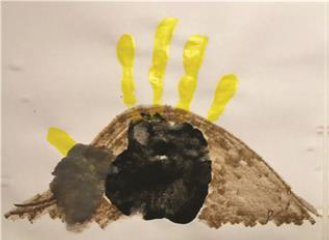
To make an empty tomb, paint the fingers of one hand yellow and the palm of that hand black. Place the hand on the paper fingers-down and spread wide. Draw a brown “hillside” between the black “tomb” and yellow “sunrays.”
After washing the hand, make a fist and paint the small surface grey. Place the fist to the side of the black hole to create a stone that has been rolled away. Alternatively, you can print out the empty tomb template at the end of this lesson for children to color, cut out, and attach to poster.
Jibu
Most stories that have been around for a while have different versions of the story. There are many books written that tell the story of the “Three Little Pigs.” Some versions change the characters; some add or take away specific scenes. All of them tell the basic story that two of the characters built houses out of materials that the villain could destroy, so they had to take refuge in the strong house built by the third character. Though the specifics are different, the broad message and lesson remain the same. The same goes for Bible stories. If you read the same story in different books of the Bible, you will hear different particulars and perspectives. Now we will read the story of the empty tomb as told in the book of John.
Read together the version of John 20:1–18 from Bible Hub or “Mary of Magdala Sees Jesus” from the Lectionary Story Bible, Year A, pp. 98–99. You may choose to act out the story.
Discuss: What are some differences you noticed in this version of the story? (Focus on the fact that Mary sees the resurrected Christ and runs to tell everyone what she saw.)
Those who witnessed the resurrection appearances did not keep silent. They were transformed.” These testimonies changed the world. “Followers continue to encounter the Risen Christ to this day. Sharing that testimony still makes a difference. Resurrection is not a one-time event, but is a daily event that occurs as people receive God’s grace, love, and new life through Jesus.
—Sermon and Class Helps, p. 64
As we feel God’s guidance and respond to God’s mission, we help continue the resurrection promise. Community of Christ believes that sacred story is the “unfolding drama of God’s reconciling work in the world” (Of Water and Spirit, p. 18). The story started a long time ago, but it is not complete. We are all characters in the book, and more characters and plot twists are being added every day.
- What does the sacred story mean to you?
- What is your part of the sacred story?
Tuma
For the Resurrection story to continue, we must act as disciples and continue Jesus’ teachings. “Following Jesus Christ into mission means living as he did—it means being generous and compassionate, sharing witness and ministry, and living in a community of shalom” (Of Water and Spirit, p. 18).
Have each student brainstorm something they can do to fulfill the mission of Jesus (invite others to church, help someone in need, be a role model for a friend or sibling, stand up for someone who is being picked on). Each can write and complete the following sentence under their empty tomb: “God calls me to ____________.”
Baraka
Read “That Easter Morn, at Break of Day” CCS 480. Have the children take turns reading the stanzas and sing the chorus together.
Let the children state what God is calling them to do. Start a circle prayer with each child asking God to be with them as they follow Jesus in mission.