
Bisaleli ya losambo
Likanisi ya losambo 1
Makomami mosusu
Psalm 118:1–2, 14–24; Isaiah 25:6-9; 1 Corinthians 15:1–11
Maloba ya ebandeli
Boyei malamu
Morning at the Empty Tomb Reflection
Play “morning sounds” in the background to help the participants visualize the scene. Suggestions: “Sounds of the Earth: Morning Birds,” or “Dawn Chorus” available on iTunes. Morning sounds can also be found on YouTube or other websites. As the soundtrack is playing, invite people into the following reflection.
Morning sounds begin to play.
Reader 1: Early on the first day of the week, while it was still dark, Mary Magdalene came to the tomb and saw that the stone had been removed from the tomb (John 20:1).
Reader 2: Close your eyes and imagine for a moment the walk to the tomb. Breathe in the scent of fresh morning, listen for the sounds of dawn, and see the darkness of night beginning to fade in the growing light of the new day. Imagine walking through the morning and arriving at the empty tomb. How are you experiencing the hope and promise of new life this day?
Pause for a few moments of silent reflection then fade out the morning sounds.
Loyembo ya bofungoli
“Mabelé, Mabele, Lamuká!” CCS 472. Ezali na ntina mingi
A soloist sings the first three verses. The community joins for last verse.
TO “Bósepela na Yesu” CCS 474
Participants sing or they can sing along with the vocal recording found on Community of Christ Sings Audio Recordings, available from Herald House.
TO “Tombolá mingongo na yo ya esengo” CCS 475
Confessional Prayer for Peace
Pelisa bougie ya kimia
Libondeli
Mosantu, .
We pray to you this Easter morning to open our eyes so we might recognize you in the breaking of the bread and be prepared to follow wherever you lead. Breathe on us your peace.
We confess our fear and shortcomings. We ignore the poor and the hungry and overlook those who mourn. We abuse the earth you made for us. We are deaf to the cries of the burdened and indifferent to calls for peace.
Forgive us.
Help us to trust in you to change our lives and make us new that we may know the joy and peace of Jesus Christ, our Risen Lord.
We give thanks for your steadfast love that endures forever! Amen.
—Psalm 118:1–2, adapted
Eyano
Moment ya ko focuser
Read The Easter Story by Carol Heyer (Scholastic, Inc., 2006, ISBN 9780439855358). Begin reading with the women at Jesus’s tomb.
OR Tell the Easter story in your own words.
OR Read the Easter story from a children’s story Bible
Loyembo
“Siyahamb’ Ekukhanyen’ Kwenkhos’/We Are Marching in the Light of God” CCS 95
TO “Amen, Siakudumisa!/Amen, Yemba Masanzoli na Nkolo!” CCS 109. Ezali na ntina mingi
Invite participants to stand, clap, dance, and praise, singing the hymn multiple times. You may consider adding other instruments, such as drums and shakers.
Lendisá bayangani báyemba na minɔkɔ mosusu oyo ezali ya bango te.
Eyano ya motema malamu ya bayekoli
Kotanga
Read the lyrics to “Sometimes We Wait, Expecting God,” CCS 304.
Libondeli
We celebrate the Living Christ but also pray for sharpened attention to see him everywhere he dwells in the world around us. The Living Christ will show up sometimes where we least expect—on the street corner, in the grocery store, at the dinner table with our own families. When we see him, may we have the courage also to be him—to be the Living Christ who redeems, restores, and reconciles to everyone we meet, in every place we are in. May our offerings—of awareness, resources, time, and advocacy—continue to make way for the peace of Christ to be present in our world. Amen.
Kopambola mpe Kozwa Dime ya Misio ya Esika mpe ya Mokili mobimba
Scripture Reading: John 20:1-18 OR Mark 16:1-8
Choral Anthem
“Alleluia, He Lives!” (SATB) Joel Raney, Hope Publishing Company
OR “Christ Is Risen, Alleluia!” (SATB) Jay L. Althouse, Hope Publishing Company
OR Community Hymn
“Christ Is Alive!” CCS 473
OR “The Risen Christ” CCS 477
OR “Mfurahini, Haleluya/Christ Has Arisen, Alleluia” sing twice CCS 471
Lendisá bayangani báyemba na minɔkɔ mosusu oyo ezali ya bango te.
Liteya ya Pasika
Based on Mark 16:1–8 and John 20:1–18 OR choose one as the focus
Losambo ya Pastoral
Loyembo ya nsuka
“Jesus Christ Is Risen Today” CCS 476
OR “Now the Green Blade Rises” CCS 482
OR “Good Christians All, Rejoice” CCS 479
Kotinda Liboso
Go in peace!
Postlude ya sima
Likanisi ya losambo 2
Makomami mosusu
Psalm 118:1-2, 14-24; Isaiah 25:6-9; 1 Corinthians 15:1-11
Kobongisa
Arrange a worship setting with a white cloth draped on a cross. If candles were part of the worship setting during a Good Friday service, light all those candles for the Easter service. The purple cloth used during the season of Lent will be needed during the Focus Moment.
Maloba ya ebandeli
Boyei malamu
Libiangi mpo na kosambela Botangi ya eyano
Leader: Let Israel say,
People: “God’s steadfast love endures forever.”
Leader: Let those who fear the Lord say,
People: “God’s steadfast love endures forever.”
Leader: The Lord is our strength and might.
People: God has become our salvation.
Leader: We shall not die, but we shall live,
People: and recount the deeds of the Lord.
Leader: Open the gates of righteousness,
People: that we may enter through them and give thanks to the Lord.
Leader: This is the day that the Lord has made;
All: Let us rejoice and be glad in it.
—based on Psalm 118:2-24
Loyembo ya Masanzoli
“Good Christians All, Rejoice” CCS 479
OR “Christ Leads!” CCS 28
TO “Tombolá mingongo na yo ya esengo” CCS 475
Libondeli ya kofungola
Eyano
Eyano ya motema malamu ya bayekoli
Scripture Reading: Doctrine and Covenants 165:1a,b
Maloba
Stewardship is how we support Christ’s mission – not just financial stewardship but whole-life stewardship. Our whole-life response in living Christ’s mission is how we create God’s vision of shalom. Discipleship is the hard and messy work of living Christ’s mission, and whole-life stewardship is the framework within which we give in support of this mission.
When we fully receive God’s grace and generosity, every breath of our lives expresses gratitude to God, and we respond by living Christ’s mission.
—Choose Generosity: Discovering Whole-life Stewardship, Herald House, 2019, pp.13
Let us express our gratitude this day!
Kopambola mpe Kozwa Dime ya Misio ya Esika mpe ya Mokili mobimba
Focus Moment: What Color Is Easter?
Find a discussion of liturgical colors and the Easter season at: Sermons4Kids
Hymn of Easter Joy
“Celebrate Jesus” CCS 474
Sing along with the vocal recording found on Community of Christ Sings Audio Recordings, available from Herald House. This song works especially well with children and youth. Encourage their leadership of the sing-along.
OR “Woman, Weeping in the Garden” CCS 478
OR “I Danced in the Morning” CCS 23
Easter Message
Based on Mark 16:1-8 and John 20:1-18 OR choose one on which to focus
Losambo mpo na Kimya
Nzembo ya Kimya
“My Peace” CCS 149
TO “Dona Nobis Pacem” CCS 155. Ezali na ntina mingi
Divide into 3 parts; sing as a round.
Statement of Peace
As the disciples were radically changed, empowered, emboldened, and filled with hope and peace as a result of their encounter with the resurrected Christ, may we also choose to be changed and to share that peace, knowing the assurance of God’s love.
Pelisa bougie ya kimia
Libondeli
Loving God, as we light the candle of Peace, help us to remember those who are experiencing moments so difficult that they have lost sight of your existence. On this Easter morning as we meditate on the hope your resurrection brings, that even in the face of evil, tragedy and death, we need not fear. Let your glory be revealed in our lives in such a way as to help restore their faith and reflect the peace that you have to give. Amen.
—Lois Hillman
Ministère ya Musique
“O Risen Christ, Still Wounded” CCS 41
OR “Jesus, Promise of an Angel” CCS 32
Loyembo ya Esengo
“Klisto oyo asekwi” CCS 477
TO “Yesu Klisto asekwi lelo” CCS 476
OR “Now the Green Blade Rises” CCS 482
Lipamboli ya lipamboli
Eyano
Postlude ya sima
Esika ya bulɛɛ: Plan ya losambo ya etuluku moke
Feti
Boyei malamu
Losambo mpo na Kimya
Beta ngonga to benga mbala misato malɛmbɛmalɛmbɛ.
Bougie ya Kimya ya Pole
Mosantu, .
We pray to you this Easter morning to open our eyes so we might recognize you in the breaking of the bread and be prepared to follow wherever you lead. Breathe on us your peace.
We confess our fear and shortcomings. We ignore the poor and the hungry and overlook those who mourn. We abuse the earth you made for us. We are deaf to the cries of the burdened and indifferent to calls for peace.
Forgive us.
Help us to trust in you to change our lives and make us new that we may know the joy and peace of Jesus Christ, our Risen Lord.
We give thanks for your steadfast love that endures forever! Amen.
—Psalm 118:1–2, NRSV adapted
For more ideas: The Daily Prayer for Peace services offered at the Temple in Independence, Missouri, can be found on the church’s website as Calendar Events at CofChrist.org.
Momeseno ya Molimo
Kofanda na kati ya Liloba
Nakotanga vɛrsɛ moko na mongongo makasi. Lokola ozali koyoka makomi tiká ete maloba, bililingi to bafraze eya na makanisi. Meká kotya makanisi na yo na bango te. Tika bango bapema elongo na yo.
Nsima ya mwa ntango mokuse ya kimia nakotanga makomi ntango ya kotinda. Ntango oyoki lisusu makomi yoka lolenge nini elimo ya Nzambe ezali kotindika yo to kobenda likebi na yo.
On this mountain the LORD of hosts will make for all peoples a feast of rich food, a feast of well-aged wines, of rich food filled with marrow, of well-aged wines strained clear.
And he will destroy on this mountain the shroud that is cast over all peoples, the sheet that is spread over all nations; he will swallow up death forever.
Then the Lord GOD will wipe away the tears from all faces, and the disgrace of his people he will take away from all the earth, for the LORD has spoken.
It will be said on that day, Lo, this is our God; we have waited for him, so that he might save us. This is the LORD for whom we have waited; let us be glad and rejoice in his salvation.
—Isaiah 25:6-9 NRSV
Kopema
Tanga makomi mbala ya mibale.
On this mountain the LORD of hosts will make for all peoples a feast of rich food, a feast of well-aged wines, of rich food filled with marrow, of well-aged wines strained clear.
And he will destroy on this mountain the shroud that is cast over all peoples, the sheet that is spread over all nations; he will swallow up death forever.
Then the Lord GOD will wipe away the tears from all faces, and the disgrace of his people he will take away from all the earth, for the LORD has spoken.
It will be said on that day, Lo, this is our God; we have waited for him, so that he might save us. This is the LORD for whom we have waited; let us be glad and rejoice in his salvation.
—Isaiah 25:6-9 NRSV
Benga ba membres ya groupe bakabola biyano na mituna oyo:
- Maloba, bafraze to bililingi nini eyaki na makanisi?
- Elimo ya Nzambe ezali komonisa yo nini na nzela ya koyoka maloba oyo?
Kokabola Nzinga nzinga ya Mesa
John 20:1-18 NRSVue
20 Early on the first day of the week, while it was still dark, Mary Magdalene came to the tomb and saw that the stone had been removed from the tomb. 2 So she ran and went to Simon Peter and the other disciple, the one whom Jesus loved, and said to them, “They have taken the Lord out of the tomb, and we do not know where they have laid him.”3 Then Peter and the other disciple set out and went toward the tomb.4 The two were running together, but the other disciple outran Peter and reached the tomb first. 5 He bent down to look in and saw the linen wrappings lying there, but he did not go in. 6 Then Simon Peter came, following him, and went into the tomb. He saw the linen wrappings lying there, 7 and the cloth that had been on Jesus’s head, not lying with the linen wrappings but rolled up in a place by itself. 8 Then the other disciple, who reached the tomb first, also went in, and he saw and believed, 9 for as yet they did not understand the scripture, that he must rise from the dead.10 Then the disciples returned to their homes.
11 But Mary stood weeping outside the tomb. As she wept, she bent over to look into the tomb, 12 and she saw two angels in white sitting where the body of Jesus had been lying, one at the head and the other at the feet. 13 They said to her, “Woman, why are you weeping?” She said to them, “They have taken away my Lord, and I do not know where they have laid him.” 14 When she had said this, she turned around and saw Jesus standing there, but she did not know that it was Jesus. 15 Jesus said to her, “Woman, why are you weeping? Whom are you looking for?” Supposing him to be the gardener, she said to him, “Sir, if you have carried him away, tell me where you have laid him, and I will take him away.” 16 Jesus said to her, “Mary!” She turned and said to him in Hebrew, “Rabbouni!” (which means Teacher). 17 Jesus said to her, “Do not touch me, because I have not yet ascended to the Father. But go to my brothers and say to them, ‘I am ascending to my Father and your Father, to my God and your God.’ ” 18 Mary Magdalene went and announced to the disciples, “I have seen the Lord,” and she told them that he had said these things to her.
—John 20:1-18 NRSVue
Na lisolo ya Yoane mpo na ntongo ya Pasika, bato ndenge na ndenge bayaki kondima Klisto na banzela ekeseni:
- The beloved disciple looked into the empty tomb, and believed instantly. What did he understand when he saw the empty tomb? What did he believe? John gives us no answer, but merely says faith was the result.
- Petelo amonaki lilita ya mpamba mpe elamba ya mpamba epai ebembe ezalaki. Kasi, na bokeseni na moyekoli oyo alingaki mingi, Petelo azongaki na ndako kozanga kondima to bososoli.
- Mary Magdalene saw the empty tomb, but understood only the body was gone. Stolen? Moved to another location? The empty tomb did not prompt her to believe in the resurrection. She saw two messengers of God within the tomb, but that didn’t lead to faith. She encountered the Risen Christ, but mistook him for the gardener. Her eyes were opened only when he spoke her name, recalling a familiar relationship of love and caring.
From that point, relationship is the key theme of the story.
Jesus tells Mary not to hold onto him. “Don’t expect this relationship to be a continuation of the old.” Resurrection had transformed the old relationship into something new. Jesus directs Mary to go and tell the disciples. As she hurried to tell the disciples what she had seen, she became the “apostle to the apostles.”
Those who witnessed resurrection appearances did not keep silent. They were transformed. From their testimony and witness came a movement that grew and changed the world. Followers continued to encounter the Risen Christ in various ways through the centuries. Sharing that testimony still makes a difference in the world, bringing new life. Resurrection, therefore, is not a one-time event that came and went. It is a daily event as people receive God’s grace, love, and new life through Jesus Christ.
Mituna
- Who are you looking for when you look into the tomb? Who is the resurrected Christ to you?
- Ndenge nini omoni ete Nzambe azali kobenga yo na nkombo na yo? Ndenge nini ebongoli boyokani na yo na Nzambe? Na basusu?
- How do you experience daily resurrection through God’s love and grace?
Kotinda
Liloba ya Bokabi
“Kokabola mpo na bolamu ya bato banso ezali molimo ya Siona” ( Malongi mpe Mayokani 165:2f ).
Tozwaka ngolu mpe bokabi ya Nzambe. Kitunga ya makabo ezali soki olingi kosunga misala ya bituluku mike oyo ezali kokoba lokola eteni ya eyano na yo ya motema malamu.
Libondeli oyo ya likabo euti na buku A Disciple’s Generous Response:
Nzambe ya esengo, Tokabolaka makabo na biso na esengo mpe na botondi na eyano na makabo ya bokabi oyo opesi biso. Tika makabo oyo tokabolaka emema esengo, elikia, bolingo, mpe kimia na bomoi ya basusu ete bakoka kokutana na ngolu mpe ngolu na yo. Amen
Libyangi mpo na Likita oyo ekolanda
Loyembo ya nsuka
CCS 478, “Woman, Weeping in the Garden”
Libondeli ya nsuka
Ba Additions optionnelles Selon Groupe
Elambo ya Elambo ya Nkolo
Pamba te, nazwaki epai ya Nkolo oyo napesaki bino mpe, ete Nkolo Yesu na butu oyo batɛkaki ye, azwaki limpa. mpe ntango asilaki kopesa matondi, abukaki yango mpe alobaki: “Oyo ezali nzoto na ngai oyo ezali mpo na bino. Bosala boye mpo na kokanisa ngai.” Bobele bongo, azwaki kɔpɔ mpe, nsima ya kolya, alobaki ete: “Kɔpɔ oyo ezali kondimana ya sika na makila na ngai.Bósala boye mbala nyonso ntango bokomɛla yango, mpo na kokanisa ngai.” Mpo mbala nyonso oyo bozali kolya limpa oyo mpe komɛla kɔpɔ, bozali kosakola liwa ya Nkolo tii akoya.
—1 Bakolinti 11:23–26 NRSV
Liloba ya Komunio
Bato nyonso bayambami na mesa ya Klisto. Elambo ya Nkolo, to Komunio, ezali elambo oyo kati na yango tomikundoli bomoi, liwa, lisekwa, mpe bozali ya kokoba ya Yesu Klisto. Na Lisanga ya Klisto, tozali mpe komona Komunio lokola libaku ya kozongisa sika liyokani na biso ya libatisi mpe kosalama lokola bayekoli oyo bazali kobika na etinda ya Klisto. Basusu bakoki kozala na bososoli ekeseni to ebakisami na kati ya bonkoko na bango ya bondimi. Tobengisi baoyo nyonso bazali kosangana na Elambo ya Nkolo mpo na kosala yango na bolingo mpe kimia ya Yesu Klisto.
Tokabolaka na Komunio lokola elakiseli ya lipamboli, kobikisa, kimia, mpe lisanga.
Na bolengeli toyemba uta na Lisanga ya Klisto Ayemba 522, “Tika Tosalela Batalanta mpe minoko.”
Kopambola mpe kopesa mampa mpe vinyo.
Makanisi mpo na Bana
Materials: Easter basket. one plastic egg with a rock inside, one empty plastic egg marked with a cross, Small treats or Easter candy (one for each person0.
Today is Easter and I brought an Easter basket to share part of the story of Jesus with you.
On Easter we are joyful because Jesus has been resurrected. That means Jesus died on the cross but lives again.
Show egg with rock.
- Inside this egg is a stone. (open and show rock).
- After Jesus died, his body was placed in a tomb (like a cave) and a huge, heavy stone was rolled in place to cover the entrance. On Sunday morning, two women went the tomb and discovered that the stone had been rolled away and the tomb was open. The stone reminds us that even a huge stone could not keep Jesus in the tomb.
Show egg with cross.
- When the two women went inside the tomb, it was empty. Jesus was not there. At first the women thought that someone had taken Jesus away. But an angel told them, “He is not here. He is risen. The empty egg reminds us that Jesus’ tomb is empty. He is risen, He is not dead, he lives in our hearts.
Let’s bow our heads.
We thank you God that you love the world so much that you sent your only Son. We are thankful that his story does not end with his death, but resurrection and new life. Amen.
Share treats with children.
Sermon Helps: John 20:1-18
Kolukaluka na Makomami
Nsango Elamu ya Yoane ezali kolakisa Yesu lokola Nkolo asekwi, Masiya, mpe Mwana ya Nzambe; moko oyo tosengeli kozala na kondima epai na ye. Lisoló ya lisekwa ezali nsuka ya maloba wana ya kondima mpe, mpo na Yoane, elembeteli ya nsuka oyo emonisi ete Yesu azali. Makomi elobeli mimeseno mibale ekeseni ya litatoli ya lisekwa: moko ezalaki lilita, oyo etikalaki mpamba na liwa; moko ezalaki lapolo ya Klisto ya Bomoi. Basusu bamonaki kaka lilita oyo ezalaki mpamba. Basusu bamonaki ata mokolo moko te lilita, kasi bakutanaki na Klisto oyo asekwi. Nsango Elamu ya Yoane eyebisi biso ete Maria Magadalena amonaki nyonso mibale. Ezalaki te lilita ya mpamba nde elongaki kondima na ye kasi lokito ya mongongo ya molakisi na ye.
Na lisolo ya Yoane mpo na ntongo ya Pasika, bato ndenge na ndenge bayaki kondima Klisto na banzela ekeseni:
Moyekoli ya bolingo atalaki na kati ya lilita ya mpamba, mpe andimaki mbala moko. Asosolaki nini ntango amonaki lilita oyo ezalaki mpamba? Andimaki nini? Yoane apesi biso eyano te, kasi alobi kaka ete kondima nde ebimisaki yango.
Petelo amonaki lilita ya mpamba mpe elamba ya mpamba epai ebembe ezalaki. Kasi, na bokeseni na moyekoli oyo alingaki mingi, Petelo azongaki na ndako kozanga kondima to bososoli.
Mary Magdalene saw the empty tomb, but understood only the body was gone. Stolen? Moved to another location? The empty tomb did not prompt her to believe in the resurrection. She saw two messengers of God within the tomb, but that didn’t lead to faith. She encountered the Risen Christ, but mistook him for the gardener. Her eyes were opened only when he spoke her name, recalling a familiar relationship of love and caring. “My sheep hear my voice. I know them…” (John 10:27). The Living Word and the one word, her name, brought Mary to faith and rejoicing.
From that point, relationship is the key theme of the story. With a surprising economy of words, in verses 17–18 John outlines a swift reordering of relationships.
Jesus tells Mary not to hold onto him. The word touch in Greek implies “being attached to,” in essence, holding onto. It could mean: “Don’t hug me”; “Don’t be too attached to me”; “Don’t become dependent on me”; or “Don’t expect this relationship to be a continuation of the old.” Resurrection had transformed the old relationship into something new.
“I am ascending…to my God and your God.” The relationship with God must take priority, in death and resurrection as it did in life. But in addition, Jesus was saying his followers could enjoy the same relationship with God that he enjoyed. The disciples, as Jesus’ siblings, could claim God as Father in a new, complete relationship.
Jesus directs Mary to go and tell the disciples. Despite betrayal, denial, fleeing in fear, and lack of support, the disciples were still Jesus’ disciples. He claimed them. His relationship with them was closer than ever.
Boyokani ya Maria na ntango ebongwanaki. Atyaki makanisi na ye na makambo ya kala mpe oyo ebungaki. Yesu alakisaki ye epai ya mikolo mizali koya mpe oyo ekoki kozala. Wana azalaki kosala mbangumbangu mpo na koyebisa bayekoli makambo oyo amonaki, akómaki “ntoma epai ya bantoma.”
Baoyo bamonaki komonana ya lisekwa bafandaki nyɛɛ te. Babongwanaki. Na litatoli mpe litatoli na bango eyaki mouvement moko oyo ekolaki mpe ebongoli mokili. Balandi bakobaki kokutana na Klisto oyo asekwi na banzela ndenge na ndenge na boumeli ya bikeke. Kokabola litatoli wana ezali naino kosala bokeseni na mokili, komemaka bomoi ya sika. Na yango, lisekwa ezali likambo ya mbala moko te oyo eyaki mpe ekendeki. Ezali likambo ya mokolo na mokolo lokola bato bazali kozwa ngolu ya Nzambe, bolingo, mpe bomoi ya sika na nzela ya Yesu Klisto. Yamba bomoi ya sika.
Makanisi ya Central
- Many who came to the empty tomb were not prompted to belief by what they saw. Faith takes different paths, but often it is because of relationships that speak to us of the Divine.
- Kokutana na Klisto oyo asekwi ezali likambo ya mbongwana oyo ebongoli boyokani mpe elakisaka biso epai ya lobi oyo ebengi biso na etinda ya Klisto.
- Moto na moto akoki kokutana na lisekwa ya mokolo na mokolo lokola azali kobika na bolingo mpe ngolu ya Nzambe.
Mituna mpo na Molobi
- Ntango nini okutani na Klisto ya Bomoi? Nini etindaki yo ondima?
- Ndenge nini omoni ete Nzambe azali kobenga yo na nkombo na yo? Ndenge nini ebongoli boyokani na yo na Nzambe? Na basusu?
- Na nzela nini bondimi na bino moko epanzani na misio?
- How has your congregation experienced resurrection and entered new life overflowing into mission?
Sermon Helps: Mark 16:1-8
Kolukaluka na Makomami
On Easter morning people will come expecting to hear post-resurrection stories of Christ. Some will look forward to remembering how Jesus had breakfast with disciples by the sea, or overhearing a conversation with the Risen Christ in the garden outside the open tomb. However, the text for today does not refer to any meals on the beach or peaceful garden scenes with Jesus. This passage from Mark includes no post-resurrection appearances, and it is likely the original text of Mark did not include any such sightings.
Studying the earliest manuscripts of Mark, many scholars have concluded the original text ended with Mark 16:8. This ending is abrupt and leaves the audience dangling in awkward silence. It was not unusual for later writers or redactors, to make changes to the texts they were copying. Therefore, what we now have as the “shorter” and “longer” endings to Mark could be the work of an editor trying to bring a tidier closure to Mark’s Easter story.
The text begins with a funeral, or at least the final preparations of a corpse. People came expecting to find the body of Jesus decaying in tomb. The vision, mission, and movement to change the world to which these women and others were beginning to lay claim, had come to a screeching and tragic halt three days earlier. Now all that was left to do was prepare the body, mourn, and go back to life as it was before they met Jesus.
But they found the tomb empty and heard an incomprehensible message about Jesus being in Galilee. Leaving the tomb in terror, the women told no one of their experiences, possibly because they could not reconcile their experiences with the expectations they brought to the tomb. Our expectations, too, can become the lenses and filters for what we see and hear. Disciples and congregations must ask, “With what expectations are we viewing and hearing the world?”
A young man at the tomb told the women Jesus was not there. How could this be? This was where they last saw Jesus. He must be there because it was where they left him. The message of the Easter story is one of surprise, which means not always finding Jesus where we last saw him. In our lives we sometimes wander around old places still expecting Jesus to be there waiting for us. Sometimes those old places, even though they may be painful, can become more comfortable than the new places where the resurrected Christ may now be.
The women fled; terror had seized them. Before his death they witnessed how Jesus’ radical ways had angered religious and community leaders. Now he had overcome death and they were told to meet him in Galilee. How much more radical might a resurrected Jesus be? Is it possible the terror was from the uneasiness of considering what he might now be doing in Galilee and what they might be called to do?
Maybe the original abrupt ending of Mark is the most suitable way to tell the Easter story. The story continues, and as disciples who believe in a resurrected Christ we are called to live out the next chapter of that story. That next chapter is about us meeting him in the Galilees of our communities.
Makanisi ya Central
- Easter is about surprise.
- Our expectations influence what we see and hear.
- We are all called to help write the next chapters of the Easter story.
- The resurrected Christ is in our communities waiting for us to meet him there.
Mituna mpo na Molobi
- Do we see the world through the lens of resurrection or through the lens of an unexplained empty tomb?
- What are the empty tombs in our lives on which we continue to linger and cling?
- Why is it sometimes more comfortable to linger around the empty tomb than to go find Jesus in Galilee?
- What evidence is there that you and your congregation are following the Living Christ into “Galilee”?
Mateya
Liteya ya Mikóló
Tyá likebi na Eteni ya Makomami
Yoane 20:1–18
Liteya Likanisi
Witness of Christ
Mikano
Bayekoli bako...
- explore the tomb experiences of three disciples.
- examine varied responses to events.
- resolve to share the good news.
Biloko ya kopesa
- Babiblia
- Lisanga ya Klisto Ayemba ( CCS ) .
Liyebisi na Molakisi
In preparation for this lesson, read “Exploring the Scripture” for John 20:1–18 in Sermon & Class Helps, Year B: New Testament, pp. 64–65, available through Herald House.
Kosangisa
Have class members share the name of their favorite Easter hymn. (See CCS 471–482.) What is the message that resonates with you?
Sing one of the favorites mentioned.
Komipesa
John gives a very detailed account of those finding the tomb empty. He first mentions “it was still dark.” John continually contrasts the darkness in the world and the light God sends into the world through Jesus. So it is not odd that he speaks of Mary Magdalene arriving at the tomb in the dark.
There were three followers that discover the empty tomb. Mary Magdalene arrived first. When she saw the stone rolled away, she ran to Peter and the unnamed disciple “whom Jesus loved” and told them of the empty tomb. They had a footrace back to the tomb. What is interesting to note here is how differently each responded to what they found.
The unnamed disciple entered the tomb, saw it empty with the grave clothes lying folded, and believed. Exactly what he believed is not stated and somewhat difficult to discern, but his faith was intact.
Peter saw the empty tomb with the shrouds but left without understanding or faith. It was a puzzle yet to be explained.
Mary Magdalene experienced the empty tomb, knew the body was gone, but her eyes were opened when Jesus called her name. John 10:27–28 reads, “My sheep hear my voice. I know them, and they follow me. I give them eternal life, and they will never perish. No one will snatch them out of my hand.”
Three disciples—same morning, same tomb, but different comprehension of the experience. One’s faith is immediate, one needs time to contemplate, and one hears Jesus’ voice and knows with certainty.
Today there are those who believe and have faith without “seeing.” There are those who need time to study and learn and grow into faith. There are those who are spiritually attuned and hear God’s voice.
- To which disciple do you relate?
- What prompted you to believe in Christ?
While transformation looked different for each of the disciples, the instruction to go and witness of what they had seen and heard was the same. Jesus’ death was not the end. The story of God’s movement in the world had only just begun through the Resurrection.
- How has your transformation in Christ led you to mission?
- How has your congregation experienced a resurrection?
Kopesa eyano
Beloved pastor and author Henri Nouwen wrote,
The church is called to announce the Good News of Jesus to all people and all nations. Besides the many works of mercy by which the Church must make Jesus’ love visible, it must also joyfully announce the great mystery of God’s salvation through the life, suffering, death, and resurrection of Jesus. The story of Jesus is to be proclaimed and celebrated. Some will hear and rejoice, some will remain indifferent, some will become hostile. The story of Jesus will not always be accepted, but it must be told.
We who know the story and try to live it out, have the joyful task of telling it to others. When our words rise from hearts full of love and gratitude they will bear fruit, whether we can see this or not.
—Bread for the Journey, New York: Harper One, 1997, p. 332
Those who walked closest to Jesus often failed to share bout Jesus. The disciples heard Jesus predict his death three times; Peter confessed Jesus as Messiah but totally misunderstood what that really meant and even rebuked Jesus. Because they didn’t understand what was going on, they did not share the good news.
Fortunately, we are blessed with hindsight and scriptures that tell us the story. We recount the story over and over again. We experience the story. God continues to speak and reveal more of God’s nature and desires for the world. We must share the story, the good news that God is alive and loves the world.
- How do you share the good news?
- In what ways is your congregation reaching beyond the walls of the church to share the good news?
- What fears impede your witness?
Kotinda
Doctrine and Covenants 162:7a
Ezali na bomoi mingi kozelaka koyoka maloba ya bosikoli ya nsango malamu, to kotombolama uta na bozangi elikia na maboko ya basali ya bolingo. Kasi bakobunga epai na bino kozanga eyano ya bokabi ya bayekoli oyo bakabolaka uta na boboto na bango moko ete basusu bakoka koyeba bisengo ya bokonzi.
Doctrine and Covenants 162:8
You are a good and faithful people, but sometimes you fail to see the power that is resident in your own story and fellowship. Look carefully, listen attentively, and sense the Spirit among you. Be fervent in your witness, passionate in your discipleship, and vigorous in your labor on behalf of peace and justice. Where two or three such disciples form community, there will the Spirit be. Many will come to see. Continue your journey, O people of the Restoration. You have been blessed thus far but there is so much yet to see, so much yet to do. Go forth with confidence and live prophetically as a people who have been loved, and who now courageously choose to love others in the name of the One you serve. Amen.
- The challenge is to go and tell. With whom will you share the good news this week?
Kopambola
Read Doctrine and Covenants 161:7 as a closing prayer.
The Spirit of the One you follow is the spirit of love and peace. That Spirit seeks to abide in the hearts of those who would embrace its call and live its message. The path will not always be easy, the choices will not always be clear, but the cause is sure and the Spirit will bear witness to the truth, and those who live the truth will know the hope and the joy of discipleship in the community of Christ. Amen.
Liteya ya bilenge
Tyá likebi na Eteni ya Makomami
Malako 16:1–8 mpe Yoane 20:1–18
Liteya Likanisi
Christ is risen! We, too, are witness to the Resurrection.
Mikano
Bayekoli bako...
- hear two traditions of witness to the Resurrection.
- hear the story of Mary Magdalene’s visit to Jesus’ tomb and her encounter with the Risen Christ.
- celebrate the joy that Jesus is alive by committing to his mission.
Biloko ya kopesa
- Babiblia
- Papie
- Papyé ya tableau to tableau blanc
- Ba marqueurs
- Ba stylos
- Lisanga ya Klisto Ayemba ( CCS ) .
Liyebisi na Molakisi
In preparation for this lesson, read “Exploring the Scripture” for Mark 16:1–8 and John 20:1–18 in Sermon & Class Helps, Year B: New Testament, pp. 64–67, available through Herald House.
Kosangisa
Tuna bana-kelasi:
- What would you consider the most significant event that has happened in your life that you would feel free to share?
- How did you respond? Were you in shock? Were you excited? Were you afraid?
- Did you keep it to yourself?
- Did you tell others? Did others believe you?
- How did this event change you? Change others?
Komipesa
In celebrating Easter, we remember the Resurrection stories of the New Testament. Each of the four Gospels offers a glimpse of the disciples’ experience with the Risen Lord. We will look at two of the stories today.
First, the Gospel of Mark is considered the oldest of the Gospels, most likely written between 66–70 CE. Mark is unique among the Gospels as it contains three endings to the Resurrection story—verse 8, the shorter ending, and the longer ending. We will consider the verse 8 ending of Mark today. The earliest manuscripts available stop at verse 8, offering an abrupt ending with an empty tomb and the audience dangling in awkward silence.
Read Mark 16:1–8.
- As the women bought spices and walked to the tomb, what do you think they expected to find?
- Jesus’ mission and the following of disciples appeared to end with his death three days before this story. Do you think the women were planning to return to their homes and life as it had been before they met Jesus? Why or why not?
- If you were one of these women looking in the empty tomb and an angel told you Jesus would be in Galilee, would you “say nothing to anyone for they [you] were afraid”?
The second Resurrection story we will consider is from the Gospel of John. This is the climax of faith for John, proof of Jesus’ identity as the Son of God. John shares two separate traditions of witness to the Resurrection. First, the empty tomb is witnessed by Mary Magdalene who runs and brings Simon Peter and the other disciple whom Jesus loved to see for themselves. The second tradition shares experiences with the Living Christ. Mary Magdalene saw both the empty tomb and encountered Jesus.
Tanga Yoane 20:1–18 .
- Why do you think John includes two separate traditions of witness to the Resurrection?
- Why does John mention the disciple whom Jesus loved “saw and believed” but does not comment on the response of Simon Peter?
- When the supposed gardener spoke her name, Mary’s eyes were opened to see Jesus. What emotions may she have felt in that moment?
Kopesa eyano
The message of the Easter story is one of surprise. We may not always find Jesus where we last saw him. We often expect Jesus to be waiting for us in our comfortable places. But Jesus is at work in the world, not just inside our church building or campground. If we listen for our name, like Mary, our eyes will be opened to see that familiar relationship of love and caring all around us.
Provide the class with paper, pens, and markers.
- Have the students create a chart that compares and contrasts the Easter texts from Mark and John.
- Add to the chart any inference the class may have about the characters’ experiences.
- Have the students draw an empty tomb and write the names of places or people through which they may have witnessed the Risen Christ.
Followers have continued through the centuries to encounter the Risen Christ in various ways. Sharing that testimony still makes a difference in the world, still brings change, and still brings hope.
Kotinda
Christ is risen! God is the God of life. In Christ, God’s love overcomes all that demeans and degrades creation, even death itself. Easter gives us hope that the tragic suffering of victims throughout history is not the last word.
Just as the early disciples quickly learned, Jesus’ mission continues in his Resurrection. As disciples, we serve in that mission by Inviting People to Christ; working to Abolish Poverty, End Suffering; Pursuing Peace; Developing Disciples to Serve; and Experiencing Congregations in Mission.
Select one Mission Initiative to focus on this week to celebrate Easter and the Living Christ. What will you do?
Kopambola
Sing together as a closing blessing “Mfurahini, Haleluya (Christ Has Risen, Alleluia)” CSS 471.
Liteya ya Bana
Tyá likebi na Eteni ya Makomami
Malako 16:1–8 mpe Yoane 20:1–18
Liteya Likanisi
Mary and others experienced the empty tomb; the Resurrection story continues today as we live Jesus’ mission.
Mikano
Bayekoli bako...
- discuss how expectations can affect how people respond to circumstances.
- explore and compare two scripture texts.
- learn about our sacred story.
- identify ways to live in mission.
Biloko ya kopesa
- Biblia to Biblia ya lisolo ya maloba Biblia, Mobu B , ya Ralph Milton, bililingi ya Margaret Kyle (Wood Lake Publishing, 2008, ISBN 9781551455648)
- Optional: video Will You Pass the Attention Test? found at YouTube
- Pack of gum prepared ahead of time (see Engage section)
- Black, yellow, and gray paint
- Optional: empty tomb template, included with lesson
- Ba marqueurs to ba crayons
- Ba stylos to ba crayons
- Lisanga ya Klisto Ayemba ( CCS ) .
Note to teacher: In preparation for this lesson, read “Exploring the Scripture” for Mark 16:1–8 in Sermon & Class Helps, Year B: New Testament, pp. 66–67 and John 20:1–18 in Sermon & Class Helps, Year B: New Testament, pp. 64-65, available through Herald House.
Kosangisa
Before the children arrive, move things around in your classroom. Reorient a table, turn chairs upside-down, or put supplies in different places. Try to make the room look shockingly different. Observe the students’ reactions as they enter.
- What is the matter? Why do you look so surprised?
Discuss how the children felt and what they thought when they first entered the room. Lead them to understand that the room did not meet their expectations.
Show the video Will You Pass the Attention Test? found at YouTube.
Discuss what the children saw and what they didn’t notice. Were you expecting something to happen with the car and missed what happened with the buildings? Alternatively, ask the children to share times when they had specific expectations that were not met. When we have certain expectations, it’s hard for our minds to switch gears if something else happens.
Komipesa
Today’s scripture passage tells about some women visiting Jesus’ tomb after he died, but their expectations were altered by the reality of the empty tomb.
Read together Mark 16:1–8 or “Jesus Is Alive Again” from the Lectionary Story Bible, Year B, pp. 100–101.
This passage in Mark begins three days after Jesus died. Mary Magdalene and the other women came to the tomb to prepare Jesus’ body and to mourn his death. But instead they found an empty tomb and were told Jesus was back in Galilee. Because this was not what they expected, they simply could not understand. In terror, they ran away and told no one what happened.
Before class, prepare a pack of gum with empty wrappers. Offer the children sticks of gum. Observe and discuss their reactions to the empty wrappers.
Directions can be found here, beginning at 4:05: dskidsermons.com. Used with permission.
Just like Mary Magdalene, you were focused on the shock of getting an empty wrapper instead of a stick of gum. It probably took you a moment before you began to figure out how it happened. This is an example of how confused Mary Magdalene was and possibly why she didn’t tell anyone what she saw.
Empty Tomb Craft
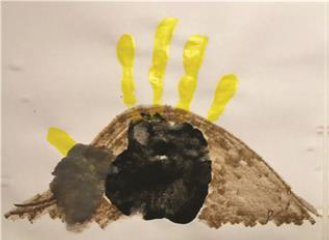
To make an empty tomb, paint the fingers of one hand yellow and the palm of that hand black. Place the hand on the paper fingers-down and spread wide. Draw a brown “hillside” between the black “tomb” and yellow “sunrays.”
After washing the hand, make a fist and paint the small surface grey. Place the fist to the side of the black hole to create a stone that has been rolled away. Alternatively, you can print out the empty tomb template at the end of this lesson for children to color, cut out, and attach to poster.
Kopesa eyano
Most stories that have been around for a while have different versions of the story. There are many books written that tell the story of the “Three Little Pigs.” Some versions change the characters; some add or take away specific scenes. All of them tell the basic story that two of the characters built houses out of materials that the villain could destroy, so they had to take refuge in the strong house built by the third character. Though the specifics are different, the broad message and lesson remain the same. The same goes for Bible stories. If you read the same story in different books of the Bible, you will hear different particulars and perspectives. Now we will read the story of the empty tomb as told in the book of John.
Read together the version of John 20:1–18 from Bible Hub or “Mary of Magdala Sees Jesus” from the Lectionary Story Bible, Year A, pp. 98–99. You may choose to act out the story.
Discuss: What are some differences you noticed in this version of the story? (Focus on the fact that Mary sees the resurrected Christ and runs to tell everyone what she saw.)
Those who witnessed the resurrection appearances did not keep silent. They were transformed.” These testimonies changed the world. “Followers continue to encounter the Risen Christ to this day. Sharing that testimony still makes a difference. Resurrection is not a one-time event, but is a daily event that occurs as people receive God’s grace, love, and new life through Jesus.
—Sermon and Class Helps, p. 64
As we feel God’s guidance and respond to God’s mission, we help continue the resurrection promise. Community of Christ believes that sacred story is the “unfolding drama of God’s reconciling work in the world” (Of Water and Spirit, p. 18). The story started a long time ago, but it is not complete. We are all characters in the book, and more characters and plot twists are being added every day.
- What does the sacred story mean to you?
- What is your part of the sacred story?
Kotinda
For the Resurrection story to continue, we must act as disciples and continue Jesus’ teachings. “Following Jesus Christ into mission means living as he did—it means being generous and compassionate, sharing witness and ministry, and living in a community of shalom” (Of Water and Spirit, p. 18).
Have each student brainstorm something they can do to fulfill the mission of Jesus (invite others to church, help someone in need, be a role model for a friend or sibling, stand up for someone who is being picked on). Each can write and complete the following sentence under their empty tomb: “God calls me to ____________.”
Kopambola
Read “That Easter Morn, at Break of Day” CCS 480. Have the children take turns reading the stanzas and sing the chorus together.
Let the children state what God is calling them to do. Start a circle prayer with each child asking God to be with them as they follow Jesus in mission.