
Zouti Adorasyon
Plan Adorasyon an
Lòt Ekriti yo
Genesis 17:1-7, 15-16; Psalm 22:23-31; Mark 8:31-38
Preparasyon
Items for Focus Moment: chair, book of scripture, small bell or chime, sign printed with “The End is Near”; a chair. Recruit three people of any age for the Focus Moment. These helpers can be chosen ahead of time or in the spirit of the moment.
Be ready to project or print the following scripture: Romans 4:13-25.
Prelid
Byenveni
Apèl pou Adorasyon
All the ends of the earth shall remember and turn to the Lord, and all the families of the nations shall worship before him. For dominion belongs to the Lord. And he rules over the nations.
Rejoice, O my heart, and cry to the Lord, and say, “O Lord, I will praise you forever; my soul will rejoice in you, my God, and the rock of my salvation.”
—Psalm 22: 27-28; 2 Nephi 3:50, adapted
Im Louwanj
“Praise to the Living God” CCS 8
OSWA “Lwanj pou Bondye Abraram nan” CCS 94
OSWA “Vini, Sous Tout Benediksyon” CCS 87
Ankouraje patisipan yo pou yo chante nan lòt lang apa de pa yo.
Priyè Ouvèti
Repons
Refleksyon Karèm
Last Sunday was the beginning of a five-Sunday journey through the Lenten season. Unlike the early disciples who didn’t seem to understand where the journey was heading, we do. But during Lent we have an opportunity to imagine ourselves on the same journey as the disciples, experiencing their excitement and at times their uncertainties. There were signposts along the way, not visible ones, but words that Jesus spoke to them. Let your Lenten reflections this week help you focus on signposts for your own journey as a disciple alongside Jesus Christ.
Priyè pou lapè
Light the peace candle
Optional: have a volunteer ring a chime or bell three times
Deklarasyon
Lent is a time that leads us to turn our focus inward, to think about where we are on the journey walking with Jesus. Week by week we remember parts of his journey in the last days of his earthly life and the courage it took for him to keep moving.
While we are not on the same kind of journey, we are walking as he did on this Earth that was created as a blessing to all creatures. While we do so we need to actively participate in helping to protect, preserve and restore this wonderful planet to be what God created it to be. In doing so we will be peacemakers.
Prayer
to be read aloud in unison adding an Amen at the end
"Touche Latè a Lejèman" CCS 137
OSWA "Bondye Kreyasyon an" CCS 147
Moman Konsantrasyon
Portrayal
Invite the three people chosen to participate to take their places: one on the chair with a book of scripture in hand, one holding the bell or chime, and one carrying the sign. The person with the bell or chime quietly rings it while slowly walking around the person on the chair. Alternatively, a person participating online could unmute and do this part by providing any audible distraction.
Meanwhile, the person seated continues to focus on reading. The person with the sign begins to circle around the seated person too, holding the sign so they can see it while the chiming, bell ringing or other sounds continue. The person seated keeps focusing completely on reading. After 2-3 minutes have elapsed signal to the participants to stop and return to their seats or mute again.
Deklarasyon
That was an example of not letting anything disturb us. Sometimes outside events can arouse feelings of anxiety, fear, and uncertainty. We lose the ability to stay focused on God and God’s promises. We let disturbing things overwhelm our minds.
Scriptures can help guide us into refocusing by holding up how people encountered God through many generations. In Community of Christ, we hold the following Basic Belief about scripture:
Scripture is writing inspired by God’s spirit and accepted by the church as the normative expression of its identity, message, and mission. We affirm the Bible as the foundational scripture for the church. In addition, Community of Christ uses the Book of Mormon and the Doctrine and Covenants – not to replace the witness of the Bible or improve on it, but because they confirm its message that Jesus Christ is the Living Word of God. When responsibly interpreted and faithfully applied, scripture provides divine guidance and inspired insight for our discipleship.
—Sharing in Community of Christ, 4th Edition, Herald House, 2018, p. 36.
Eksplorasyon Lekriti Sent yo
Display Romans 4:13-25 or refer to the printed or projected scripture. Allow two to three minutes for participants to read the scripture, then briefly discuss this question:
What does the scripture say to you about the faithfulness of God? about hope?
Mesaj maten
Baze sou Women 4:13-25
Refleksyon
Invite participants to take three deep breaths. Ask them to think about the message they just heard. What thoughts will they take with them into the coming week? What was something new to think about and remember? If time permits, after several moments to ponder, invite them to turn to a neighbor and share.
Repons jenere disip yo
Deklarasyon
God is the giver of life and hope. We can place our trust in God’s faithfulness toward us. We can respond to God’s generosity by being good stewards of creation and sharing our giftedness and resources.
Benediksyon ak Resepsyon Dimyèm Misyon Lokal ak Mondyal
Egzamen Karèm: Rankontre defi yo nan nouvo fason
Karèm envite nou ralanti, epi peye atansyon, pou nou fè plas pou transfòmasyon. Egzamen an se yon senp pratik lapriyè ki revize jounen an oswa semèn nan avèk Bondye, pou nou remake sa ki te pote lavi, sa ki te difisil, ak kote nou ta ka rankontre defi lavi yo nan nouvo fason.
Nou fè konfyans ke Lespri a prezan nan lajwa nou yo ak nan defi nou yo.
Mwen envite w pran yon ti poz, epi pran kèk gwo souf, pandan w ap konsantre w sou tèt ou pandan m ap poze w kesyon refleksyon sa yo:
Pou kisa ou rekonesan jodi a? Remake moun yo, moman yo, ak kado ki te ba ou lavi.
Envite Bondye pou ede ou gade dèyè sou jounen ou oswa semèn ou avèk onètete, konpasyon, ak kiryozite.
Ki moman ki te difisil, defi, dezagreyab, oswa inatandi? Kisa yo te reveye nan ou?
Ki kote ou te fè eksperyans lanmou, koneksyon, kouraj, lapè, oswa espwa? Ki kote ou te wè Lespri a ap travay?
Ki kote ou ta ka reyaji yon lòt jan? Ki nouvo fason pou fè fas ak yon defi ki ta ka posib?
Lage sa ou bezwen kite ale: doulè, regrè, laperèz, oswa ansyen abitid. Kite gras antre ak posiblite pou rekòmanse.
Ofri jounen ki devan w lan bay Bondye. Mande l pou l ouvè pou nouvo posiblite ak kouraj pou w rankontre nenpòt bagay ki vini avèk lanmou, konpasyon ak espwa.
Lapriyè
Bondye nouvo posiblite yo,
Ede nou wè lavi nou avèk konpasyon ak onètete.
Montre nou ki kote nouvo fason pou reponn posib.
Ede nou libere sa ki pa bay lavi ankò epi ouvri nou pou lapè ou.
Ban nou kouraj pou nou rankontre demen avèk lanmou, espwa ak imajinasyon.
Amèn.
Hymn of Trust
“I Know Not What the Future Hath” CCS 246
OR “Standing on the Promises” CCS 257
Ankouraje patisipan yo pou yo chante nan lòt lang apa de pa yo.
Ou ka jwenn tradiksyon kantik sa a an panyòl ak an franse nan: Herald House
OR “By Gracious Powers” CCS 268
Ankouraje patisipan yo pou yo chante nan yon lòt lang apa de lang pa yo a.
Unison Prayer
“I Have Decided to Follow Jesus” sing at least twice CCS 499
Read stanzas 1 and 3 aloud in unison. End with Amen.
Consider reading in multiple languages.
Postlid
Espas Sakre: Plan Adorasyon an Ti Gwoup
Rasanbleman
Byenveni
Nou mete tèt ansanm ak lòt kretyen ki pandan plizyè syèk obsève Karèm kòm karant jou ant Mèkredi Sann ak Pak, san konte Dimanch. Pandan Karèm, nou santre atansyon nou sou Jezi pandan n ap sonje lavi ak ministè li. Karèm nan ban nou tou yon mwayen pou nou konsantre plis sou pwòp lavi nou an relasyon ak Jezi. Epi sezon Karèm nan ankouraje nou pou nou vire do bay tout sa ki distrè nou oswa bloke angajman nou nan disip. Se pou sezon Karèm nan ede nou mache avèk Jezi, menm si chemen an mennen nou nan kwa a.
Priyè pou lapè
Sonnen yon klòch oubyen yon carillon twa fwa dousman.
Limen chandèl lapè a.
God of lightness and darkness, peace in our world today may seem unreasonable, far-fetched, ludicrous. Also ridiculous was the thought that Abram and Sarah might have a son. Yet, their descendants now number as many as the stars. God, we know you are capable of the most unlikely things, and we praise you for that! You create something of nothing—every day! We trust that you are working in the world, shining peace into the world like stars in the night sky.
May we pause to see the stars, to see the peace, which you create daily. And then, may we join you. May we be so bold as to work to create something from nothing—and may we see that there is already a peaceful-something, even in the most ludicrously nothing places. In the name of Jesus, our north star. Amen.
Pratik espirityèl
Pratik Silans
Pratike silans ka difisil okòmansman. Lespri a ka pèdi tèt li. Pèmèt tèt ou gras nan pratik sa a. N ap kòmanse lè m sonnen klòch la. N ap rete an silans pandan senk minit. M ap sonnen klòch la ankò pou konkli tan silans nou an.
Sonje respire pwofondman. Konsantre sou chak souf ka ede kalme lespri a. Vin konsyan de sa k ap pase bò kote w; remake kijan lè a santi sou po w; fè konfyans ke w nan prezans Sen an—ki antoure w epi ki anbrase w nèt. Kite konvèsasyon enteryè w yo sispann pou yon ti tan. Se pou w totalman prezan avèk Moun ki totalman prezan avèk ou a.
Sonnen klòch la pou kòmanse.
Tann senk minit.
Sonnen klòch la pou fini peryòd silans lan.
Mande: Ki santiman yon moun genyen lè l prezan avèk Bondye an silans?
Adapted from a Guide for Lent
Pataje Otou Tab la
Women 4:13–25 NRSVue
13 For the promise that he would inherit the world did not come to Abraham or to his descendants through the law but through the righteousness of faith. 14 For if it is the adherents of the law who are to be the heirs, faith is null and the promise is void. 15 For the law brings wrath, but where there is no law, neither is there transgression.
16 For this reason the promise depends on faith, in order that it may rest on grace, so that it may be guaranteed to all his descendants, not only to the adherents of the law but also to those who share the faith of Abraham (who is the father of all of us, 17 as it is written, “I have made you the father of many nations”), in the presence of the God in whom he believed, who gives life to the dead and calls into existence the things that do not exist.18 Hoping against hope, he believed that he would become “the father of many nations,” according to what was said, “So shall your descendants be.” 19 He did not weaken in faith when he considered his own body, which was already as good as dead (for he was about a hundred years old), and the barrenness of Sarah’s womb. 20 No distrust made him waver concerning the promise of God, but he grew strong in his faith as he gave glory to God, 21 being fully convinced that God was able to do what he had promised.22 Therefore “it was reckoned to him as righteousness.” 23 Now the words, “it was reckoned to him,” were written not for his sake alone 24 but for ours also. It will be reckoned to us who believe in him who raised Jesus our Lord from the dead, 25 who was handed over for our trespasses and was raised for our justification.
—Romans 4:13-25 NRSVue
The phrase “hoping against hope,” which sometimes is used to suggest clinging on even when all seems hopeless, originates from verse 18 of today’s scripture and is central to its message. In Abraham, we meet an extraordinary person who had faith in a God who promised the impossible and then did it. God declared to Abraham, “I have made you the father of many nations.”
Such a promise would be challenging for anyone to grasp and accept. But with Abraham, who was almost 100 years old and whose wife, Sarah, was barren, it would have been beyond belief.
Abraham inherited the promise made to him by God, not because he adhered to the law, but because of solid and consistent faith in the face of much evidence to the contrary that what God had promised would come to pass. Abraham believed in hope—a hope that saw beyond the circumstances to rest on the promises and ability of God.
While the focus is on Abraham in this chapter, Paul concludes that Jesus, who was crucified because of human evil, was raised for our justification—that we might become one with God through our faith. Just as it was “reckoned unto Abraham,” so will it be reckoned unto us…those who believe in God.
As we continue this Lenten journey of self-reflection and preparation, perhaps it is best to focus not on the cross, but on the resurrection, new life, and “hope against hope” that God has promised, if only we will have faith. God had promised Abraham he would become the father of many nations. Indeed, this was impossible. Jesus told his disciples he would be killed and rise again on the third day. Indeed, this was impossible. Unless you believe in a God of the impossible, that is.
Kesyon
- Abraham believed in hope. Who in your life would you consider as models of Abraham’s faith and hope?
- Think of a time when you clung to hope when all seemed hopeless. How did your faith in God help you through that time?
- What are your hopes today, and how is faith present in this hope?
Ap voye
Deklarasyon Jenerozite
Kominote Kris la byenneme, pa sèlman pale epi chante de Siyon. Viv, renmen, epi pataje tankou Siyon: moun k ap fè efò pou yo vizibman fè yon sèl nan Kris la, pami yo pa gen pòv oswa moun k ap sibi opresyon.
—Doktrin ak Alyans 165:6a
Panyen ofrann lan disponib si ou ta renmen sipòte ministè ti gwoup ki deja egziste yo kòm yon pati nan repons jenere ou a.
Priyè ofrann pou Karèm nan adapte nan Repons Jenere Yon Disip:
Bondye ki toujou la, padone nou lè nou pa renmen nou, lè nou pa gen espwa, lè nou pa gen sa ou te kreye nou pou nou ye a. Mizèrikòd ak gras ou toujou avèk nou. Se pou nou jwenn fòs nan prezans ou, epi se pou nou reponn a lanmou ou avèk yon lespri jenere. Amèn.
Envitasyon pou pwochen reyinyon an
Imn Konklizyon an
Community of Christ Sings 244, “There’s an Old, Old Path”
Priyè Final la
Siplemantè Opsyonèl Selon Gwoup la
Sakreman Soupe Senyè a
Paske, mwen te resevwa nan men Senyè a sa mwen te transmèt nou tou: Senyè Jezi, jou yo te trayi l la, li te pran yon pen. Apre li fin di Bondye mèsi, li kase l' an kase l', epi li di: Sa a se kò mwen, ki se pou nou. Fè sa pou nou sonje m'. Menm jan an tou, apre yo fin manje, li pran gode diven an, li di: Gode diven sa a se nouvo alyans lan nan san mwen. Fè sa chak fwa n'ap bwè ladan l', pou nou sonje m'. Chak fwa n'ap manje pen sa a, chak fwa n'ap bwè nan gode sa a, n'ap anonse lanmò Seyè a jouktan li vini.
—1 Korentyen 11:23–26
Deklarasyon Kominyon
Tout moun akeyi nan tab Kris la. Soupe Senyè a, oubyen Kominyon, se yon sakreman kote nou sonje lavi, lanmò, rezirèksyon, ak prezans kontinyèl Jezikri. Nan Kominote Kris la, nou fè eksperyans Kominyon tou kòm yon opòtinite pou nou renouvle alyans batèm nou an epi pou nou fòme kòm disip ki viv misyon Kris la. Gen lòt ki ka gen konpreyansyon diferan oswa adisyonèl nan tradisyon lafwa yo. Nou envite tout moun ki patisipe nan Soupe Senyè a pou yo fè sa nan lanmou ak lapè Jezikri.
Nou patisipe nan Kominyon an kòm yon ekspresyon benediksyon, gerizon, lapè ak kominote.
Pou prepare nou, ann chante nan mizik Kominote Kris la ap chante a ( chwazi youn):
515 "Nan moman sa yo nou sonje"
516 “Reyini ansanm pou diven ak pou pen”
521 “Ann kase pen ansanm”
525 “Tab la piti”
528 “Manje pen sa a”
Benediksyon epi sèvi pen ak diven an.
Refleksyon pou Timoun yo
This Lenten activity continues through the season of Lent.
Ou ap bezwen:
- Kopi paper
- Baton lakòl
- Last week’s papers cut into thin strips
Before this meeting, cut the paper used last week into small strips.
Throughout Lent, participants will build a piece of art that reflects their Lenten journey. Be prepared to collect the progressing artwork each week. Make certain to have extra pieces of artwork in various stages of completion for participants who miss a week or two.
Say: Today is the second Sunday in Lent. Lent is a time when we prepare for Easter by intentionally taking time to grow our relationship with God. We can deepen our relationship with God in many ways, but three are especially important during Lent: fasting, praying, and almsgiving. Last week we talked about fasting.
Ask: Does anyone remember what fasting is?
Say: This week, we are going to talk about prayer. There are many ways to pray. No matter how you pray, it is important to create safe space around you or within you where you can spend time with God. Today, we are going to create a visual reminder of a safe space so we can remember how important it is.
Last week you brainstormed things you could fast from during Lent and then colored over those things. I took your papers and cut them into fine strips. We are going to glue these fine strips on a new piece of paper in the shape of a nest. You get to decide what your nest looks like and how many strips of paper you need to make it.
While participants are using glue sticks and paper strips to create nests on their papers, talk about ways we can create space for God.
Say: Once you have created your nest, write your name on the back of your paper and hand it to me. I will keep the papers until next week, when we continue to add to our art.
This week, see how you intentionally can create space in your life for God.
Èd pou Sèmon yo
Eksplore Lekriti Sent yo
The phrase “hoping against hope,” which is sometimes used to suggest clinging on even when all seems hopeless, originates from verse 18 of today’s scripture passage and is central to its message. In Abraham, we meet an extraordinary person who had faith in a God who promised the impossible and then did it. God declared to Abraham, “I have made you the father of many nations” (v.17). Such a promise would be challenging for anyone to grasp and accept. But, with Abraham, who was almost 100 years old and whose wife Sarah was barren, it would have been beyond belief. Yet, we are told Abraham “did not waver concerning the promise of God, but he grew strong in faith as he gave glory to God, being fully convinced that God was able to do what he had promised” (vv. 20–21).
Paul presents Abraham as the Father of All Believers. Abraham inherited the promise made to him by God, not because he adhered to the law, but because of solid and consistent faith—in the face of much evidence to the contrary—that what God promised would come to pass. Abraham believed in hope, a hope that saw beyond the circumstances to find rest on the promises and ability of God.
Paul’s intent is not to place Abraham on a pedestal. He does not imply Abraham was a perfect person who never doubted. What is portrayed is a man whose attitude was consistently one of faith and hope in the promise of God.
In the opening chapter of Romans, Paul describes a human race that has ignored, dishonored, and failed to worship God. In contrast, in Romans chapter 4, we find Abraham, one who is called to undo humankind’s sin by believing in God as creator and life-giver (v. 17) and by trusting in God’s promises (v. 19). However, we must recognize that it is through Jesus Christ, not Abraham, that humankind is saved.
While the focus is on Abraham in this chapter, Paul concludes that Jesus, who was crucified because of human evil, was raised for our justification—that we might become one with God through our faith. If our goal is justification, then Abraham provides a worthy signpost towards it, but it is only in Jesus that the goal is reached. As theologian Tom Wright explains, “Abraham believed that God would give life where there was none. Christians believe that God raised Jesus from the dead. In both cases, it can only be a recognition that God is God, that our life and the life of the world are in God’s hand, that God has already begun the new creation and invites us to trust God to carry it through to the end.”
“Hoping against hope, he believed…” (v.18). God had promised Abraham he would become the father of many nations. Indeed, this was impossible. Jesus told his disciples he would be killed and rise again on the third day. Indeed, this was impossible. Unless you believe in a God of the impossible, that is.
Ide Santral yo
- Abraham inherited the promise made to him by God, not because he adhered to the law, but because of solid and consistent faith.
- Abraham believed in the hope that sees beyond circumstances to find rest on the promises and ability of God.
- If our goal is to become one with God, then Abraham provides a worthy signpost towards this goal, but it is only through Christ the goal will be reached.
Kesyon pou Oratè a
- Think of a time when you clung to hope when all seemed hopeless. How did your faith in God help you through that time?
- What do you hope for right now, and what part does faith play in this hope?
- Abraham believed in hope. Who are the people in your life you would consider believers in hope?
- Jesus was raised for our justification. What do you understand by this?
Leson yo
Leson pou granmoun
Konsantre sou pasaj ekriti yo
Women 4:13–25
Konsantrasyon Leson an
Lafwa se benediksyon Bondye.
Objektif yo
Moun k ap aprann yo pral…
- Eksplore tèks Women 4:13-25 la.
- diskite sou konsèy Pòl la konsènan lafwa.
- revize repons fidèl Abraram yo.
- kreye yon plan pou mennen moun nan kominote a pou ede yo rekonèt lafwa Bondye te plante nan yo a.
Pwovizyon
- Self-Survey questions (Gather section)
- Plim oswa kreyon
- Bib oswa feyè enprime Women 4:13–25 pou chak manm klas la
- Kominote Kris la ap chante ( CCS )
Nòt pou Pwofesè a
Pou prepare w pou leson sa a, li “Eksplore Lekriti a” pou Women 4:13–25 nan Sèmon ak Èd pou Klas, Ane B: Nouvo Testaman (ak konsantrasyon sou Lèt yo) , pp. 53–54, disponib atravè Herald House .
Rasanble
After welcoming attendees, distribute copies of the self-survey (below) and pencils or pens as needed. Inform them that this is only for themselves and won’t be shared. Invite them to keep and use the survey page to make notes of anything explored today they want to remember. Allow 2–3 minutes to complete the self-survey.
Distribye Bib oubyen kopi enprime tèks Women yo. Envite manm klas yo pou yo reflechi sou repons yo te bay nan sondaj la, pou yo koute pou yo wè si yo gen ide ki gen rapò ak kesyon sondaj yo pandan w ap li Women 4:13–25. Envite yo pou yo swiv an silans pandan w ap li.
Oto-Sondaj
Vrè oswa Fo:
- Nan liv Jenèz la, pèp la te resevwa lalwa alyans lan anvan Bondye te revele yon pwomès bay Abram (Abraram) konsènan desandan yo.
- "Lwa" a fè ajans nou an santral.
- Lafwa vin anvan obeyisans nou epi li fòme li.
- Lè nou soti poukont nou pou nou planifye nouvo fason pou nou “vin legliz la”, sa montre yon mank lafwa.
- Pou Apot Pòl, objè lafwa a se Bondye ki gen pouvwa pou l venk lanmò.
Angaje
Yon devinèt komen poze kesyon sa a: Kilès ki te vin an premye, poul la oswa ze a? Lè w li tèks sa a nan Women yo, ou gade yon kalite devinèt sanblab, men olye pou w poze l kòm yon kesyon, ou deklare l kòm yon repons oswa yon reyalite.
Plizyè ane anvan Pòl te ekri lèt sa a, yo te deja bay Juif yo lòd pou yo kite Wòm. Lè Pòl te ekri lèt la, gen prèv ki montre yo te leve dekrè ki te entèdi Juif yo antre nan Wòm nan. Pandan ane ki te pase yo, kretyen ki pa Jwif yo te vin pi enpòtan nan nouvo kominote legliz ki te fèk fòme a. Sa te ka mennen nan tansyon ak konfli pandan Juif yo t ap retounen pou yo rantre nan gwoup la ankò.
Nan lèt sa a, Pòl te prezante agiman ke tou de gwoup kwayan yo—Jwif ak moun ki pa jwif—te eritye Abraram: youn paske yo te desandan fizik, e lòt la paske yo te “pitit” Abraram nan yon fason metaforik.
- Selon tèks ki nan Women yo, kisa ki te vin jwenn Abraram an premye, lalwa a oswa lafwa a? ( Pwomès konsènan desandan Abraram yo nan Jenèz chapit 15; lalwa a vini nan chapit 17. )
- Poukisa Pòl te ka mete aksan sou pwen sa a?
- Si lalwa te vini an premye, ki diferans sa ta fè pou kretyen ki pa Jwif yo?
- Ian S. Markham te deklare ke Pòl, pandan l ap reflechi sou eksperyans Abraram nan, deklare: “…lafwa nan pwomès la se premye atant Bondye genyen nan limanite” ( Feasting on the Word, Ane B, Volim 2 ). Kisa sa ta ka vle di jodi a?
Reponn
Nou souvan sonje istwa Abraram nan, nou panse ke lafwa li nan pwomès Bondye a—ke li t ap papa anpil nasyon (pa yon sèl nasyon)—te yon ti jan febli. Dayè, li te konnen ki laj li te genyen. Li te konnen Sara te gen lontan depi l te vin papa. Li te menm eseye kreye yon eritye pa mwayen yon esklav pou l te ka fè yon pitit pou li. Sa ka pa sanble ak aksyon yon moun ki te gen lafwa ke Bondye t ap akonpli sa l te pwomèt la. Pòl te ekri nan vèsè 19-20 yo: “Li pa t febli nan lafwa... Okenn mefyans pa t fè l chanje plas.”
Espesyalis Jeff Paschal mande: “Èske se posib Pòl ap konsidere lafwa Abraram nan... kòm yon lafwa solid e san fay, pa paske li pa janm doute, pa paske li pa janm eseye pran bagay yo nan men pa l, men paske Abraram vrèman fè pwomès Bondye yo konfyans ase pou l pran risk epi fè yon pa avèk lafwa.” (David L. Bartlett ak Barbara Brown Taylor, eds. Feasting on the Word, Ane B, Volim 2 , 2008), 67)
Diskite sou:
- Kijan entèpretasyon sa a ta ka ede nou wè ke:
- “Bondye ap rele yon legliz ki gen kouraj, ki pran risk epi ki fè konfyans, olye pou l viv yon lavi espirityèlman imobil kote l ap eseye tou senpleman pa fè okenn erè.” (Jeff Paschal) epi sa
- “Defi ak opòtinite yo enpòtan anpil. Èske w ap rete ezite nan lonbray laperèz ou, ensekirite ou, ak lwayote ou ki an konpetisyon? Oubyen èske w ap avanse nan limyè apèl ak vizyon diven an ba ou a?” (Doktrin ak Alyans 164:9e)
- Yo di se sèlman Bondye ki ka kreye lafwa paske se yon kado. Èske ou dakò oswa ou pa dakò? Poukisa?
- Ki opòtinite kominote legliz la ta ka genyen pou nouri mouvman lafwa nan moun k ap chèche Bondye ak nan moun ki fèk batize oubyen ki konfime kwayan yo?
Envite manm klas yo pou yo revize oto-sondaj la, epi modifye repons yo selon diskisyon jodi a. (Si yo poze kesyon, repons yo se 1-F, 2-T, 3-T, 4-F, 5-T.)
Voye
Ankouraje patisipan yo pou yo fòme gwoup de ou twa moun.
- Mande yo pou yo fòmile yon lide sou kijan pou yo envite lòt moun nan kominyon kongregasyon an. Sonje yo pati sa a nan priyè misyon an: “Ban mwen kouraj pou m pran yon nouvo risk.”
- Mande yo pou yo imajine sa sa ta ka ye nan kontèks kongregasyon w lan. Bay ase tan pou chak gwoup ka pataje lide yo.
Beni
Chante oubyen li ansanm “Avèk yon lafwa fèm” CCS 649.
Li Prensip Dirab la: Devlope Disip pou Sèvi nan Pataje nan Kominote Kris la , 4yèm edisyon, 2018, paj 23.
Devlope Disip pou Sèvi — Ekipe moun pou misyon Kris la
Nou pare pou nou ekipe gason, fanm ak timoun pou yo vin vrè ekspresyon vivan lavi, ministè, ak prezans kontinyèl Kris la nan mond lan.
Leson pou jèn yo
Konsantre sou pasaj ekriti yo
Women 4:13–25
Konsantrasyon Leson an
Gen lafwa nan pwomès Bondye yo.
Objektif yo
Moun k ap aprann yo pral…
- Eksplore sa sa vle di gen lafwa lè w sonje istwa alyans Bondye te fè ak Abraram ak Sara a jan li gen rapò ak pasaj ekriti jodi a.
- medite sou lafwa yo nan deklarasyon ki difisil pou kwè.
- konsidere priyè Misyon an kòm yon zak pèsonèl kouraj ak lafwa.
Pwovizyon
- Bandoulye
- Ti trete
- Bib, Bib Entènasyonal pou Timoun, si ou genyen
- Papye ak plim oswa kreyon
Nòt pou Pwofesè a
Pou prepare w pou leson sa a, li “Eksplore Lekriti a” pou Women 4:13–25 nan Sèmon ak Èd pou Klas, Ane B: Nouvo Testaman (ak konsantrasyon sou Lèt yo) , pp. 53–54, disponib atravè Herald House .
Rasanble
Mande yon volontè brav pou l vin jwenn ou devan sal la. Mete yon bandeau sou je elèv la. Mande volontè a: Èske w gen kè sote? Mande rès klas la: Èske ou panse yo gen kè sote? Ki jan ou ka di sa? Apre sa, di volontè a pou l louvri bouch li byen laj. Mande ankò: Èske w gen kè sote kounye a? Apre sa, mete ti goute a sou lang yo. Kite yo retire bandeau a epi poze kesyon diskisyon sa yo:
- Ki jan sa te santi lè w te swiv direksyon yo san wè anyen?
- Èske ou t ap swiv menm enstriksyon yo si yon etranje t ap ba ou lòd yo?
- Ki jan ou fè konnen kilè li an sekirite pou swiv enstriksyon yon moun e kilè ou pa ta dwe?
- Kisa sa vle di gen lafwa?
Leson jodi a se sou gen lafwa nan Bondye malgre sa ki te sanble enstriksyon ridikil nan men Bondye.
Angaje
Tèks ekriti pou jodi a se nan liv Women yo; li fè referans a yon istwa ki te ekri plizyè santèn ane pi bonè nan Ansyen Testaman an. Pou nou konprann pasaj ekriti jodi a, nou bezwen konprann istwa Abraram ak Sara.
Envite elèv yo pou yo pale sou sa yo konnen sou Abraram ak Sara. Apre sa, bay detay ki manke nan sinops sa a:
Istwa pwomès Bondye te fè bay Abram ak Sarayi (Bondye pita chanje non yo pou Abraram ak Sara) jwenn nan Jenèz chapit 15 rive 17. Bondye te fè yon alyans ak Abram kote li te di ke li menm ak Sarayi t ap vin papa ak manman anpil nasyon epi desandan yo t ap gen plis pase tout zetwal nan syèl la. Apre sa, Bondye te chanje non yo. Akò Bondye te fè avèk yo a t ap pwolonje pou tout desandan yo. Pwoblèm nan sete ke Abraram ak Sara te trè granmoun (nan fen 90 yo) epi yo pa t gen pitit. Li t ap difisil pou fè pwomès Bondye a konfyans. Akò ki te fèt la sete ke chak gason t ap sikonsi kòm yon siy konfyans sa a nan pwomès Bondye a. Abraram te kwè nan Bondye epi li te fè jan li te pwomèt la, li te fè tout gason nan kay li sikonsi, li menm tou.
Abraram ak Sara te gen yon pitit gason, Izarak, ki te fèt pou yo ane apre a. Pwomès Bondye te fè Abraram ak Sara a te akonpli grasa desandan Izarak yo. Anfèt, desandan Abraram yo gen ladan yo moun ki fè pati Jidayis, Krisyanis ak Islam. Jezi se yon desandan Abraram.
Li Women 4:13-25 nan Bib Entènasyonal pou Timoun yo, si w disponib.
- Se pa t atravè lalwa a Abraram ak Sara te resevwa pwomès pou yo vin paran yon nasyon antye. Se te atravè kisa?
- Ki pwomès Bondye fè nou?
- Ki jan nou ka montre lafwa nan Bondye?
Plizyè ane anvan Pòl te ekri lèt sa a, pèp jwif la te resevwa lòd pou yo kite Wòm. Lè Pòl te ekri lèt la, gen prèv ki montre yo te leve dekrè ki te entèdi kominote jwif la antre nan Wòm nan. Pandan ane ki te pase yo, kretyen ki pa jwif yo te vin pi enpòtan nan nouvo kominote legliz ki te fòme a. Sa te ka mennen nan tansyon ak konfli pandan jwif yo te retounen pou yo rejwenn gwoup la.
Nan lèt sa a, Pòl te prezante agiman ke tou de gwoup kwayan yo—Jwif ak moun ki pa jwif—te eritye Abraram: youn paske yo te desandan fizik, e lòt la paske yo te “pitit” Abraram nan yon fason metaforik.
Reponn
Kòmanse yon diskisyon sou sa sa vle di kwè nan yon bagay ki sanble difisil pou kwè lè w pataje kèk nan "Reyalite Difisil pou Kwè" sa yo. Envite elèv yo pou yo pataje kèk nan sa yo te tande. Diskite sou sa yo ki gen pwoblèm pou yo kwè ak poukisa kwè nan kèk bagay ka difisil.
- Ekirèy yo lakòz plis pann kouran Ozetazini. Me rive jen ak oktòb rive novanm se pi bon moman nan ane a pou "atak ekirèy" sou liy elektrik yo.
- Ou ka konnen tanperati deyò a lè w konte krikèt la k ap chante. Si w konte konbyen fwa yon krikèt chante nan 15 segonn epi w ajoute 37, w ap jwenn tanperati aktyèl apeprè an degre Farennayt.
- Timoun marasa idantik yo se frè ak sè jenetik (demi-frè ak sè), pa kouzen.
- Costco vann ase papye twalèt chak ane (anviwon yon milya woulo) pou vlope papye a toupatou sou latè 1,200 fwa.
- Pi piti kalmason yo te janm dekouvri a ka pase nan twou yon zegwi. Kalmason Angustopila dominikae a, yo te dekouvri an 2014, mezire sèlman 0.03 pous (oswa 0.86 milimèt) wotè. Dis ladan yo te ka pase nan twou yon zegwi alafwa.
- Plant ki grandi pi rapid sou Latè a grandi tèlman vit, yo mezire l an mil pa èdtan. Banbou ka grandi 35 pous chak jou nan yon vitès 0.00002 mil pa èdtan, dapre Guinness World Records.
—Adapted from bestlifeonline.com/crazy-interesting-facts/
Vèsè 19-20 yo di: “Abraram te reflechi sou tout bagay sa yo. Men, lafwa li pa t febli nan Bondye. Li pa t janm doute ke Bondye t ap kenbe pwomès li a. Abraram pa t janm pèdi konfyans nan Bondye. Li te vin pi fò nan lafwa li, li te bay Bondye louwanj.”
- Poukisa ou panse Abraram te kwè nan Bondye?
- Nan ki pwen kwè depann de moun k ap di nou sa oswa kote enfòmasyon an soti? Poukisa sa enpòtan?
Voye
Priyè Misyon an se yon priyè lafwa. Lè nou priye, n ap mande Bondye pou gide nou kote Lespri Bondye a ap travay pou nou ka vin yon pati nan travay sa a. Se yon priyè ki mande kouraj pou nou pran risk epi aji pou Bondye. Pandan ke nou ka fasilman repete priyè sa a pa kè, se prensipalman yon priyè kouraj ak lafwa.
Imajine Abraram ak Sara k ap priye yon vèsyon Priyè Misyon an tou. Li ta ka ale yon bagay konsa:
Bondye, ki kote Lespri ou ap mennen w jodi a?
Help us be alert and ready to respond.
Give us courage to trust you and give us faith to respond.
Help us become a blessing of your love and peace for the descendants which you’ve promised us.
Amèn.
Pran kèk minit pou konpoze yon priyè misyon pou lavi ou. Ki priyè ou ta ye?
Beni
Pou moun ki alèz yo, envite manm klas yo pou pataje priyè misyon yo te kreye a pou fini klas la.
Leson pou Timoun yo
Konsantre sou pasaj ekriti yo
Women 4:13–25
Konsantrasyon Leson an
Gen lafwa—tankou Abraram ak Sara—nan pwomès Bondye a.
Objektif yo
Moun k ap aprann yo pral…
- li epi aprann sou istwa Abraram ak Sara a.
- patisipe nan yon similasyon lafwa.
- kreye men k ap priye ak priyè lafwa.
Pwovizyon
- Ti trete
- Bando pou je (ase pou mwatye klas la)
- Bib la oubyen Bib Istwa Leksionè, Ane B , pa Ralph Milton, ilistrasyon pa Margaret Kyle (Wood Lake Publishing, 2008, ISBN 9781551455648); epi Bib Istwa Leksionè, Ane A , pa Ralph Milton, ilistrasyon pa Margaret Kyle (Wood Lake Publishing, 2007, ISBN 9781551455471)
- Chèz (ase pou mwatye klas la)
- Papye konstriksyon koulè (1 papye pou chak timoun)
- Makè
- Bib la
Nòt pou Pwofesè a
Pou prepare w pou leson sa a, li “Eksplore Lekriti a” pou Women 4:13-25 nan Sèmon ak Èd pou Klas, Ane B: Nouvo Testaman (ak konsantrasyon sou Lèt yo) , pp. 54-54, disponib atravè Herald House .
Rasanble
Mande yon volontè brav pou l vin jwenn ou devan sal la. Mete yon bandeau sou je timoun nan. Mande timoun nan: Èske w gen kè sote? Mande rès klas la: Èske ou panse yo gen kè sote? Ki jan ou fè konnen? Apre sa, di timoun nan pou l mete lang li deyò. Mande ankò: Èske w gen kè sote? Mete ti goute a nan men yo epi envite yo goute l. ( Nòt: Fè atansyon ak nenpòt alèji manje.) Kite yo retire bandeau a epi poze kesyon diskisyon sa yo:
- Ki jan sa te santi lè w te swiv direksyon yo san wè anyen?
- Èske ou t ap swiv menm enstriksyon yo si se te yon etranje—olye mwen—ki t ap ba ou lòd yo?
- Ki jan ou fè konnen kilè li an sekirite pou swiv enstriksyon yon moun e kilè ou pa ta dwe?
Leson jodi a se sou gen lafwa nan Bondye malgre sa ki te sanble enstriksyon ridikil nan men Bondye.
Angaje
Lekti pou jodi a nan liv Women yo, ki nan Nouvo Testaman an. Sepandan, li fè referans a yon istwa ki te ekri plizyè santèn ane pi bonè nan Ansyen Testaman an. Pou nou konprann pasaj jodi a, nou bezwen konprann istwa Abraram ak Sara ki nan Ansyen Testaman an.
Nòt: Istwa Abraram ak Sara a jwenn nan Jenèz chapit 15 rive 17. Ou ka jwenn li tou nan Lekti Bib la jan sa a:
Ane A: pp. 80–81, 128–12, 133–134, ak 142–144
Ane B: paj 80–81
Ou kapab tou bay yon ti rezime avèk plis detay jan sa apwopriye:
Istwa pwomès Bondye te fè bay Abram ak Sarayi (Bondye pita chanje non yo pou Abraram ak Sara) jwenn nan Jenèz chapit 15 rive nan 17. Bondye te fè yon alyans ak Abram kote li te di ke li menm ak Sarayi t ap vin papa ak manman anpil nasyon epi desandan yo t ap gen plis pase tout zetwal nan syèl la. Apre sa, Bondye chanje non yo. Akò Bondye te fè avèk yo a t ap pwolonje pou tout desandan yo. Pwoblèm nan sete ke Abraram ak Sara te trè granmoun (nan fen 90 ane yo) epi yo pa t gen pitit. Li t ap difisil pou fè pwomès Bondye a konfyans.
Abraram ak Sara te gen yon pitit gason, Izarak, ki te fèt pou yo ane apre a. Pwomès Bondye te fè Abraram ak Sara a te akonpli grasa desandan Izarak yo. Anfèt, desandan Abraram yo gen ladan yo moun ki fè pati Jidayis, Krisyanis ak Islam. Jezi se yon desandan Abraram.
Rakonte istwa Abraram ak Sara a. Diskite kesyon sa yo pandan w ap pwogrese nan istwa a:
- Ki jan Abram ak Sarayi te montre lafwa nan Bondye?
- Èske li fasil pou ou jis ranmase bagay ou yo epi ale san ou pa konnen ki kote ou prale?
- Èske w te janm swiv yon moun san w pa konnen ki kote w prale?
- Poukisa li te tèlman enkwayab pou Sara ak Abraram te ka gen yon tibebe nan laj yo?
- Ki jan Abraram ak Sara te montre lafwa nan Bondye?
Reponn
Abraram ak Sara te dwe fè Bondye konfyans ke pwomès li yo t ap rive vre yon jou. Yo te dwe mete tout lafwa yo nan Bondye epi koute kòmandman li te ba yo, menm lè bagay yo te sanble ireyèl oswa twò difisil.
Nòt: Seksyon sa a nan leson an ka pi byen mache nan yon lòt sal apa de espas reyinyon nòmal ou a; yon kote timoun yo mwens familye.
Mache Lafwa
Fòme patnè yo. Yo mare je youn nan patnè yo epi yo vire l plizyè fwa. Lòt patnè a deplase nan lòt bout sal la; yo dwe bay patnè li enstriksyon sou kote pou l mache nan sal la pou l asire patnè ki gen je mare a pa frape anyen. Pandan patnè ki gen je mare yo ap pwoche lòt bò sal la, di yo ke lè w ba yo lòd la, yo dwe chita. Pandan w ap eksplike sa, byen vit e tou dousman envite lòt patnè a pou l pote yon chèz epi mete l yon fason pou patnè ki gen je mare yo ka chita ladan l. Lè w pare, bay lòd pou l chita. Yon fwa ou chita byen an sekirite, retire je mare a.
- Pou patnè ki te gen je bande yo: Ki jan ou te santi w lè w pa t konnen ki kote w prale oswa sa ki pral rive?
- Pou lòt patnè yo: Èske li te difisil pou eksplike ki kote pou yo navige? Èske patnè w la te toujou koute ak atansyon epi swiv enstriksyon w yo?
- Lè yo te di patnè ki te gen je mare a pou l chita, li te dwe gen lafwa ke te gen yon chèz. Lafwa se kwè nan yon bagay nou pa ka wè. Kilè ou fè konfyans oswa ou kwè nan yon bagay ou pa ka wè?
Menm jan kèk nan nou te oblije koute enstriksyon pou nou te konnen sa pou nou fè ak ki kote pou nou ale, nou menm tou nou dwe koute Bondye. Nou dwe gen lafwa epi fè Bondye konfyans ke li konnen sa ki pi bon. Lafwa se pa kapab wè men se fè Sila a ki kapab wè a konfyans.
—adapted from betterbibleteachers.com
Lekti pou jodi a fè referans a lafwa Abraram ak Sara te genyen nan Bondye. Li Women 4:13-19 nan Lekti Labib, Ane B.
- Ki pwomès Bondye fè nou?
- Ki jan nou ka montre lafwa nan Bondye?
Voye
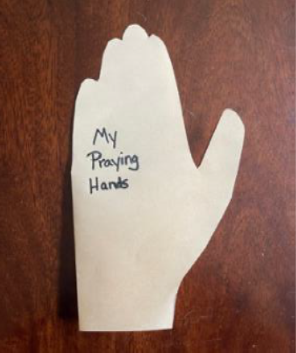
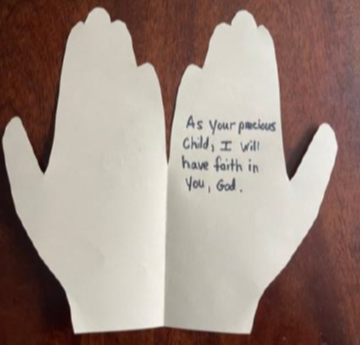
Pliye yon moso papye konstriksyon an de mwatye tankou yon anmbègè. Mete men gòch timoun nan ak ti dwèt li sou bò ki pliye a, dwèt yo ansanm anlè. Trase otou men timoun nan ak yon makè. Koupe men l, asire w ke kote ti dwèt li rankontre bò ki pliye a pa koupe. Sa ta dwe kreye men k ap priye ki pliye tankou nan foto a.
Sou devan men yo, ekri “Men m k ap priye yo.” Anndan an, fè timoun ki pi gran yo ekri pwòp priyè lafwa yo. Pou timoun ki pi piti yo, fè yo desine yon imaj priyè, ekri deklarasyon priyè pou yo, oubyen gen deklarasyon deja enprime pou yo kole nan men priyè yo. Pa egzanp: Antanke pitit ou ki gen anpil valè a, m ap gen lafwa nan ou, Bondye.
Beni
Mande timoun yo pou yo repete apre ou: “M ap gen lafwa nan ou, Bondye.” Eksplike yo ke yo ta dwe repete fraz sa a chak fwa ou montre yo. Li priyè sa a:
Bondye, mèsi pou tout bèl benediksyon ki nan mond sa a. Mwen vrèman sezi e mwen pa konprann konpleksite kreyasyon ou an.
(Pwen) M ap gen lafwa nan ou, Bondye.
Pafwa mwen santi mwen depase ak tout sa mwen sipoze fè. Mwen pa ka fè anpil bagay.
(Pwen) M ap gen lafwa nan ou, Bondye.
Pafwa mwen boulvèse. Mal bagay rive. Mwen santi tankou pa gen anyen k ap mache byen.
(Pwen) M ap gen lafwa nan ou, Bondye.
Pafwa mwen pa konprann sa mwen sipoze fè oswa ki chwa pou mwen pran. Lavi a ka tèlman konfizyon.
(Pwen) M ap gen lafwa nan ou, Bondye.
Menm jan ak Abraram ak Sara, m ap eseye koute w. Mwen konnen mwen se pitit ou ki gen anpil valè a, kidonk…
(Pwen) M ap gen lafwa nan ou, Bondye.
Amèn.