

Bisaleli ya losambo
Plan ya losambo
Makomami mosusu
Exodus 20:1–17, Psalm 19, 1 Corinthians 1:18–25
Kobongisa
Before the service, place note cards in the worship space at each seat, and place a large basket on or near the worship setting to be used during Joys and Concerns. Offer pens, markers, and pencils before the service begins.
Maloba ya ebandeli
Ba Nzembo Ya Kosangisa
select two
“All Things Bright and Beautiful” CCS 135
OR “Lord, You Have Brought Us” CCS 76
OR “Halle, Halle, Hallelujah” repeat as desired CCS 86
Boyei malamu
Call to Worship: Psalm 19:1–4
Loyembo ya Masanzoli
“This Is God’s Wondrous World” CCS 136
TO “Yekola na banzembo nyonso ya Mabele” CCS 141
OR “Dios está aqui/God Is Here Today” sing twice CCS 150
Lendisá bayangani báyemba na minɔkɔ mosusu oyo ezali ya bango te.
Losambo ya ntongo
Eyano
Sharing Joys and Concerns
Invite people to write brief notes on the note cards found at their place, pouring out concern for the welfare of others along with their joys. Explain that the information on the cards will be used to develop the Prayer of Intercession and Peace. Provide instrumental or recorded meditation music as people take a few minutes to write. Invite them to bring their cards forward to be placed in a basket located near the worship setting when the chime or bell is heard. Be ready to collect cards from those unable to come forward. Indicate that a prayer of intercession for the concerns will be combined with the Prayer for Peace.
Botangi ya Makomi ya Unison
Now, when I had heard these words, I began to feel a desire for the welfare of others; wherefore, I poured out my whole soul to God for them.
—Enos 1:12, adapted
Losambo mpo na Kimya
Pelisa bougie ya kimia
Prayer of Intercession and Peace
Ask the person who will offer the prayer to hold the basket containing the note cards during the prayer and to reference the concerns held within it.
Scripture Reading of the Gospel Text: John 2:13–22
Ministère ya Musique TO Hymne ya communauté
“What Comfort Can Our Worship Bring” CCS 199
OR “Creator of Sunrises” CCS 207
Liteya
Based on John 2:13–22
Eyano ya motema malamu ya bayekoli
Choose one of the prompt or script options found here.
Kopambola mpe Kozwa Dime ya Misio ya Esika mpe ya Mokili mobimba
Examen ya Karezimo: Kokutana na mikakatano na banzela ya sika
Karezimo ebengisaka biso kokita, mpe kotya likebi, kopesa esika mpo na mbongwana. Momekano ezali momesano ya pete ya losambo ya kotalaka mokolo to poso elongo na Nzambe, komona nini ememaki bomoi, nini ezalaki mpasi, mpe wapi tokokaki kokutana na mikakatano ya bomoi na banzela ya sika.
Totie motema ete Molimo azali na bisengo na biso mpe na mikakatano na biso.
Nabengisi bino bopema mwa moke, mpe bopema mwa mozindo, kobalusa likebi na bino na kati ntango nazali kotuna mituna oyo ya kokanisa:
Ozali na botɔndi mpo na nini lelo oyo? Talá bato, bantango, mpe makabo oyo ememelaki yo bomoi.
Benga Nzambe asalisa yo otala sima na mokolo to poso na yo na bosembo, na mawa, mpe na mposa ya koyeba.
Bantango nini ezalaki mpasi, ya mikakatano, ya kozanga esengo, to ya kozanga kokanisa? Ba niokolaki na kati na yo?
Wapi okutanaki na bolingo, boyokani, mpiko, kimia, to elikia? Omonaki wapi Molimo azali kosala?
Ekoki kozala ete oyanolaki ndenge mosusu wapi? Lolenge nini ya sika ya kolonga mokakatano oyo ekoki kosalema?
Bimisa oyo osengeli kotika: kozokisa, mawa, kobanga, to mimeseno ya kala. Tika ngolu ekota mpe likoki ya kobanda lisusu.
Pesá Nzambe mokolo oyo ezali liboso. Senga bofungwami mpo na makoki ya sika mpe mpiko mpo na kokutana na oyo nyonso eyei na bolingo, mawa, mpe elikia.
Libondeli
Nzambe ya ba possibilités ya sika, .
Salisa biso tomona bomoi na biso na mawa mpe na bosembo.
Lakisa biso esika wapi banzela ya sika ya koyanola ekoki kosalema.
Bosunga biso to bimisa oyo epesaka lisusu bomoyi te pe bofungola biso na kimia na bino.
Pesa biso mpiko ya kokutana lobi na bolingo, na elikia, mpe na makanisi.
Amen.
Loyembo ya Bomipesi
“God, the Source of Light and Beauty” CCS 593
OR “God of Grace and God of Glory” CCS 624
Lendisá bayangani báyemba na minɔkɔ mosusu oyo ezali ya bango te.
TO “Sikoyo Kende na esengo” CCS 659
Lipamboli ya lipamboli
Eyano
Postlude ya sima
Esika ya bulɛɛ: Plan ya losambo ya etuluku moke
Feti
Boyei malamu
Today is the third Sunday of Lent. We join with other Christians who for many centuries have observed it as the 40 days between Ash Wednesday and Easter, not counting Sundays.
Na Karezimo, tosalisami mpo na kotya likebi na biso na Yesu ntango tozali komikundola bomoi mpe mosala na ye. Karezimo epesaka nzela ya kosembola mpe botali na biso na bomoi na biso moko na boyokani na Yesu. Eleko ya Karezimo elendisaka biso mpe tótika eloko nyonso oyo ezali kopɛngwisa likebi to kopekisa komipesa na biso mpo na kozala bayekoli.
Tika ete eleko ya Karezimo esalisa biso totambola elongo na Yesu atako nzela ememaka na ekulusu.
Losambo mpo na Kimya
Beta ngonga to benga mbala misato malɛmbɛmalɛmbɛ.
Bougie ya Kimya ya Pole
It is in your name of love, peace, hope, and joy that we call upon you today, God, as we pause in this sacred space to be present with you. We recognize that you have been and continue to be present with us. It is in this awareness of your presence that we find the capacity to live with hope and assurance amid the uncertainties we face in our lives, cultures, and, at times, in the church.
In this time of discovery through the practices of discernment, we endeavor to be open to where your Spirit is leading us. Yet, even in our yearning to be open and mindful to where you call us, our human nature of fear, doubt, uncertainty, and differences of opinion can cause us to close ourselves off to the guidance of your Spirit. When this happens, our anxiousness can draw us away from the comfort and peace your Spirit brings in the midst of difficult questions.
Let the depth of our love for you empower us to have the depth of love for each other. Make it possible for us to see and hear and share with each other as precious brothers and sisters who are formed in your Son, Jesus Christ. Draw from us the full awareness that we belong to each other. And in this belonging, help us remember our call to care for one another as a sacred creation of you and your guidance to bring us peace.
In the name of the Prince of Peace we pray, Amen.
—Scott Murphy
Momeseno ya Molimo
Kokanisa na moto ye moko: Karezimo
Prayerfully consider the following statement from “We Proclaim Jesus Christ” found in Sharing in Community of Christ. How does this statement help you continue your Lenten journey? Print or project the reading.
The church, the body of Christ, is called to proclaim the gospel until Christ comes again. It is he who forgives us in baptism, and feeds us at his table. As disciples of Christ, we are all called to conform our lives to his by living in loving community with others, seeing Jesus in the faces of the least of God’s children, and serving those whom the world has forgotten. It is to Christ and to his gospel that we declare our loyalty and by which we will be judged.
—Sharing in Community of Christ, 3rd ed., (Herald Publishing House, 2012,
ISBN 9780830915736), 23.
Sukisa tango ya réflexion na kobetaka chime to ngonga.
Kokabola Nzinga nzinga ya Mesa
John 2:13-22 NRSVue
13 The Passover of the Jews was near, and Jesus went up to Jerusalem.14 In the temple he found people selling cattle, sheep, and doves and the money changers seated at their tables. 15 Making a whip of cords, he drove all of them out of the temple, with the sheep and the cattle. He also poured out the coins of the money changers and overturned their tables. 16 He told those who were selling the doves, “Take these things out of here! Stop making my Father’s house a marketplace!” 17 His disciples remembered that it was written, “Zeal for your house will consume me.” 18 The Jews then said to him, “What sign can you show us for doing this?” 19 Jesus answered them, “Destroy this temple, and in three days I will raise it up.”20 The Jews then said, “This temple has been under construction for forty-six years, and will you raise it up in three days?” 21 But he was speaking of the temple of his body. 22 After he was raised from the dead, his disciples remembered that he had said this, and they believed the scripture and the word that Jesus had spoken.
—John 2:13-22 NRSVue
The setting is Jerusalem just before Passover. Jesus attends the festival in Jerusalem but finds the temple courtyard looking and sounding like an open-air market. Markets are noisy places. Animals add sounds and smells. People rowdily bargain for the best prices. Coins rattle back and forth between buyer and seller. None of this was in keeping with Jesus’ understanding of the purpose of the temple.
Jesus found little in the way of sacred space and was outraged. He overturned tables and went about cleansing the area. Jesus’ words and actions suggest that those running the temple were opposing God’s purposes.
As we continue on our Lenten journey, it is a good time to consider whether we are serving something other than a sacred purpose. Perhaps we need to overturn the places in our lives that are self-serving or culture bound in ways that are contrary to God’s will.
Lent offers an opportunity to reexamine the dwelling place of God within us, and make changes. What changes might you make to the “sacred space” in your inner being?
Sometimes radical behavior and words are needed.
Mituna
- Can you think of situations in your community that need to be “cleansed” like Jesus cleansed the temple?
- What kinds of injustice have you seen or encountered in the world that caused you to want to “overturn something?”
- What positive steps can you take to address this injustice?
Kotinda
Liloba ya Bokabi
“Kokabola mpo na bolamu ya bato banso ezali molimo ya Siona” ( Malongi mpe Mayokani 165:2f ).
Tozwaka ngolu mpe bokabi ya Nzambe. Kitunga ya makabo ezali soki olingi kosunga misala ya bituluku mike oyo ezali kokoba lokola eteni ya eyano na yo ya motema malamu.
Libondeli ya likabo ya sanza oyo euti na buku A Disciple’s Generous Response:
Nzambe ya ntango nyonso, Tika ete tozala bayekoli oyo bakoki kotyela motema. Bolingo na bino ya kozanga kondima mpo na moko na moko na biso emonisami na nzela ya bomoi mpe mosala ya Yesu Klisto. Tika ete toyanola na bosembo na mosala wana lokola tozali kopesa biyano moko na mosusu, epai na bino, mpe bisomei. Amen.
Libyangi mpo na Likita oyo ekolanda
Loyembo ya nsuka
Community of Christ Sings 450, “Lead Me, Lord” (sing twice)
Libondeli ya nsuka
Ba Additions optionnelles Selon Groupe
Elambo ya Elambo ya Nkolo
We come together to share in the Lord’s Supper “as a visible witness of loving Christian fellowship and shared remembrance of Jesus Christ’s death and resurrection” (Doctrine and Covenants 164:4a).
Pamba te, nazwaki epai ya Nkolo oyo napesaki bino mpe, ete Nkolo Yesu na butu oyo batɛkaki ye, azwaki limpa. mpe ntango asilaki kopesa matondi, abukaki yango mpe alobaki: “Oyo ezali nzoto na ngai oyo ezali mpo na bino. Bosala boye mpo na kokanisa ngai.” Bobele bongo, azwaki kɔpɔ mpe, nsima ya kolya, alobaki ete: “Kɔpɔ oyo ezali kondimana ya sika na makila na ngai.Bósala boye mbala nyonso ntango bokomɛla yango, mpo na kokanisa ngai.” Mpo mbala nyonso oyo bozali kolya limpa oyo mpe komɛla kɔpɔ, bozali kosakola liwa ya Nkolo tii akoya.
—1 Bakolinti 11:23–26 NRSV
Liloba ya Komunio
Bato nyonso bayambami na mesa ya Klisto. Elambo ya Nkolo, to Komunio, ezali elambo oyo kati na yango tomikundoli bomoi, liwa, lisekwa, mpe bozali ya kokoba ya Yesu Klisto. Na Lisanga ya Klisto, tozali mpe komona Komunio lokola libaku ya kozongisa sika liyokani na biso ya libatisi mpe kosalama lokola bayekoli oyo bazali kobika na etinda ya Klisto. Basusu bakoki kozala na bososoli ekeseni to ebakisami na kati ya bonkoko na bango ya bondimi. Tobengisi baoyo nyonso bazali kosangana na Elambo ya Nkolo mpo na kosala yango na bolingo mpe kimia ya Yesu Klisto.
Na eleko oyo ya Karezimo tika tokabola na Komunio lokola elakiseli ya lipamboli, kobikisa, kimia, mpe lisanga.
Na bolengeli toyemba uta na Lisanga ya Klisto Ayemba 527, “Limpa ya Mokili.”
Kopambola mpe kopesa mampa mpe vinyo.
Makanisi mpo na Bana
Materials: Pencils or a small box of crayons.
Cards with this prayer:
Lord, We pray in hope for the day all children can go to school. Amen.
During Lent we spend time preparing for Easter. Many people observe Lent by fasting, or giving something up from Ash Wednesday until Easter. Others pray read scripture, or do things that help them be better disciples.
Mokolo ya lomingo nyonso na ntango ya Karezimo tozali kolobela likambo moko tokoki kosala mpo na komilengela mpo na Pasika.
One of the best things about starting school is getting new school supplies. With pencils sharpened we are ready to learn new things.
In some places children don’t have the opportunity to go to school. Many children work to help support the family. In some places girls are not allowed to go to school.
As disciples we can help children go to school. We can contribute to organizations that provide school supplies to children, or run schools for girls (OutreachInternational.org).
Today we have a prayer that reminds us to pray for all children to be able to attend school. Hand out prayer cards.
Place the prayer where you leave for school and each morning as you leave you can say the prayer.
Read Prayer aloud.
Lord, We pray in hope for the day all children can go to school. Amen.
Liteya Esalisaka
Kolukaluka na Makomami
The setting is Jerusalem just before Passover. Jesus attends the festival in Jerusalem but finds himself uttering harsh words with angry actions. Rather than the usual Passover pilgrimage, Jesus’ journey includes prophetic voice and action especially targeting injustices.
Jesus pointed his vigorous attack (John mentions with a whip) toward the practice of selling sacrificial animals to the pilgrims and exchanging
Roman coins, which bore the image of the emperor. While the temple appeared to fulfill its purposes, closer inspection revealed that people had forgotten its role.
The temple courtyard looked and sounded like an open-air market. Markets are noisy places. Animals add sounds and smells. People rowdily bargain for the best prices. Coins rattle back and forth between buyer and seller. None of this was in keeping with Jesus’ understanding of the purpose of the temple.
Jesus found little in the way of sacred space and was outraged. He overturned tables and went about cleansing the area. The ways of the
world had invaded gradually, perhaps not intentionally, serving something other than a sacred purpose. Jesus’ words and actions suggest that those running the temple were opposing God’s purposes.
Jesus speaks, his words are misunderstood, and John provides the necessary clarification and a glimpse of what may come. John warns against the danger of thinking we understand Jesus. Often, the “Jesus” we think we understand is a “Jesus” of our design. We’ve become comfortable with that understanding. But what if there is more to his words than we are hearing, more to his will than we are doing?
As we continue on our Lenten journey, it is a good time to consider whether we are serving something other than a sacred purpose. Perhaps we need to overturn the places in our lives that we mask as God’s will but, in reality, are self-serving or culture bound. The early disciples did not fully understand Jesus’ words. They didn’t yet know the cross and resurrection story. What about us? We have knowledge of what is coming. Can we use that knowledge to help transform and reshape the temple of our lives?
Makanisi ya Central
- We often focus our lives on self-serving, culture-bound priorities rather than God’s will.
- Lent offers an opportunity to reexamine our temple (sacred space), the dwelling place of God within us, and make changes.
- Like the early disciples, we may have become too comfortable with our understanding of Jesus and his mission.
Mituna mpo na Molobi
- What does it mean to be the church of Jesus Christ?
- Sometimes radical behavior and words are needed. Can you think of situations in your community that need to be “cleansed” like Jesus cleansed the temple?
- What would Jesus see if he walked into our congregations on Sunday? Would he want to overturn something?
- Can you think of comfortable behaviors that may not truly represent Christ’s mission in the world? How might they be transformed?
- When is anger righteous? How might it be linked to injustices?
Mateya
Liteya ya Mikóló
Tyá likebi na Eteni ya Makomami
Yoane 2:13–22
Liteya Likanisi
Sacred Spaces
Mikano
Bayekoli bako...
- explore the context of Jesus’ actions.
- discuss personal and congregational focus.
- envision mission outside the walls of a physical space.
Biloko ya kopesa
- Babiblia
- Ba stylos to ba crayons
- Notecards
- Lisanga ya Klisto Ayemba ( CCS ) .
Liyebisi na Molakisi
In preparation for this lesson, read “Exploring the Scripture” for John 2:13–22 in Sermon & Class Helps, Year B: New Testament, p. 52, available through Herald House.
Kosangisa
Sing “Lord, Prepare Me” CCS 280 one time. Then, share an experience of being “sanctuary” this past week.
Sing “Lord, Prepare Me” CCS 280 twice.
Komipesa
All four Gospels record the story of Jesus’ anger in the temple. John places the story of cleansing the temple at the beginning of Jesus’ ministry as he emphasizes Jesus’ prophetic voice and action.
The marketplace was essential during the Passover festival. Travelers needed a place to purchase pure, spotless animals and exchange local coins for Roman coins for the temple tax. These were needed to access the temple. While the other Gospels imply that price gouging was an injustice Jesus railed against, it is not mentioned in John’s Gospel.
The temple, the dwelling place of God, was magnificent. To appease his subjects, Herod the Great began restoration of the temple in 20 BCE, and it was still in process. But over the years, it had strayed from its original purpose and mission as a sacred place. Business ventures became the focus.
Jesus’ actions were twofold. First, he ushered in the idea that animal sacrifices were no longer needed for access to God. And second, the temple of Jesus’ body is where the Spirit and truth of God dwells. Worship is no longer restricted to a physical place. God is found and experienced through faith in Jesus Christ.
This scripture challenges us to examine our own focus. Do we spend time, talent, and treasure on a church building or campground or other physical space? Is the time spent proportional to time spent in mission? We must not lose the sacred purpose of gathering.
- How would you define “sacred space”?
- Identify a physical sacred place that would be difficult to give up. Why is it important to you? How would you respond if asked to leave it behind?
- How does your congregational budget and program support mission inside and outside your place of worship?
- What would Jesus see if he walked into your place of worship on Sunday?
Kopesa eyano
Community of Christ has been formed by two temples: the Kirtland Temple in Ohio and the Independence Temple in Missouri.
The Independence Temple was “dedicated to the pursuit of peace, reconciliation and healing of the spirit” (Doctrine and Covenants 156:5).
Doctrine and Covenants 163:8c states, “…the Temple calls the entire church to become a sanctuary of Christ’s peace, where people from all nations, ethnicities, and life circumstances can be gathered into a spiritual home without dividing walls, as a fulfilment of the vision for which Jesus Christ sacrificed his life.”
- How does your discipleship reflect this Temple dedication?
- How does your congregation function as a sanctuary of Christ’s peace?
In Sharing in Community of Christ, 4th Edition, pp. 54–55, we read:
The Christian journey is a pilgrimage toward shalom; a movement toward wholeness revealed to us in the way of Christ. Jesus’ life, ministry, death, and resurrection take us into the intimate center of God and impel us outward into mission; to embody wholeness and grace in a suffering world.
As we journey, we covenant to become a “dwelling place for God” (Ephesians 2:22). We seek to become personally “a sanctuary of Christ’s peace” for the sake of family, friends, congregation, community, denomination, the world, and God’s reign.
President Stephen Veazey shared the following in a sermon on June 10, 2007.
Both temples—in Kirtland and Independence—remind us that, above all else, Jesus Christ seeks to restore us to life as we were created to experience it; life as God intends it to be; life characterized by love, generosity, relationships of mutuality, sharing, and peacefulness.
—Sharing in Community of Christ, 4th Edition, p. 51
- In what ways do we become a “sanctuary of Christ’s peace”?
- How do we take personal experiences with God into our everyday world?
Kotinda
On a notecard write the name of a specific place you will be this week. Post the card on the refrigerator or another visible place. Offer a prayer that you will look for, see, and partner with God in this ordinary but sacred place this week.
Kopambola
Sing or read as a closing prayer “Can Steel and Stone and Swirling Spire” CCS 281.
Liteya ya bilenge
Tyá likebi na Eteni ya Makomami
Yoane 2:13–22
Liteya Likanisi
Jesus took dramatic action to challenge religious practices of the temple. This story also challenges us to rethink our practices as disciples of Jesus.
Mikano
Bayekoli bako...
- practice Holy Attention as an opportunity to value the worth of all persons and to respect others as an unrepeatable miracle of God.
- explore the radical challenge Jesus presented to the temple authorities and to us.
- consider how the church’s future is related directly to our willingness to go where the Spirit is calling us to go.
- imagine new ways to use the basic blueprint (spiritual formation, community, compassionate ministry, and action) to create new communities of disciples.
Biloko ya kopesa
- Babiblia
- Papyé mpe ba stylos to ba crayons
- Papyé ya tableau to tableau blanc
- Ba marqueurs
Liyebisi na Molakisi
In preparation for this lesson, read “Exploring the Scripture” for John 2:13–22 in Sermon & Class Helps, Year B: New Testament, p. 52, available through Herald House.
Kosangisa
Today is the third Sunday of Lent. Lent is a season of repentance, self-examination, reflection, and preparation for the coming of Easter. In the early church, Lent was a time to prepare new converts for baptism. Today, Christians focus on deepening their relationship with God. We will spend a few moments of class during Lent to engage in spiritual practices.
Today we will engage in the practice of Holy Attention.
This practice allows us to suspend our inner thoughts and agendas and give reverent and receptive focus to a specific person or part of God’s creation. Respecting another as an unrepeatable miracle whose life journey is unique and sacred brings awareness to and affirmation of God’s presence in all creation. We do this in the spirit of Christ who saw deeply into the hearts of people and recognized their true identities as God’s beloved. During Lent, as we continue to empty ourselves (fasting) and evaluate our lives (examen), we begin to make space for awareness of where God is showing up in the world around us.
Guide the class through this practice by reading the following instructions aloud and providing adequate time for the students to reflect on each step and question.
Enter a time of quiet reflection. Relax your body and breathing and recall a particular person, group of people, or part of creation. Ask God to bless you with curiosity and gratitude as you consider the life journey of others.
- In what ways do you feel connected to this person, group, or part of creation?
- In what ways do you experience separation from this person, group, or part of creation?
- How are you being led to share peace and love with this person, group, or part of creation?
Ask the class to respond to the following questions:
- What new awareness did you experience as you engaged in this practice?
- In what ways can giving holy attention to others impact your journey as a disciple?
- What person or part of creation do you feel drawn to give holy attention?
Komipesa
Give each member of the class a piece of paper to record their answers to the following questions before reading today’s scripture story. You may choose to have students work in pairs, particularly younger students.
- List details you remember from the story of Jesus driving the money changers out of the temple.
- Why were cattle and money changers in the temple?
- How do you make sense of Jesus’ anger in this scene?
- How did the authorities respond to Jesus’ action?
Ask the class to share and discuss their responses.
Read as a class John 2:13–22, having each person read one verse until finished.
Note to instructor: The following commentary helps learners understand the meaning in the scripture passage. Adapt as needed according to students’ age and needs.
All four Gospels (Matthew, Mark, Luke, and John) include a story of Jesus driving the moneychangers from the temple. John’s version of the story includes details not included in the others, such as Jesus making a whip out of rope and driving the animals out of the temple. John places this story at the beginning of Jesus’ ministry as opposed to the final week before his crucifixion as in the other three Gospels. Commentaries suggest that John’s placement of this story at the beginning serves a symbolic function highlighting the challenges and threats that new life as a disciple of Jesus pose to the existing order.
Readers often assume that Jesus’ actions are about dishonest practices occurring in the temple, when in reality, Jesus is confronting the whole system itself, not just its abusers. It is important to understand the religious and historical context. Passover was a pilgrimage feast. The faithful traveled to Jerusalem to worship in the temple. To participate in worship and present burnt offerings, animals were needed, yet difficult to travel with. The temple tax could not be paid using Greek or Roman coins because of the human image of the emperor on them. To pay the tax required to enter the temple meant exchanging those coins for the Tyrian currency of Jerusalem. Jesus was driving out those who were placing difficult restrictions on the worshipers, disrupting a system of producing income for temple authorities.
The Jews, as John refers to the temple authorities, asked, “What sign can you show us for doing this?” meaning on what authority is Jesus doing this? Jesus explains his actions by pointing to his death and resurrection. His authority is based on his whole life bearing testimony to the power of God in the world. Jesus, an observant Jewish male, is not anti-Jewish but is prophetically challenging the institutions of the faith as the prophets Amos and Jeremiah did.
- What unjust systems would Jesus challenge today? How would he respond?
- What unjust systems have you seen challenged in your school, community, or in the news?
Kopesa eyano
Jesus took dramatic steps to challenge the practices and institutions of his time. Reading this scripture passage for today issues a radical challenge for our time about the organization of the church. Christian communities must be open to change, renewal, and restoration to avoid the dangers of complacency and the status quo.
Former Community of Christ President Stephen Veazey challenged the church in September 2017 to move beyond the status quo and experiment with new ways of being the church. Read the excerpt of this message as a class, asking each person to listen for one idea that catches their attention.
Ask the class to share one idea that caught their attention.
Excerpts From President Veazey’s Sermon, “A Time to Act!”
20 September 2017
The word of calling, hope, and possibility emerges from the reality that great change is happening in the world. And the rate of change is accelerating. This change includes how people view God, culture, finances, technology, politics, and religious institutions.
The word of calling, hope, and possibility is that new ways of understanding, communicating, and living the gospel in response to changing circumstances already are happening in Community of Christ. The church’s future is related directly to our willingness to go where the Spirit is calling us to go.
As we respond to the unavoidable change in the world, simply persisting in typical church activities will not take us into the future. We need to adjust how we understand, communicate, and live the gospel in a new time.
I sense the future church will be focused more on spiritual, relational, and missional growth and less on debating correct doctrines or maintaining organizational structures. The future church will fulfill the counsel in Doctrine and Covenants 163:1 that as we embody our name, Community of Christ, by embracing its full meaning, we will become a blessing to many.
The future church is being formed by a basic concept: Our chief purpose is to birth, nurture, and multiply communities of disciples and seekers engaged in spiritual formation and compassionate ministry and action. This basic blueprint—spiritual formation, community, compassionate ministry and action—is true to the vision of Christ. Everything else, like organizational structure, resources, funding methods, congregational forms, etc., should support this primary purpose.
Such communities of disciples and seekers can gather anywhere, any time. While some may choose to do so, they are not dependent on owning buildings or property. They will be connected locally and globally. They will be salt, leaven, and light…
Our journey into the future will continue through more congregations becoming willing to transform in response to new opportunities. It also will occur through starting new expressions of the church to model what we are talking about. We already are working on all of this and more.
Kotinda
Being open to the leading of God’s Spirit requires us as disciples to not be complacent with just “doing church.” As a class create a list of ideas for how we might “be the church,” using the basic blueprint of spiritual formation, community, compassionate ministry, and action.
- What kind of church do you want Community of Christ to be?
- How will you be part of the church’s future?
Kopambola
As a class recite the Mission Prayer together:
God, where will your Spirit lead today?
Help me be fully awake and ready to respond.
Grant me courage to risk something new
and become a blessing of your love and peace.
Amen.
Liteya ya Bana
Tyá likebi na Eteni ya Makomami
Yoane 2:13–22
Liteya Likanisi
To fulfill God’s vision of shalom, our actions should reflect God’s mission.
Mikano
Bayekoli bako...
- identify the purpose and meaning of sanctuary and mission.
- discuss the scripture story and God’s mission.
- kotala Initiative ya Mission Kolongola bobola, kosilisa mpasi.
Biloko ya kopesa
- Room Charades cards included with lesson (following the Bless section)
- Lisanga ya Klisto Ayemba ( CCS ) .
- Biblia to Biblia ya lisolo ya maloba Biblia, Mobu B , ya Ralph Milton, bililingi ya Margaret Kyle (Wood Lake Publishing, 2008, ISBN 9781551455648)
- Sample mission statements, included with lesson (following the Bless section)
- Paper and brown paint OR church template and glue, template included with lesson
- Ba marqueurs to ba crayons
- Ba stylos to ba crayons
Liyebisi na Molakisi
In preparation for this lesson, read “Exploring the Scripture” for John 2:13–22 in Sermon & Class Helps, Year B: New Testament, p. 52, available through Herald House.
Kosangisa
Greet children as they enter and ask them to form a circle. Play “Room Charades.” Have the children take turns drawing a room from the cards included with this lesson. They should each act out their rooms without any sounds and allow other children to guess the room. Use the “Church Sanctuary” card last. You may choose to act out that one yourself.
We do different things and act in different ways depending on where we are. Our church sanctuary (worship space) is a place where we worship, praise, and learn about God. Church can be fun, but we act differently in the sanctuary than we do on the playground or at a sporting event. In the sanctuary we try extra hard to be aware of and focus on God.
Invite the children to sing “Lord, Prepare Me” CCS 280.
Today’s scripture is about a time when Jesus found people using the church and sanctuary for activities that were not God’s purpose.
Komipesa
Read together John 2:13–22 or “The Moneychangers” from the Lectionary Story Bible, Year B, p. 86.
- Have you ever done spring cleaning at your house or at school?
- What sort of jobs do you do to help clean?
- What was Jesus cleaning out of the Temple? (moneychangers and those selling animals)
Jesus came to the temple in Jerusalem during the Passover festival, a big Jewish holiday celebration. He wanted to pray in the house of worship. Instead, he found himself distracted by and angry with those who were using the temple to make money. People came to the temple to pray and worship, but also to give offerings. Church officials decided to make people buy special temple money to donate, and they charged them hefty fees. It would be like our pastor requiring us to exchange our own money for something they created. We would put that fake money in the offering plate and the pastor would keep our real money for themself.
- Did the actions of the moneychangers fulfill the mission or purpose of the temple? (No) Why not?
- Do you know what mission means? If we’re on a mission, what are we doing?
Every company, school, and organization has a mission statement. And if they don’t, they should! That is how everyone involved in the organization knows what the overall goals and purposes are.
Have children take turns reading the mission statement examples included at the end of the lesson. Children may want to guess the company after the statement is read.
Alternatively, for older children you can find mission statement quizzes online at:
- Match the mission statement to the company
- Can You Match the Mission Statement to the Brand?
- Quiz: 10 chains rocking modern mission statements
Jesus Christ came on a mission to show us how to live as God’s people. Let’s define mission as “special ministries that help people in the community” (Of Water and Spirit, p. 106).
- What are some examples of Jesus’ mission? (Children may need help getting started. Some examples include: share the good news, heal the sick and injured, invite and welcome all people, bring blessing to those who are poor.)
- Have the children create a class description for the word “Mission.” Each child can share and write what mission means to them. Alternatively, write the list on a board or chart paper.
Kopesa eyano
Christ’s mission is our mission. The mission statement for Community of Christ is “We proclaim Jesus Christ and promote communities of joy, hope, love, and peace.”
Community of Christ also has five specific Mission Initiatives that help us focus on how to do Christ’s mission. One of those Mission Initiatives is Abolish Poverty, End Suffering (Of Water and Spirit, p. 109).
In our scripture story, the moneychangers’ actions were not only soiling the sacred place of the temple and opposing God’s purpose (Sermon & Class Helps, p. 52), but they created injustice and cheated people, especially the poor. Can you name some injustices in the world—things that aren’t fair, just, or right?
God gives us everything we need in life and then some, but still some people are suffering, hungry, or without clothes or shelter. Remember that God’s vision for creation is a life of shalom in community.
- How can you work to abolish poverty and end suffering in your community?
- How can our class work to abolish poverty and end needless suffering in our community?
- How can our congregation work to abolish poverty and end needless suffering in our community?
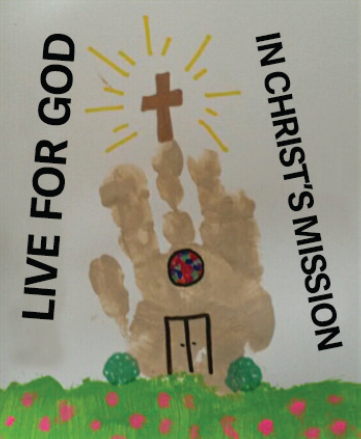
To make a church, paint the palm of one hand brown and place it fingers-together on the poster paper. Once the paint dries, add a door, windows, and a cross with markers as desired. Alternatively, you can print out the church template at the end of this lesson for children to color, cut out, and attach to poster.
Kotinda
The church is the body of Christ able to complete God’s mission here on Earth. Jesus came to show us how to be his disciples. If we strive to fulfill God’s purposes, we will realize God’s vision of shalom.
Have each student brainstorm something they can do this week to fulfill Jesus’ mission to Abolish Poverty and End Suffering (donate money during the Disciples’ Generous Response, offer to share your lunch with a classmate who has little or no food, step in if someone is being teased or bullied). Each can write and finish the following sentence under their church: “This week I will…”
Kopambola
Invite the children to state what they will do this week to fulfill Jesus’ mission. Offer a prayer thanking God for the blessings we are given and to help us share with others. Invite children to sing “Lord, Prepare Me” CCS 280. Think about what God’s mission for the church is and how we can fulfill that vision.
Room Charade
| Bedroom | Bathroom |
| Kitchen | School classroom |
| Gymnasium | Music room |
| School lunchroom | Church sanctuary |
Sample Mission Statements
(Coca-Cola)
- To refresh the world…
- To inspire moments of optimism and happiness…
- To create value and make a difference.
(Amazon)
Our vision is to be earth’s most customer-centric company; to build a place where people can come to find and discover anything they might want to buy online.
(Starbucks)
To inspire and nurture the human spirit—one person, one cup, and one neighborhood at a time.
(Walmart)
Saving people money so they can live better.
(McDonald’s)
To be our customer’s first choice when it comes to top quality products, outstanding service/cleanliness, and great value for money.
(IKEA)
To create a better everyday life for many people.
(Microsoft)
To empower every person and every organization on the planet to achieve more.
(Facebook)
To bring the world closer together.
(Google)
To organize the world’s information and make it universally accessible and useful.