
Worship Tools
Worship Outline
Additional Scripture
Psalm 118:1–2, 19–29 (A,B,C)
Worship Center
Plan for enough palm leaves for each participant and place the leaves in a basket or several baskets at the front or center of your worship gathering. Have several empty bowls or baskets ready for the Disciples’ Generous Response.
Prelude
Sharing and Caring
Gathering Song
“Come Away from Rush and Hurry” CCS 83
OR “Between Our Thoughts” CCS 163
OR “Let Us Pray for One Another” CCS 186
Welcome
Prayer for Peace
Light the peace candle
Prayer
Holy One,
We pray to you for peace as we make our preparations for Holy Week. We pray for the known and the unknown; for the malfunctions and for the successes we experience in our pursuit of peace. Help open our eyes to that day when riding on a simple animal through the streets of Jerusalem demonstrated love, hope, joy, and faith—even knowing that death would also be part of the journey. Help us to follow your path of peace and to make it our way also. Amen.
Scripture Reading: Mark 11:1–11
Song
“Filled with Excitement/Mantos y palmas” CCS 465
Encourage participants to sing in a language other than their own.
OR “Jesus, Remember Me” CCS 459
OR “No Tramp of Soldiers’ Marching Feet” CCS 466
Reading: Be a Joyful People!
Reader 1: We cannot tell you how long we have been waiting. We have carried the hope of our ancestors in our hearts for this exact moment of liberation. That is why we cannot stay silent in our praise, now that we catch a glimpse of this humble king riding through these streets on a donkey. These streets have seen our pain and struggle, but today they witness our hope and joy. It is this deep joy that inspires our proclamation:
People: Hosanna! Blessed is the one who comes in the name of the Lord!
Reader 1: Be faithful to the spirit of the Restoration, mindful that it is a spirit of adventure, openness, and searching. Walk proudly and with a quickened step. Be a joyful people. Laugh and play and sing, embodying the hope and freedom of the gospel.
People: Hosanna! Blessed is the one who comes in the name of the Lord!
—based on Mark 11:1–11
Receiving the Palms
Invite participants to come forward to receive palms from the worship center while singing a song of praise. Repeat the song as often as needed to complete the activity.
“Halle, Halle, Hallelujah” CCS 86
OR “Sanna, Sannanina” CCS 469
Sermon
Based on Mark 11:1–11
Song of Response
Sing again several times through as a response to the message.
“Halle, Halle, Hallelujah” CCS 86
OR “Sanna, Sannanina” CCS 469
Disciples’ Generous Response
Dramatic Reading
Three readers come forward with palms in hand.
Reader 1: Today I lay down this palm because it represents my hope for a better world. I yearn for a time when all people will experience equality, redemption, worth. I ache at the divisions between us and find hope as I await the Christ who humbly makes his entrance into our lives.
Lays down palm on the altar.
Reader 2: Today I lay down this palm for my children, because I believe in a future of hope. I anticipate the One who will pass by this place, carrying with him a vision shared through each generation for God’s shalom made real here and now. I pray my children will experience the promise of peace I commit to working toward.
Lays down palm on the altar.
Reader 3: Today I lay down this palm because it represents what needs to be released in me. I have held onto fear and despair for too long, and now I can hear the Spirit’s joy calling deep within. It is not a joy that promises the absence of pain and struggle, but a joy that empowers me to live a vision that is worth whatever cost may come.
Lays down palm on the altar.
Reader 1: As we prepare to enter Holy Week, for what do you lay down your palm?
Reader 2: As we sing together the next song, we invite you to prayerfully approach the altar and lay down your palm with whatever offerings you have brought this day.
Reader 3: May we prepare our hearts to be generous and open as we enter this week of suffering, sacrifice, and the promise of abundant life.
Blessing and Receiving of Local and Worldwide Mission Tithes
Offertory Song
Sing multiple times, prayerfully, in the spirit of Taizé as people bring
forward their palms and offerings.
“Jesu, Tawa Pano/Jesus, We Are Here” CCS 71
Encourage participants to sing in languages other than their own.
OR “Bless the Lord” CCS 575
Filled with Excitement
Read CCS 465, “Filled with Excitement/Mantos y palmas.” Invite participants to join in reading the last line of the refrain, “Hosanna! Hosanna to the King!”
Lenten Examen: Meeting Challenges in New Ways
Lent invites us to slow down, and pay attention, making room for transformation. The Examen is a simple prayer practice reviewing the day or week with God, noticing what brought life, what was difficult, and where we might meet the challenges of life in new ways.
We trust that the Spirit is present in our joys and our challenges.
I invite you to pause for a moment, and take a few deep breaths, turning your attention inward as I ask these reflective questions:
What are you grateful for today? Notice the people, moments, and gifts that brought you life.
Invite God to help you look back on your day or week with honesty, compassion, and curiosity.
What moments were difficult, challenging, uncomfortable, or unexpected? What did they stir in you?
Where did you experience love, connection, courage, peace, or hope? Where did you see the Spirit at work?
Where might you have responded differently? What new way of meeting a challenge might be possible?
Release what you need to let go of: hurt, regret, fear, or old patterns. Allow grace in and the possibility of beginning again.
Offer the day ahead to God. Ask for openness to new possibilities and courage to meet whatever comes with love, compassion, and hope.
Prayer
God of new possibilities,
Help us see our lives with compassion and honesty.
Show us where new ways of responding are possible.
Help us release what no longer gives life and open us to your peace.
Give us courage to meet tomorrow with love, hope, and imagination.
Amen.
We Prepare to Enter Holy Week
Song
“O Christ Who by a Cross” CCS 315
OR “All Glory, Laud, and Honor” CCS 467
OR “All Creatures of Our God and King” CCS 98
Encourage participants to sing in languages other than their own.
Closing Blessing
Invite someone to share a special prayer of blessing as we enter Holy Week.
Response
Sending Forth
Go in peace.
Postlude
Sacred Space: Small-Group Worship Outline
Gathering
Welcome
Prayer for Peace
Ring a bell or chime three times slowly.
Light the peace candle
Holy One, mysterious One, we have entered this quiet space in search of peace. Softness and safety surround us, almost enfold and cradle us. It is good to be in this place where our minds can be still, our breathing can slow, our spirits can be soothed. We need these moments. Within them we can open our deep places, our soul places, to you. And it is in you that we find the possibility of peace awakening and igniting our dreams once more.
We become weary, God. Weary of believing in the healing of all nations, weary of hoping for the reign of your compassionate justice in all lands. We become afraid of the violence and toxic hatreds that engulf the human family. We weep for the children, for the mothers and fathers of the children. We hope we will not have to hear another story of human life—beautiful, miraculous life—wasted frivolously as though it were of no value.
But the world outside these walls is a sea of such stories. And at times we feel we will drown in the tears of Earth’s peoples, your people, God.
Creator, we come with dissonance in our beings: a longing for the holy peace that would name all persons sacred and in which none would hurt or destroy in your holy mountain forevermore. And coexisting with this longing, a knowledge of brutality and suffering of such magnitude we cannot bear to understand the depth of its reality.
Meet us now, God, in this aching, yearning, empty space and break our hearts wide open. Connect us with both the suffering and the sacredness. For if you are the strand of grace between these realities, we shall be able to bear the anguish of the “not yet” as we live into the healed, holy creation of the “yet to be.”
Breathe your enlivening Spirit upon our weary frames. Wipe the tears from our eyes, lift the dark curtain from our minds, enflame our cold hearts with the bright joy of your love.
Speak peace, your peace into the silence of this moment, Creator. And we shall believe it in this moment and work for it in all the moments to come. In the name of your Son, Jesus, we pray. Amen.
—Carolyn Brock
Spiritual Practice
Dwelling in the Word
I will read a scripture aloud. As you hear the scripture, allow words, images, or phrases to come to mind. Try not to focus on them. Let them rest with you.
After a brief moment of silence I will read the scripture a second time. As you hear the scripture again, listen for how God’s Spirit is nudging you or catching your attention.
Read the scripture:
Blessed is the one who comes in the name of the Lord. We bless you from the house of the Lord.
The Lord is God, and he has given us light. Bind the festal procession with branches, up to the horns of the altar.
You are my God, and I will give thanks to you; you are my God, I will extol you.
O give thanks to the Lord, for he is good, for his steadfast love endures forever.
—Psalm 118:26–29 NRSV
Pause, and then read the scripture a second time:
Blessed is the one who comes in the name of the Lord. We bless you from the house of the Lord.
The Lord is God, and he has given us light. Bind the festal procession with branches, up to the horns of the altar.
You are my God, and I will give thanks to you; you are my God, I will extol you.
O give thanks to the Lord, for he is good, for his steadfast love endures forever.
—Psalm 118:26–29 NRSV
Questions
- As you listened to this scripture what words, phrases, or images came to mind?
- How have you experienced God’s steadfast love?
Sharing Around the Table
Mark 11:1–11 NRSVue
11 When they were approaching Jerusalem, at Bethphage and Bethany, near the Mount of Olives, he sent two of his disciples 2 and said to them, “Go into the village ahead of you, and immediately as you enter it you will find tied there a colt that has never been ridden; untie it and bring it. 3 If anyone says to you, ‘Why are you doing this?’ just say this: ‘The Lord needs it and will send it back here immediately.’ ” 4 They went away and found a colt tied near a door, outside in the street. As they were untying it, 5 some of the bystanders said to them, “What are you doing, untying the colt?” 6 They told them what Jesus had said, and they allowed them to take it. 7 Then they brought the colt to Jesus and threw their cloaks on it, and he sat on it. 8 Many people spread their cloaks on the road, and others spread leafy branches that they had cut in the fields. 9 Then those who went ahead and those who followed were shouting,
“Hosanna!
Blessed is the one who comes in the name of the Lord!
10 Blessed is the coming kingdom of our ancestor David!
Hosanna in the highest heaven!”
11 Then he entered Jerusalem and went into the temple, and when he had looked around at everything, as it was already late, he went out to Bethany with the twelve.
—Mark 11:1–11 NRSVue
Today’s passage is Mark’s account of Jesus’ arrival and entry into Jerusalem.
The people had varying expectations of the Messiah, and all were a threat to power. If the Messiah came as a warrior king, like David, it was a threat to the Roman authorities. If the Messiah were an ancient prophet, like Elijah, it threatened the power of the temple authorities to speak for God. If the Messiah were a great priest who would cleanse the religion and set new standards of righteousness, it threatened the temple authorities and Pharisees.
But Jesus rode the colt into Jerusalem to send a message of humility and peace. He did not ride a horse, symbol of war, privilege, and power. He gave the Romans no excuse to arrest him. He was displaying a peaceable kingdom, in solidarity with the weak and oppressed.
The disciples finally understood that Jesus was the Messiah, but things looked so different from their expectations. They put cloaks and fresh branches on the road, a custom reserved for royalty (2 Kings 9:13). They shouted, “Hosanna!” which meant “O save!” and was used to express hope for deliverance in battle. The people sought war, not peace—judgment, not grace. They announced the coming of the reign of David, not God.
Jesus presented the people with a choice. Would they support an alternate peaceable kingdom of God? Or would they reject his message of peace and transformation?
Questions
- When have your expectations of Jesus Christ been misplaced or unfulfilled?
- How can people today mirror the humility and peace Jesus intended for his entry into Jerusalem?
- Where do you see God working to bring about the kingdom?
Sending
Generosity Statement
“Sharing for the common good is the spirit of Zion” (Doctrine and Covenants 165:2f).
We receive God’s grace and generosity. The offering basket is available if you would like to support ongoing small-group ministries as part of your generous response.
This offering prayer is adapted from A Disciple’s Generous Response:
God of rejoicing, We share our gifts joyfully and with thanksgiving in response to the generous gifts you have given us. May the offerings we share bring joy, hope, love, and peace into the lives of others that they might experience your mercy and grace. Amen.
Invitation to Next Meeting
Closing Hymn
CCS 461, “Ah, Holy Jesus”
Closing Prayer
Optional Additions Depending on Group
Sacrament of the Lord’s Supper
For I received from the Lord what I also handed on to you, that the Lord Jesus on the night when he was betrayed took a loaf of bread, and when he had given thanks, he broke it and said, “This is my body that is for you. Do this in remembrance of me.” In the same way he took the cup also, after supper, saying, “This cup is the new covenant in my blood. Do this, as often as you drink it, in remembrance of me.” For as often as you eat this bread and drink the cup, you proclaim the Lord’s death until he comes.
—1 Corinthians 11:23–26 NRSV
Communion Statement
All are welcome at Christ’s table. The Lord’s Supper, or Communion, is a sacrament in which we remember the life, death, resurrection, and continuing presence of Jesus Christ. In Community of Christ, we also experience Communion as an opportunity to renew our baptismal covenant and to be formed as disciples who live Christ’s mission. Others may have different or added understandings within their faith traditions. We invite all who participate in the Lord’s Supper to do so in the love and peace of Jesus Christ.
We share in Communion as an expression of blessing, healing, peace, and community.
In preparation let’s sing from Community of Christ Sings (select one):
515 “In these Moments We Remember”
516 “Coming Together for Wine and for Bread”
521 “Let Us Break Bread Together”
525 “Small Is the Table”
528 “Eat This Bread”
Blessing and serving of bread and wine.
Thoughts for Children
Materials: ribbons 18–24 inches long (enough for everyone to have at least one)
Today is Palm Sunday. It is called Palm Sunday because waving palm leaves in the time of Jesus was a way to show excitement and to honor someone.
What are some ways we honor someone?
Encourage responses and give examples: Take a picture of them, clap when we see them, shout excitedly or sing, like at a birthday party.
Jesus was arriving in Jerusalem. He sent his disciples to bring a donkey so he could ride it into the city. Many people were excited to see him. They waved palms and laid their coats in front of him as a sign of honor. They shouted “Hosanna! Blessed is the One who comes in the name of the Lord!”
We can wave our ribbons like the people waved palm branches (hand out ribbons).
Let’s all shout “Hosanna!” three times and wave our ribbons: “Hosanna! Hosanna! Hosanna!”
Invite the children to keep their ribbon to remember that we honor Jesus and are excited to have him in our lives.
Sermon Helps
Exploring the Scripture
Peter’s acclamation of Jesus as the Messiah in Mark 8:29 is a turning point in his Gospel story. Two changes occur: (1) Jesus begins to tell his disciples about his coming death, and (2) he begins the journey to Jerusalem that ends in the crucifixion. Today’s passage is Mark’s account of Jesus’ arrival and entry into Jerusalem.
Zechariah 14:4 proclaims that on the day of the Lord, “his feet shall stand on the Mount of Olives.” Mark specifically mentions the Mount of Olives, framing the entry as a proclamation of the long-awaited day of the Lord. Jesus arranged in advance for his entry, with supporters unknown to the disciples. As in the rest of this Gospel, they were ignorant; but they obeyed Jesus’ instructions. Amid a threatening environment, Jesus had allies who prepared the colt and smoothed the way for his entry.
Jesus staged his arrival as a dramatic metaphor for the Messiah he would be. The people had varying expectations of the Messiah. None matched Jesus’ understanding, and all were a threat to power. If the Messiah came as a warrior king, like David, it was a threat to the Roman authorities. If the Messiah were an ancient prophet, like Elijah, it threatened the power of the temple authorities to speak for God. If the Messiah were a great priest, who would cleanse the religion and set new standards of righteousness, it threatened the temple authorities and Pharisees.
Jesus rode the colt into Jerusalem to send a message of humility and peace. He did not ride a horse, symbol of war, privilege, and power. He gave the Romans no excuse to arrest him. He was displaying a peaceable kingdom, in solidarity with the weak and oppressed. Only in this case, the leaders of Israel were the oppressors of their people, and they feared him.
The disciples finally understood that Jesus was the Messiah, but they didn’t know what that meant. Jesus’ proclamation of an inclusive, compassionate reign of God turned the hope of centuries into the today of fulfillment. But it looked so different from their expectations that they could not respond well to the reality. They put cloaks and fresh branches on the road, a custom reserved for royalty (2 Kings 9:13). They shout, “hosanna,” which meant “O save!” This shout of praise from Psalm 118:25–26, was used in royal processions to express hope for deliverance in battle. The people sought war, not peace—judgment, not grace. They announced the coming of the reign of David, not God. Silence was Jesus’ only response. His entry into Jerusalem was triumphant only in the eyes of his followers and the crowd.
Jesus presented the people with a choice. Would they support him in an alternate peaceable kingdom of God? Or would they reject his message of peace and transformation? For Jesus, the ride must have been disappointing.
Once inside the city, Jesus went directly to the temple and looked around. Unlike the account in Matthew and Luke, Jesus didn’t act against the commercial enterprises he saw that evening. He merely took note and returned to Bethany for the night. His actions on the following day came after a night of reflection.
Central Ideas
- Jesus’ growing popularity was seen as a threat among the religious figures of his day.
- Jesus staged his entry as a demonstration of humility and servanthood, not royal privilege and military might.
- The crowds expected a warrior king who would save them from oppression. They refused to accept the symbols he chose.
- His entry into Jerusalem was triumphal only in the eyes of the people. Quiet dignity characterized the hidden majesty of this silent king.
- We must go beyond “hosanna” and impulsive demonstrations to discern where God is at work in the world and then follow.
Questions for the Speaker
- When have your expectations of Jesus Christ been misplaced or unfulfilled?
- How can people and congregations best mirror the humility and peace Jesus intended for his entry into Jerusalem?
- Today is the day of action and fulfillment. How are you inclined to settle back into the comfort of “someday”?
- Where do you see God in the world working to bring about the kingdom?
Lessons
Adult Lesson
Focus Scripture Passage
Mark 11:1–11
Lesson Focus
Beyond Hosanna
Objectives
The learners will…
- discover deeper meaning of Jesus’ triumphal entry into Jerusalem.
- explore pathways of peace.
- take action to pursue peace
Supplies
- Bibles
- Community of Christ Sings (CCS)
Note to Teacher
In preparation for this lesson, read “Exploring the Scripture” for Mark 11:1–11 in Sermon & Class Helps, Year B: New Testament, pp. 57–58, available through Herald House.
Gather
Read or sing “O Christ Who by a Cross” CCS 315. Spend several minutes meditating on the words.
Open class with a prayer.
Engage
It was parade day. The end was nearing and Jesus had yet to become the Messiah people had expected or wanted. In fact, up until this point, according to Mark, Jesus continually cautioned disciples and others not to share publicly about the miracles they had seen and experienced.
Now, in full public view, Jesus prepared to ride into Jerusalem on the back of a young, never-before-ridden colt procured by the disciples as Jesus ordered. The donkey was the animal of choice for princes when they wished to signify peaceful intentions. Pilgrims traveling to the Passover walked. Jesus entering on the back of donkey symbolized a person of honor.
As Jesus entered, the gathered crowds spread cloaks and leafy branches on the roadway to reduce the dust as a sign of honor. They shouted:
“Hosanna!
Blessed is the one who comes in the name of the Lord!
Blessed is the coming kingdom of our ancestor David!
Hosanna in the highest heaven!”
The hope that Jesus would deliver them from Roman rule was evident.
As Jesus’ humble, peaceful procession entered from the east, a Roman procession entered from the west. Fully outfitted with horses and weapons, their position of control and oppression was clear. It was quite a contrast of parades: one proclaiming domination, the other simply but profoundly proclaiming the peaceful reign of God Jesus came not to conquer by rule or force, but to teach the ways of peace. In doing so, his very life was in jeopardy. His disciples and followers, excited this day, did not understand. By the end of the week, they would become discouraged and broken.
The shouts of “Hosanna” would recede into doubt and agony until God’s plan in Christ was fully revealed.
- What do we learn from the disciples or crowds who were part of Jesus’ entry to Jerusalem?
- Name an experience in which you have been disappointed in God’s answer.
- How do your current understandings limit your expectations of God?
Respond
Jesus’ purposely and carefully planned entrance into Jerusalem ushered in a new, radical understanding of God’s kingdom. This kingdom on earth would not be established by violent means, but would be characterized by sacrificial, unconditional love. Jesus’ way is the way of peace.
Community of Christ Basic Beliefs state:
Peace is God’s shalom: justice, righteousness, wholeness, and the well-being of the entire creation. Jesus, the Prince of Peace, came to preach the kingdom and to be our peace through the cross. The Holy Spirit empowers us for the costly pursuit of peace and justice for all people.
—Sharing in Community of Christ, 4th Edition, p. 38
- How is pursuit of peace and justice costly?
- For whom is it costly?
Doctrine and Covenants 163:2a and 3a–b
2a. Jesus Christ, the embodiment of God’s shalom, invites all people to come and receive divine peace in the midst of the difficult questions and struggles of life. Follow Christ in the way that leads to God’s peace and discover the blessings of all of the dimensions of salvation.
3a. You are called to create pathways in the world for peace in Christ to be relationally and culturally incarnate. The hope of Zion is realized when the vision of Christ is embodied in communities of generosity, justice, and peacefulness.
b. Above all else, strive to be faithful to Christ’s vision of the peaceable Kingdom of God on earth. Courageously challenge cultural, political, and religious trends that are contrary to the reconciling and restoring purposes of God. Pursue peace.
Discuss:
- How do we create pathways for peace?
- How can they be “culturally and relationally incarnate”?
- How do you identify “cultural, political, and religious trends” that are contrary to God’s purposes?
- How do you or your congregation challenge these trends?
Send
As you walk with Jesus this Holy Week, reflect on the Enduring Principle Pursuit of Peace (Shalom).
- God wants shalom (justice, reconciliation, well-being, wholeness, and peace) for all of creation.
- Jesus Christ, the embodiment of God’s shalom (peace), reveals the meaning of God’s peace in all aspects of life.
- The vision of Zion is to promote God’s reign on Earth, as proclaimed by Jesus Christ, through the leavening influence of just and peaceful communities.
- We courageously and generously share the peace of Jesus Christ with others.
- Led by the Holy Spirit, we work with God and others to restore peace (shalom) to creation.
- We celebrate God’s peace wherever it appears or is being pursued by people of good will.
—Sharing in Community of Christ, 4th Edition, p. 30
Identify one step you will take this week to build peace.
Bless
Pray together:
We will trust in the Holy Spirit that leads us to do good; to do justly, to walk humbly, and to judge righteously. Amen (Doctrine and Covenants 10:6).
Youth Lesson
Focus Scripture Passage
Mark 11:1–11
Lesson Focus
The triumphal entry of Jesus
Objectives
The learners will…
- participate in the spiritual practice of silence.
- hear the story of Jesus’s triumphal entry into Jerusalem.
- explore the peace of Jesus Christ.
Supplies
- Bibles
- Sharing in Community of Christ, 4th Edition, Herald House, 2018
- Paper and pens
- Chart paper or whiteboard
- Markers
Note to Teacher
In preparation for this lesson, read “Exploring the Scripture” for Mark 11:1–11 in Sermon & Class Helps, Year B: New Testament (with focus on the Gospel according to Mark), pp. 57–58, available through Herald House.
Gather
Today is Palm Sunday, the last Sunday of Lent. Lent is a season of repentance, self-examination, reflection, and preparation for the coming of Easter. In the early church, Lent was a time to prepare new converts for baptism. Today, Christians focus on deepening their relationship with God.
Today we will engage in the spiritual practice of silence. Practicing silence reminds us that relationship with God is a mutual act. In silence, we take the time to listen intently and be present with God without words. Often, our most profound spiritual experiences cannot be fully described with words. Intentional time in silence allows us to be fully present with God without the confines of language.
- Find a place free from noise or distractions.
- Practicing silence may be difficult at first. The mind may run wild, and centering in God’s presence could take some spiritual effort!
- Breathe deeply. Focusing on each breath in and out can help quiet the mind and center you in God’s Spirit.
- Become aware of your surroundings; notice how the air feels on your skin; trust that you are in the presence of the holy—fully surrounding and embracing you.
- Don’t expect that God will speak to you in a certain way. Just open yourself to what is. Allow your inner conversations to stop for a while, being fully present with the one who is fully present with you.
- After being silent for about five minutes, offer a prayer of gratitude for God’s constant presence whether you are fully aware of it or not. Pray that you may continue to draw closer to God and discover what God is saying and doing within you.
Discuss:
- How does it feel to be present with God in silence? Was this easy or difficult? Explain.
- In the silence, did you discover something new about yourself? Your relationship with God?
- How can this practice help deepen your discipleship?
Engage
As you read Mark 11:1–11, invite students to place themselves in the story paying attention to what they see, hear, smell, and feel.
- What details did you notice? What did you see, hear, smell, and feel?
- Did any details surprise you?
- Do any of the details differ from your memory of Palm Sunday dramas and services?
The Gospel of Mark tells the story of Jesus’s triumphal entry into Jerusalem in three parts:
- Obtaining the colt
- Approaching the city
- Visiting the temple
The first two parts involve symbolism from the Hebrew Scriptures (Old Testament). Zechariah 9:9 lays the framework for Jesus riding into the city on an unbroken colt, in which “Jerusalem is called to rejoice because its victorious king comes humble, and mounted on a donkey.” This connection provides a dramatic metaphor for the Messiah Jesus would be. But the people had different expectations of what a Messiah should be. Some expected a warrior king, like David, who would be a threat to the Roman Empire. Others expected the Messiah to be like Elijah or other ancient prophets, a threat to the temple authorities. Still others expected the Messiah to be like a great priest who would cleanse the religion and set new standards of righteousness, again posing a threat to the authorities of the temple and Pharisees. Being “near the Mount of Olives” also alludes to Zechariah 14:14 where it is proclaimed that on the day of the Lord “his feet shall stand on the Mount of Olives.” Mark is framing Jesus’s entry into Jerusalem as a proclamation of the long-awaited day of the Lord.
During the approach to the city, the second part of the story, again Mark uses Old Testament imagery with the crowd spreading cloaks on the road, a custom reserved for royalty, as in the 2 Kings account of Jehu ascending the throne. Jesus rode the colt into Jerusalem to send a message of humility and peace. As he rode by, the crowds chanted, “Hosanna,” which meant “O save,” expressing their hope for deliverance.
In the final part of this passage Jesus “went into the temple and when he had looked around at everything,” he went out to Bethany. In Mark, Jesus returns the next day to drive out the moneychangers. This differs from Matthew and Luke who have Jesus disrupt the temple the same day he arrives.
- What do you imagine Jesus was feeling as he rode the colt into the city?
- Compare and contrast people’s expectations for the Messiah.
- The disciples didn’t understand what Jesus meant by Messiah. Do you think Christians today understand Jesus as Messiah in the peaceable kingdom of God? Or do some still await a powerful political warrior king?
Respond
Read “We Share the Peace of Jesus Christ” and the scripture passages from Sharing in Community of Christ, 4th Edition, pp. 13–15.
- How would you describe the peace of Jesus to your friends?
- In what ways can you share the peace of Jesus Christ with someone else?
Send
We have spent the last six weeks on a journey though Lent, reflecting on scripture, participating in spiritual practices, and thinking about our lives as disciples of Jesus.
- How has this journey prepared you for Holy Week?
- How has Jesus entered your life in a new way?
- What is God’s invitation to you during Holy Week?
Bless
Close the class with a prayer.
Children’s Lesson
Focus Scripture Passage
Mark 11:1–11
Lesson Focus
Jesus entered Jerusalem humbly, portraying peace and compassion.
Objectives
The learners will…
- discover how our mannerisms and actions portray different expectations.
- discuss the meaning of the scripture story.
- define the term, Messiah.
- explore how we can pursue peace and act with compassion.
Supplies
- Scrap paper or random worksheets (see the Gather section)
- Bible (NRSV recommended) or Lectionary Story Bible, Year B, by Ralph Milton, illustrated by Margaret Kyle (Wood Lake Publishing, 2008, ISBN 9781551455648)
- Jesus and king pictures, (end of lesson)
- Small, sweet treats (like mini marshmallows) and ice cubes
- Paper for each student
- Green paint
- Optional: palm branch template (end of lesson)
- Markers or crayons
- Pens or pencils
- Community of Christ Sings (CCS)
- Optional: Community of Christ Sings Audio Recordings, available from Herald House
Notes to Teacher
In preparation for this lesson, read “Exploring the Scripture” for Mark 11:1–11 in Sermon & Class Helps, Year B: New Testament (with focus on the Gospel according to Mark), pp. 57–58, available through Herald House.
Gather
Greet children as they enter and instruct them to form a circle. Be direct and strict, but not rude or mean. “Hi, Tom! Sit here!” Continue to give gruff directions to the class for a minute or two. “Take out a pencil! Fill out this paper! Write your name and today’s date!”
- Do you notice anything different about how I am acting this morning?
Discuss how the children felt and how willing (or not) they were to follow your directions. Explain how it matters what words you use, how you present yourself, and how you speak to people.
Allow each of the children an opportunity to be a leader by playing a version of the game Simon Says. The person who is “it” can gruffly or directly instruct the rest of the class to perform a task (for example, jump on one foot, bend over and touch toes), but the class does not have to obey. When the person who is “it” instructs the class politely (for example, “Will you please jump on one foot?”) the class should follow those instructions.
Engage
Today’s scripture passage is about when Jesus entered Jerusalem and how he chose to present himself.
Read together Mark 11:1–11 or “Jesus Goes to Jerusalem” from the Lectionary Story Bible, Year B, p.95.
Jesus made specific choices how he entered the city of Jerusalem. He had been there before, so he was able to have a donkey ready and waiting for him. In ancient Palestine, donkeys were noble creatures. Jesus specifically chose a donkey. Kings rode horses into battle, but kings rode donkeys when they came in peace.
Display the pictures of Jesus on a donkey and a king on a camel (end of lesson).
- How would you describe the king? What is he ready to do? What message is he trying to convey?
- How would you describe Jesus? What is he ready to do? What message is he trying to convey?
- What are the differences between Jesus and the king?
Like we discussed earlier, the message is important. The crowds in Jerusalem gathered around Jesus as he entered. They were shouting “Hosanna!” which meant “O, Save.” They thought Jesus was coming to literally save them from their oppressors and to physically drive away the government and armies that were making their lives difficult. They hoped for war, not peace; they hoped their persecutors would find judgment and punishment, not grace and forgiveness. But they completely misunderstood Jesus (Sermon and Class Helps, p. 57).
- Have you heard Jesus described as the Messiah? What do you think that means?
The Messiah is the one chosen to save a world in need. But what does it mean to save the world? Does it mean to stop bad things from happening? (No.) The word shalom means fullness or completeness of peace. Jesus did not come as the Messiah to lead us into battle against our enemies. Jesus showed us how to live a life of shalom in community, to live God’s way instead of our own.
Respond
Invite the children to sing the campfire song “Alleluia, Praise Ye the Lord.” To make the song a friendly competition, form the class in two groups and have one group sing “Alleluia” and the other group sing “Praise Ye the Lord.” The idea is to get the children excited.
- Have you ever been to a parade?
- What was the parade celebrating?
- Describe the atmosphere and your feelings.
As we discussed, the people of Jerusalem celebrated Jesus’s entrance because they thought Jesus was going to lead the fight against those who threatened the Jewish people. But Jesus turned that expectation upside-down. Instead, God is full of love and compassion. “Because God created us (and saw that all was good), we can look for the good in others” (Of Water and Spirit, p. 33). “Understanding the basic goodness built into creation impacts how we treat one another and the world” (Of Water and Spirit, p. 29). If we remember this, we can treat everyone with the same love and compassion that God shows us.
Give each child a small, sweet treat to eat, like a mini marshmallow. Ask the children to describe how it tastes. Next, have each child place an ice cube in their mouth for as long as they can stand. Immediately after they remove the ice cube, give them another treat to eat. Again, ask them to describe how the treat tastes. Because their tongue is so cold, they won’t be able to taste the sweetness!
God created and God loves each one of us. All people are made good by God (like the treats were sweet). But sometimes we let our own thoughts and opinions get in the way of how we see other people (like the cold ice cube kept us from tasting the sweet treat). Jesus taught us to love others as God does. Doing this means adjusting our thoughts and opinions about other people (like removing the ice cubes). We seek to see people how God sees them (like the sweet treat before the ice).
“Because God created each of us…with great love and compassion, we can share that love and compassion with others. We can help create shalom” (Of Water and Spirit, p. 32). One of our Enduring Principles is the Pursuit of Peace. To pursue means to seek after—to set it as a goal. Our goal is to create peace on Earth. This is why Jesus’s entrance was humble rather than triumphant. “Jesus Christ taught us to live a life of peace and caring” (Of Water and Spirit, p. 33).
Palm Branch Craft
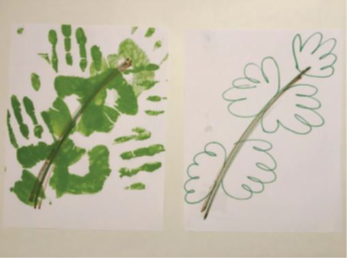
Give each child a piece of paper. To make a palm branch, draw a brown or green line (branch) on the paper. Paint the palm of one hand green and stamp it several times on either side of the branch overlapping the branch slightly. Alternatively, you can print out the palm branch template at the end of this lesson for children to color.
Send
The Good Samaritan is a story Jesus told to demonstrate true compassion. A man was attacked and left injured by the side of the road. A priest and a Levite both passed by the injured man without helping. But a Samaritan stopped to help the man get to a hotel and receive medical attention. The Samaritan and the injured man came from very different backgrounds, yet the Samaritan felt compassion for the man. He saw through God’s eyes that the injured man needed help, and he chose to act with love.
Have each student brainstorm someone or a group of people they have a hard time liking (someone who is different, a group of people who think or act differently, someone who is negative or who complains a lot). Remind them that Jesus taught us to “live together…and care about one another, despite [our] differences” (Of Water and Spirit, p. 32).
Each can write and complete the following sentence under their palm branch: “This week I will treat ______ with compassion and love.”
Bless
Gather and have the children say the name of someone they want to see through God’s eyes—as a beautiful part of creation. Offer a prayer of blessing for those who were mentioned.
Invite children to sing “Sanna, Sannanina” CCS 469, imagining they are in a crowd welcoming the Messiah. You can learn the tune and pronunciations using the Community of Christ Sings Audio Recordings, available from Herald House.