

Worship Tools
Worship Outline
Additional Scriptures
Psalm 106:1-6, 19-23; Matthew 22:1–14; Philippians 4:1–9
Prelude
Welcome
Call to Worship
Praise the Lord!
O give thanks to the Lord, for the Lord is good;
with steadfast love that endures forever.
Who can utter the mighty doings of the Lord,
or declare all praise?
Happy are those who observe justice,
who do righteousness at all times.
—Psalm 106:1–3, adapted
Prayer for Peace
Light the peace candle
Prayer
Holy One,
We pray for…
Deep peace of the running waves to you,
Deep peace of the flowing air to you,
Deep peace of the quiet earth to you,
Deep peace of the shining stars to you,
Deep peace of the shades of night to you.
Moon and stars always giving light to you.
Amen.
—Anonymous, Medieval Celtic Prayer
Hymn of Rejoicing
Prior to singing, discuss the text of the hymn of rejoicing you have chosen. Point out the recognizable parts of life in which children and adults can rejoice—the beauty of the Earth, the joy of human love, peace on Earth, every gift sent from above, every flower, each day the Spirit sends. Ask participants to focus on these joys as they sing.
“For the Beauty of the Earth” CCS 130
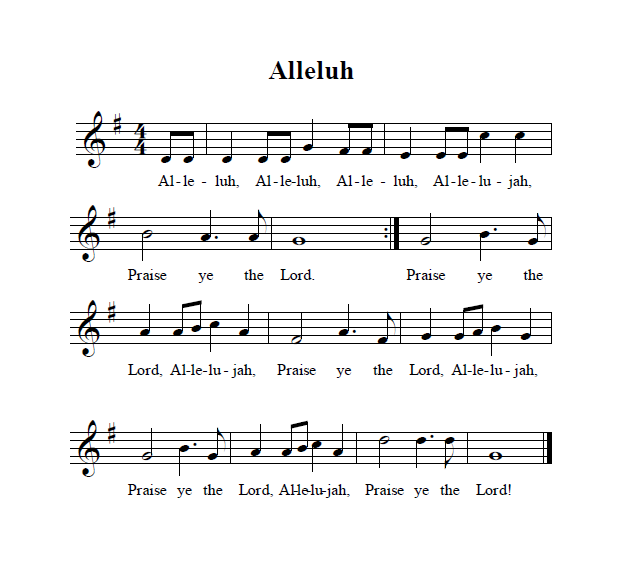
OR “Alleluh” see music after the service outline
OR “Of All the Spirit’s Gifts to Me” CCS 45
Invocation
God of all, you have called us here today for healing, hope, and transformation. As we listen to the scriptures, pray our prayers, sing our hymns, and hear the words of wisdom, we confess our impatience with life sometimes. Open our hearts to hear your claim on our lives; that we may fully and joyfully serve you. Amen.
Response
Scripture Reading: Exodus 32:1–14
Focus Moment
Statement
As we just heard in today’s scripture from the Old Testament book of Exodus, the Israelites were scared in the wilderness, without contact with their leader, Moses. Just when the Israelites needed their leader, Moses went up the mountain to be with God.
Leaders are necessary to help guide us as we each strive to follow God. Without a leader we might try to hide in a seemingly safe place, or we might think we are invincible. Leaders challenge the way things are and invite us to think about the way things could be.
Storybook
Read the book, Swimmy by Leo Lionni, Dragonfly Books; reissued in 1973, ISBN: 13: 9780394826202. This has been translated into various languages.
One day Swimmy finds himself alone after a bigger fish eats the rest of his school of fish. He swims and swims until he finds a school that looks just like his, only to find them scared to come out of the dark places. Swimmy challenges the fish on this plan and creates a new one. He offers a solution that allows the fish to feel safe as they come out of hiding. Swimmy shows his friends how—with ingenuity and teamwork—they can overcome any danger.
Follow-up:
- Share how you think Swimmy felt when he lost his brothers and sisters.
- Explain how the little fish scared the big fish? They swam together to make one big fish.
- Can the school of fish in this story be called a community? Why do you think that? Yes. They came together for the common good.
- How are we better together as a community than alone?
OR Personal Story
Invite someone to share a brief testimony about when, like the Israelites, they were lost and alone, either literally or figuratively, and what their solution was to the situation. Or ask someone to share a testimony of idolizing someone or something (movie or TV stars, athletes, sports teams, money, electronics) and how that affected their life.
Hymn of Petition
“Soften My Heart” Sing twice CCS 187
OR “Source and Sovereign, Rock and Cloud” CCS 4
OR “O Breath of Life” CCS 486
Morning Message
Based on Exodus 32:1–14
OR Share Stories of Waiting
Invite two people to share their stories of waiting. For example, waiting for a job, to adopt a child or start a family, to achieve a life goal, to be healed, and so on…
Ask one to share a story of waiting that has come to an end. Is that season of waiting now viewed with an awareness of positivity that came with the waiting?
Ask another person who is in a waiting season to share. Encourage the storyteller to be honest about the difficulties and rewards of waiting. It is often difficult to find hope during seasons of waiting.
Responsive Prayer of Confession
Leader: Gracious God, our ancestors sinned;
People: Lord, we too are guilty.
Leader: They made a calf at Horeb and worshiped a cast image.
People: Lord, we too are guilty.
Leader: They exchanged the glory of God for the image of an ox that eats grass.
People: Lord, we too are guilty.
Leader: They forgot God, who had done great things in Egypt, wondrous works in the land of Ham, and awesome deeds by the Red Sea.
People: Lord, we too are guilty.
ALL: Forgive us, Lord, we pray. Amen.
—Psalm 106:6, 19–22, adapted
Disciples’ Generous Response
Statement
Today we will focus on generosity. In the model called the Generosity Cycle, there are four phases: Invitation, Discovery, Response, and Reflection. It is an opportunity for us to create space for a spiritual discipline focused on generosity. It’s a time set aside to recognize the grace of God and to discover a deeper joy in discipleship through intentional whole-life stewardship.
We receive God’s gifts freely. We do not earn them through our faithful works. As disciples, we are called to share God’s gifts with others. Our giving blesses us and creates new relationships that offer more opportunities to share. And the cycle continues. Receiving and responding are equal and reciprocal actions that create an ongoing cycle—that’s what the Generosity Cycle will help frame for us.
May we take time to reflect on God’s generous gifts in our lives and how we respond as disciples to those blessings.
Blessing and Receiving of Local and Worldwide Mission Tithes
Hymn of Sending Forth
Encourage participants to sing in languages other than their own.
“Standing on the Promises” CCS 257
Translations into Spanish and French for this hymn can be found on Herald House.
OR “Sizohamba Naye/We Will Walk with God” sing several times CCS 377
OR “The Trees of the Field” CCS 645
Sending Forth: Doctrine and Covenants 162:3a–b
Postlude
Sacred Space: Small-Group Worship Outline
Gathering
Welcome
Ordinary Time is the period in the Christian calendar from Pentecost to Advent. This part of the Christian calendar is without major festivals or holy days. During Ordinary Time we focus on our discipleship as individuals and as a faith community.
Prayer for Peace
Ring a bell or chime three times slowly.
Light the peace candle.
O Lord, we pray for the power to be gentle, the strength to be forgiving, the patience to understand, and the endurance to accept the consequences of holding to what we believe to be right.
May we put our trust in the power of good to overcome evil and the power of love to overcome hatred. We pray for the vision to see, and the faith to believe, in a world emancipated from violence—a new world where fear shall no longer lead humans to commit injustice or selfishness that brings suffering to others.
Help us, Lord, to devote our whole life, and thoughts, and energy, to the task of making peace. Help us to pray always for the inspiration and the power to fulfill the destiny for which we and all beings were created. In the name of the God of Peace.
Amen.
Spiritual Practice
Holding in the Light
Read the following:
Our Enduring Principle focus this week is on Blessings of Community. We are taught to create communities of peace in our families, neighborhoods, congregations, nations, tribes, and
around the world. One spiritual practice that helps us feel connected to our communities is called Holding in the Light. It is a form of intercessory prayer/meditation adapted from the Quaker movement.
Share the following instructions:
We will stand in a circle. I will light the candle that I hold. The rest of you will hold your hands in front of you as if you are helping me hold the light.
Allow time for the group to get situated.
Look at the candlelight and become aware of your own breathing. Begin to center yourself with breath prayer. Breathe in the word love. Breathe out the word light. Repeat this three more times.
Call to mind names of those loved ones, communities, or countries you wish to pray for as we hold the light. You may name them aloud or hold them silently in your heart.
Pause to allow time for people to share names aloud as they desire.
Now imagine those you named being surrounded by light as bright as the candle. Continue breathing and meditating on the names of those you hold in the light in our circle.
After three minutes of silent meditation and holding in the light, share the following:
Offer a moment of gratitude for your loved ones, your communities, and this experience of holding in the light. Next time you see the light of a sunset or sunrise, may it remind you to pause and prayerfully hold someone you love in the light. Amen.
Sharing Around the Table
Exodus 32:1–14 NRSVue
When the people saw that Moses delayed to come down from the mountain, the people gathered around Aaron and said to him, “Come, make gods for us, who shall go before us; as for this Moses, the man who brought us up out of the land of Egypt, we do not know what has become of him.” Aaron said to them, “Take off the gold rings that are on the ears of your wives, your sons, and your daughters and bring them to me.” So all the people took off the gold rings from their ears and brought them to Aaron. He took these from them, formed them in a mold, and cast an image of a calf, and they said, “These are your gods, O Israel, who brought you up out of the land of Egypt!” When Aaron saw this, he built an altar before it, and Aaron made a proclamation and said, “Tomorrow shall be a festival to the Lord.” They rose early the next day and offered burnt offerings and brought sacrifices of well-being, and the people sat down to eat and drink and rose up to revel.
The Lord said to Moses, “Go down at once! Your people, whom you brought up out of the land of Egypt, have acted perversely; they have been quick to turn aside from the way that I commanded them; they have cast for themselves an image of a calf and have worshiped it and sacrificed to it and said, ‘These are your gods, O Israel, who brought you up out of the land of Egypt!’ ” The Lord said to Moses, “I have seen this people, how stiff-necked they are. Now let me alone so that my wrath may burn hot against them and I may consume them, and of you I will make a great nation.”
But Moses implored the Lord his God and said, “O Lord, why does your wrath burn hot against your people, whom you brought out of the land of Egypt with great power and with a mighty hand? Why should the Egyptians say, ‘It was with evil intent that he brought them out to kill them in the mountains and to consume them from the face of the earth’? Turn from your fierce wrath; change your mind and do not bring disaster on your people. Remember Abraham, Isaac, and Israel, your servants, how you swore to them by your own self, saying to them, ‘I will multiply your descendants like the stars of heaven, and all this land that I have promised I will give to your descendants, and they shall inherit it forever.’ ” And the Lord changed his mind about the disaster that he planned to bring on his people.
—Exodus 32:1–14 NRSVue
Today’s passage from the middle of the second part of Exodus (chapters 20–40) describes the covenant between God and the Israelites. The passage begins with the Israelites’ impatience as they wait for Moses to return from the mountaintop. In Moses’ absence, the people are restless and unsure about what is happening. They turn their attention to Aaron and ask him to “make gods for us.” Aaron responds by directing everyone to give him all of their gold to build an idol, a golden calf. The people then begin to credit the golden calf with their release from bondage. When Aaron hears their claims, he builds an altar, perhaps trying to redirect the Israelites’ focus to the Lord. For the rest of this passage God and Moses engage in an emotion-filled conversation. God is angry and frustrated with the people.
Several important principles can be drawn from this story. First, life as a disciple does not mean everything is going to be easy. Set free from bondage to follow God’s call, we must commit to the journey and remain faithful even during difficult times. Sometimes this means exercising much patience when circumstances do not unfold as we expect or when leaders are not available when we want their attention.
Second, fear and paranoia often cause communities to act in unfaithful ways. When times are tough, we must work individually and collectively to stay centered on God’s vision for the world. We must avoid building “golden calves.” Also, we are to support prayerfully those called and set apart to lead.
Third, when it is a person’s turn to lead, she or he needs to take seriously the responsibility to help keep people focused on Christ’s mission in the world. To do this, leaders must stay in constant conversation with God, praying for guidance and mercy.
Questions
- When have you experienced doubt and fear that caused you to want immediate answers?
- When have you had to exercise patience because circumstances were not unfolding in the way or timeframe in which you expected?
- What “golden calves” have you created as replacements for God in times of doubt and fear?
Sending
Generosity Statement
Faithful disciples respond to an increasing awareness of the abundant generosity of God by sharing according to the desires of their hearts; not by commandment or constraint.
—Doctrine and Covenants 163:9
The offering basket is available if you would like to support ongoing, small-group ministries as part of your generous response. This offering prayer is adapted from A Disciple’s Generous Response:
God of our discipleship,
As we navigate our world of debt and consumerism, help us to save wisely, spend responsibly, and give generously. In these ways may we prepare for the future and create a better tomorrow for our families, friends, the mission of Christ, and the world. Amen.
Invitation to Next Meeting
Closing Hymn
Community of Christ Sings 212, “God Weeps”
Closing Prayer
Optional Additions Depending on the Group
- Communion
- Thoughts for Children
Sacrament of the Lord’s Supper
Communion Scripture
Choose one scripture to read from this selection: 1 Corinthians 11:23–26; Matthew 26:17–30; Mark 14:12–26; Luke 22:7–39.
Invitation to Communion
All are welcome at Christ’s table. The Lord’s Supper, or Communion, is a sacrament in which we remember the life, death, resurrection, and continuing presence of Jesus Christ. In Community of Christ, we also experience Communion as an opportunity to renew our baptismal covenant and to be formed as disciples who live Christ’s mission. Others may have different or added understandings within their faith traditions. We invite all who participate in the Lord’s Supper to do so in the love and peace of Jesus Christ.
We share in Communion as an expression of blessing, healing, peace, and community. In preparation let’s sing from Community of Christ Sings (select one):
- 515, “In These Moments We Remember”
- 516, “Coming Together for Wine and for Bread”
- 521, “Let Us Break Bread Together”
- 525, “Small Is the Table”
- 528, “Eat This Bread”
Bless and serve bread and wine.
Thoughts for Children
Materials:
- Four sheets of paper with the numbers 1–4 written on them (one number per page)
- Tape
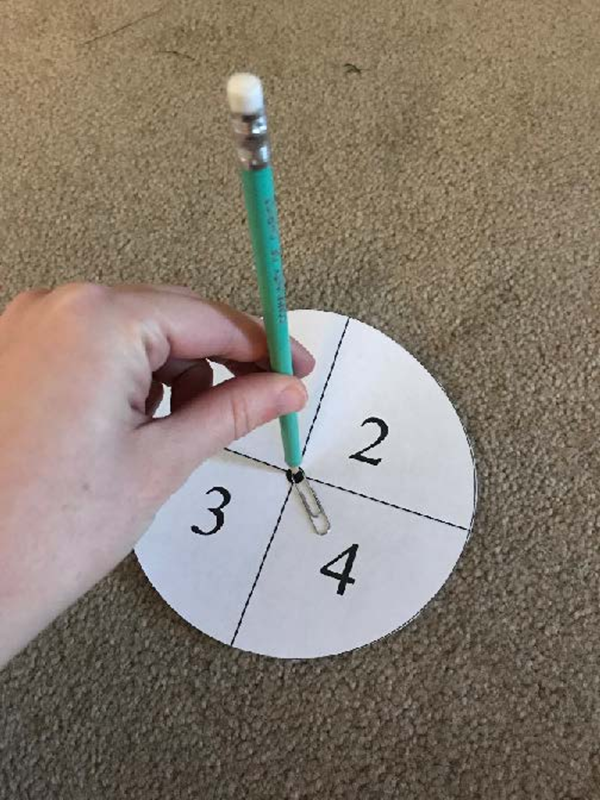
- Homemade spinner (paper clip, pencil, paper with four quadrants [image and instructions on next page])
Before your time together begins, tape the numbered pieces of paper in different corners of your meeting space.
Say: The Israelites were facing uncertainty as they traveled. At one point, Moses went up on a mountain to talk to God. When they realized they didn’t know when their leader would return, they panicked and disobeyed God. They abandoned God’s guidance for them. They lacked the faith to continue their journey with God when things got difficult.
The choice to remain focused on God is not always easy. Even when we struggle with faith, God is faithful to us.
We are going to play a game. For each round of play, you will try to guess which number the spinner will land on. The goal is to not be in the corner that has the same number as the spinner. You will move to a corner of the room that you think will be safe. I will allow a few seconds for movement and will count down to let you know when no further movement is allowed.
Allow kids to pick their first corner. Spin the homemade spinner and call out the number on which it lands. Anyone standing in that corner is out. Continue with more rounds until everyone is out of the game.
Ask: How did you decide where to move?
Affirm all answers.
Ask: Was there a way to be certain of your choice?
Allow time for responses.
Say: Sometimes it is difficult to be certain about matters of faith. One thing that can make things more clear is to learn spiritual practices that help us better understand God’s presence with us. There are many different spiritual practices. Today let’s practice the Chalice Prayer. Chalice means “cup.”
A Chalice Prayer
There are many stories in the news about people and places that suffer with violence and war. Often we know people who are sad, ill, or hurting.
Think of a place in need of peace or someone you know who is sad, lonely, or sick.
Form your hands into the shape of a bowl or cup.
Imagine holding those people in your hands. As you say a prayer hold your hands up to God. Your prayer might be: “Loving God, hold this person in your loving care. Amen.”Say to parents: Find more spiritual practices for children on All Things Are Spiritual.
Sermon Helps
Exploring the Scripture
Today’s passage is in the middle of the second part of Exodus (chapters 20–40) that describes the covenant between God and the Israelites. Christian and Jewish traditions credit Moses with writing the story of the exodus. The actual author is unknown.
This passage begins with the Israelites’ observation that Moses’ return from the mountaintop is delayed. Exodus 24:18 states that Moses was gone for 40 days and nights, but it is unclear when the people expected his return.
In Moses’ absence, the people are restless and unsure about what is happening. They turn their attention to Aaron and ask him to “make gods for us” (Exodus 32:1). Aaron directs everyone to collect all the gold in the group which he uses to build a golden calf (vv. 3–4). The people credit the golden calf with their release from bondage. When Aaron hears their claims, he builds an altar. Aaron might be trying to redirect the Israelites’ focus to the Lord (vv. 5–6).
In defense of the Israelites’ actions, some Bible commentaries argue the cow, or at least the altar, was to serve as a “seat” for God or a representation of God. Other commentaries argue the Israelites lacked faithfulness because they viewed the cow as a replacement for Moses and perhaps even God as the center of their devotion. Whatever the case, clearly God is not pleased (see v. 7) with what the Israelites have done and commands Moses to deal with the people. God also specifically names the people as Moses’ people not claiming them as God’s people.
For the rest of this passage (vv. 7–14), God and Moses engage in an emotion-filled conversation. God is angry and frustrated with the people. God calls their actions perverse and refers to “how stiff-necked they are” (v. 9). God’s final argument has eerie parallels to the story of the flood (Genesis 6–9) where God wipes out the wicked people and starts a new nation with Noah. Moses pleads for God’s mercy for the Israelites. He begs God to remember the promises already made by God to Abraham, Isaac, and Irael. In the end, Moses prevails, and God does not destroy the Israelites.
Several important principles can be drawn from this story. First, life as a disciple does not mean that everything is going to be easy. Set free from bondage to follow God’s call, we must commit to the journey and remain faithful even during difficult times. Sometimes this means exercising much patience when circumstances do not unfold as we expect or when leaders are not available when we want their attention.
Second, fear and paranoia often cause communities to act in unfaithful ways. When times are tough, we must work to individually and collectively stay centered on God’s vision for the world. We must avoid building “golden calves.” Also, we are to support prayerfully those called and set apart to lead. When we vote to support priesthood members and other leaders, it means prayerfully trusting them to be faithful leaders who will do their best to fulfill their callings.
Third, when it is a person’s turn to lead, she or he needs to take seriously the responsibility to help keep people focused on Christ’s mission in the world. To do this, leaders must stay in constant conversation with God, praying for guidance and mercy.
Central Ideas
- It is easy to forget whose you are when times are tough.
- It is easy to turn to alternative “gods,” such as the golden calf.
- It is easy to lose sight of the destination when a journey gets difficult.
- It is easy for leaders and people to lose their way if they do not remain centered on Christ’s mission.
Questions for the Speaker
- What is happening in your congregation right now that creates doubt and fear in people?
- What attitudes and behaviors do you see as people give in to their doubts and fears?
- What are potential “golden calves” being “worshiped” by you or your congregation?
- What words of encouragement and hope can you share to remind people they are God’s children and part of living Christ’s mission on Earth in the best and worst of times?
Lessons
Adult Lesson
Focus Scripture Passage
Exodus 32:1–14
Lesson Focus
Humans struggle at times to remain faithful to God.
Objectives
The learners will…
- explore different interpretations of the scripture passage.
- discuss what might be seen as taking us away from God.
- reflect on how to become right with God.
Resources
- Ancient Christian Commentary on Scripture—Old Testament III—Exodus, Leviticus, Numbers, Deuteronomy, Downers Grove, IL: InterVarsity Press, 2001, 139–142
- International Bible Commentary, Collegeville, MN: The Liturgical Press, 1998, 438–439
- Any lectionary commentary series for Year A, 2019–2020
Supplies
- Bible or copies of Exodus 32:1–14
- Board or flip chart; chalk or markers
- Small note cards or pieces of paper
- Pens or pencils
- Community of Christ Sings (CCS)
Notes to teacher
In preparation for this lesson, read “Exploring the Scripture” for Exodus 32:1–14 in Sermon & Class Helps, Year A: Old Testament, pp. 115–116, available through Herald House.
Gather
Picture the Israelites camped at the base of Mount Sinai, where they were still being fed manna each morning and quail each evening, where they were resting after an arduous and at times frightening journey toward a destination as yet unknown. What might they have been feeling? Exhaustion? Uncertainty? Impatience?
Now picture them with those feelings just biding their time waiting for Moses, the leader who has gotten them this far, missing in action. He is somewhere up on the mountain. But he’s been gone several days. Anything could have happened to him. Is he even alive? Has he abandoned them? Should they seek a new leader?
Consider the focus scripture passage with those questions in mind. Try to imagine yourself among the Israelites. What would you be thinking?
Engage
Distribute Bibles or copies of the focus scripture passage.
Ask for volunteers to read Exodus 32:1–14 as noted below.
People (all class members)
Aaron
The Lord
Moses
Narrator (everything not in quotes)
Some scholars believe that this narrative points to the people’s deep-seated assimilation into the Egyptian culture, which included the worship of gods. All along their wilderness journey the Lord God had been working with them to lead them into becoming a people of covenant with the one true God. But when times got tough and doubt and impatience set in, they reverted to the paganism they had left behind.
Write the following five points on a board or flip chart as you introduce them.
Christian commentary on scripture offers these ideas about this text:
- Self-indulgence leads to idolatry.
- God allows us the chance to intercede.
- Persistence in prayer is a good thing.
- The Spirit must be added to the letter of the law.
- Idolaters can be converted and become part of Christ’s body.
Discuss:
- Explore each of the statements above in relation to this scripture. What strikes you as a new way of interpreting the text? Why?
- Which of the statements from ancient Christian commentary connects with you personally? Why?
- What might be some of the “golden calves” in our current cultural climate?
Respond
Sometimes people in our faith community may feel a bit like the Israelites when it seems the church isn’t moving quickly enough to follow the counsel to pursue peace, justice, and reconciliation in the broader cultural context. Others feel the opposite: the church is moving too fast.
- Explore ways to discern where God is leading faithful followers.
- What are ways to deal positively with doubts, fears, and uncertainties that we as a faith community are moving too fast or too slow?
- When we fall prey to distancing ourselves from God, for whatever reason, how might we renew our covenant to be disciples?
Send
This scripture is often a focus during the Lenten season. It helps direct our thinking about how we have made choices that take us away from the God who yearns for a covenant relationship with each of us and leads us to repent (turn toward God).
Even now, in this lectionary season of Ordinary Time, this scripture can help us reorient to the Triune God and God’s ways and help us turn away from those things, such as self-made idols that consume our time and attention, that lead us away; in other words, to put into practice the Enduring Principle, Responsible Choices.
Distribute small note cards or sheets of paper and pens or pencils. Invite class members to write one thing that may be like an idol in their lives, consuming time and attention that could be redirected toward strengthening their covenant relationship with God. Encourage them to write how they plan to change.
Bless
Invite class members to repeat the following phrases from, “Lord, Lead Me by Your Spirit” CCS 209.
You’re ever true and faithful (pause for class to repeat it)
in meeting all my need. (pause)
I barely comprehend you; (pause)
I often am afraid. (pause)
Enable me to seek you (pause)
with all my heart and mind, (pause)
and to find the reassurance (pause)
in the mystery you are. (pause)
—Eric L. Selden, ©1980 Community of Christ
Youth Lesson
Focus Scripture Passage
Exodus 32:1–14
Lesson Focus
Stay focused on God’s vision for creation even in difficult times.
Objectives
The learners will…
- understand how the Israelites worshiped the golden calf because they wanted certainty.
- learn about how to discern God’s vision for creation.
Supplies
- Bible
- Community of Christ Sings (CCS)
- Yearning for God: Discernment and Spiritual Practice, available free of charge at HeraldHouse.org
- Chart paper and markers
- Homemade game spinner (see directions below)
- Supplies needed (if any) for selected spiritual practice
- Four sheets of paper with numbers 1–4 written (one number per page)
- Music and a way to play it
- Adhesive tape
Note to teacher
In preparation for this lesson, read “Exploring the Scripture” for Exodus 32:1–14 in Sermon & Class Helps, Year B: Old Testament, pp. 115–116, available through Herald House.
Gather
As students gather, present them with the scenario of a zombie apocalypse. Explain to them that the leaders of our country and of the world are nowhere to be found and they don’t know what they should do next. They decide they must leave their home and journey somewhere safer. Ask them collectively to create a list of things they will need for the journey.
- Why did you choose these things to bring along?
- Is there anything not tangible you’d need for the journey?
- Would you need God’s protection and guidance?
- Have you had a situation in your life where you didn’t know what to do and had to wait for God to respond?
The Israelites weren’t facing zombies, but they were facing uncertainty as they traveled to the Promised Land. At one point, Moses went up on a mountain to talk to God. When they were faced with uncertainty and didn’t know when their leader would return, they panicked and disobeyed God.
Engage
Read Exodus 32:1–14 and then discuss the following:
- What caused the Israelites to be concerned?
- Why was God angry with them?
- What could they have done instead of abandoning God’s vision for them?
- Do you think the Israelites would have been less concerned if they had been able to talk to God themselves? Why?
- Has there been a time in your life when you felt uncertainty and acted in a way contrary to God’s vision?
Explain that when the Israelites became uncertain, they abandoned God’s plan for them and reverted to previous understandings of the divine and how the divine interacts with the world. God was angry because they lacked the faith to continue when things got difficult.
Create a T chart. On one side of the chart ask students to share ways they currently cope with uncertainty. For example, when they are feeling overwhelmed, do they binge watch Netflix? Once you have enough examples on the first side go back through your list and come up with alternative responses to uncertainty that focus on God. For example, if they watch TV when they are worried about a big test, an alternative response could be to pray that God helps them find motivation and prepares their brain to receive the knowledge before starting to study. The choice to remain focused on God is not always easy or enjoyable. However, just as God was faithful to the Israelites God is faithful to us. We must remain faithful to God’s vision for our lives and for all of creation.
Respond
Tell students they are going to play a game of uncertainty. Tape the papers with the numbers 1-4 written on them in different corners of the room. For each round of play the students will try to guess on which of the numbers the spinner will land. The goal is to not be in the corner that has the same number as the spinner. Students will move to a corner of the room they think will be safe. Play music while they make their choices and stop the music to signify that their decision needs to be made and that no further movement is allowed. Spin the homemade spinner and call out the number on which it lands. Anyone standing in that corner is out. Continue with more rounds until everyone is out of the game.
- How did you decide where to move?
- Was there a way to be certain of your choice?
Explain that it is difficult to be certain of exactly where God is calling us to go. However, unlike the game, there are things we can do to better understand God’s vision and be prepared to respond correctly even when we aren’t certain.
- What are some ways we can be more in tune with God?
- Are there certain places you feel closer to God? How can you recreate those conditions in your daily life?
Send
Explain to the class that one way we can better understand God’s vision is to participate in spiritual practices. Just like sports and music practices help us be better at playing or singing, when we practice spiritually, we get better at being with God. There are many spiritual practices. Some practices will not work for every person. It is important to find a spiritual practice that works for you so you can deepen your relationship with God.
Introduce the class to a spiritual practice from Yearning for God: Discernment and Spiritual Practice. If supplies are needed for the chosen practice, make sure to provide them. Invite students to continue trying this practice throughout the week. Encourage them to turn to spiritual practices in the face of uncertainty in their lives and in the world.
Bless
Close by singing “Seek Ye First” CCS 599.

To make this spinner, cut out the circle. Place a paper clip on the dot at the center of the circle and place a pencil inside the paper clip on the same dot. Now, when you flick the paper clip, it will spin around the pencil and land on a number.
Children’s Lesson
Focus Scripture Passage
Exodus 32:1–14
Lesson Focus
Responsible disciples choose to follow and pray to God—even when the journey gets difficult—because nothing humankind can create is greater than the works of God.
Objectives
The learners will…
- create statues.
- participate in guided discussions about the scripture story.
- recognize the “idols” in their own lives and community.
- create a model of something that acts as a reminder to always turn to God.
Supplies
- Bible or Lectionary Story Bible, Year A, by Ralph Milton, illustrated by Margaret Kyle (Wood Lake Publishing, 2007, ISBN 9781551455471)
- Play-Doh or modeling Clay (enough for each student)
- “Idol objects”—items that represent different idols in the lives of your students (cell phone, video games, money, pictures of celebrities, athletes, and YouTubers, etc.). Keep items hidden in a bag until needed.
- Community of Christ Sings (CCS)
Notes to teacher
In preparation for this lesson, read “Exploring the Scripture” for Exodus 32:1–14 in Sermon & Class Helps, Year A: Old Testament, pp. 115–116, available through Herald House.
Gather
As the children enter, give each of them some Play-Doh or modeling clay. Set a timer for five minutes. Challenge the class to make the best statue they can within the five minutes. Explain that the class will vote on the best statue after the time is up.
Once the timer goes off, ask each child to display their statue so that everyone in the class can see. Allow some time for each child to explain their creation. Take a vote to determine which of the class statues is the best. Put that statue somewhere prominent where everyone can continue to see throughout class. All other statues should be smashed and placed back into the container.
Lead a quick discussion about the activity:
- What was difficult about making these statues?
- Point to the statue on display. What makes this statue the very best?
- Could someone else make a better one? How?
- Can anything we make with our own hands be better than what God can create?
Explain that after learning the Ten Commandments, the Israelites continued following Moses on their journey to the Promise Land. In today’s story, it doesn’t take them long to break one of those commandments by building a statue made of gold.
Engage
Begin reading excerpts below of Exodus 32:1–14, and from “The People Do a Bad Thing” on pages 218–219 in Lectionary Story Bible, Year A.
Read:
Moses often went up to the top of the mountain. He felt really close to God when he was up there.
It was hard being a leader for the people of Israel. The people walked through the hot desert every day. They shivered in the cold every night. They were tired and cranky.
Stop and ask:
- Do you ever need a break from being around people?
- Where do you go to be closer to God?
Continue reading:
“Why is Moses up on that mountain so often?” said the people.
“That is where he can talk to God,” said Aaron. Aaron was Moses’ brother.
“We never get to talk to God,” said the people. “We don’t really like that God Moses talks about. We want a god we can see. We want a god we can pray to.”
Stop and ask:
- Is it sometimes hard to believe in a God you cannot see?
- Do you have an image in your mind of what God looks like? What is the image?
Continue reading:
Aaron said to them, “Take off the gold rings that are on the ears of your wives, your sons, and your daughters, and bring them to me.” So all the people took off the gold rings from their ears, and brought them to Aaron. He took the gold from them, formed it in a mold, and cast an image of a calf; and they said, “These are your gods, O Israel, who brought you up out of the land of Egypt!” When Aaron saw this, he built an altar before it; and Aaron made proclamation and said, “Tomorrow shall be a festival to the Lord.” They rose early the next day, and offered burnt offerings and brought sacrifices of well-being; and the people sat down to eat and drink, and rose up to revel.
Stop and ask:
- Did anybody have a golden calf as their image of God?
- How do you think Moses is going to react?
- How do you think God is going to react?
- Refer to the Ten Commandments. Which one of the Ten Commandments are the Hebrew people breaking?
Continue reading:
The Lord said to Moses, “Go down at once! Your people, whom you brought up out of the land of Egypt, have acted perversely; they have been quick to turn aside from the way that I commanded them; they have cast for themselves an image of a calf, and have worshiped it and sacrificed to it, and said, ‘These are your gods, O Israel, who brought you up out of the land of Egypt!’” The Lord said to Moses, “I have seen this people, how stiff-necked they are. Now let me alone, so that my wrath may burn hot against them and I may consume them…”
Stop and ask:
- Have you ever thought God would be so angry at people that God would want to kill them?
- What made God so angry?
Continue reading:
“Please don’t!” said Moses. “If you do that, the people in Egypt will laugh. They will say that the people of Israel were not your special chosen people after all. ‘Their god got them out into the desert, and then their god burned them up!’ That’s what the Egyptians will say.”
“Well, okay,” said God. “But you get down there right now. Tell them to get rid of that golden calf!”
So Moses hurried down. “Aaron!” he yelled. “What is going on? Why are the people praying to a golden calf?”
Aaron looked very guilty. “I don’t know,” he said. “They just brought me all their gold. I didn’t know what to do with it. So I threw it into the fire. And out came this calf.”
Stop and ask:
- Did Aaron tell Moses the truth? Why not?
- Have you ever been too scared to tell the truth? Why were you afraid?
Continue reading:
Moses gathered all the people together. “Listen to me!” he said. “You did a bad thing. Because of that, I have ground up your calf into a powder. I have put that powder into the water you drink. That will make it taste bad. It will make you feel bad. That is your punishment.”
“Oh no!” said the people.
“Oh yes!” said Moses. “Now listen to me. Those of you who are sorry for what you did—those of you who want to pray to the real God—you go stand over there. Those who don’t want to pray to the real God—well, you can just go away. I don’t want to see you anymore!”
Stop and ask:
- What punishment did the people get for worshiping the golden calf?
- Would you want to follow the man who punished you or would you decide to leave?
- These people had been starving and thirsty in the desert, wandering around for a long time, and now they were being punished by having to drink water with gold powder in it. Was it easy for them to follow God? Is it easy for you to follow God?
Finish reading:
Some of the people were really angry at Moses. They liked praying and singing to the golden calf. So they just walked away.
Then Moses turned back to the people who hadn’t gone away. “Do you want to pray to the real God? Do you want to pray to the God who brought you out of Egypt? Do you want to pray to the God who gave you food and water in the desert? Do you?”
“Yes, we do!” the people all shouted. “Yes we do!”
“All right. Then right now I want you to pray. Tell God you are sorry for what you did. Then you must promise God not to do bad things again.”
And so the people of Israel were very quiet. They were all praying to God. “I’m sorry, God,” they said. “I will try very hard to live in your way.”
Ask:
- Describe a time you’ve had to ask someone to forgive you. Was it hard?
- Now that they’ve learned, do you think the Israelites will continue to sin?
Respond
Take the “idol objects” out of your bag and place them in the middle of the group. Allow time for the children to look at and talk about the different items. Challenge them to figure out what they all have in common. You may need to help guide their guesses by answering questions or giving hints.
Once they’ve figured out the answer (all the items represent things that people love or want to have). Explain that we may not want to build a calf out of gold, but there are many other things around us today that make us lose sight of God. An idol is something or someone we worship, greatly admire, or love so much that we no longer turn to God. If we aren’t careful, objects such as these can become idols; they can distract us from God.
Say: It is not always easy to be a disciple of Jesus. Sometimes when situations in our lives become difficult, we want to give up and turn to something we can see or use—like the idols on the table—rather than continuing to follow God.
Remove the Play-Doh or modeling clay statue from its location. Ask the class what happened when Moses came down from the mountain and found the Israelites worshiping the golden calf. (He ground it into dust and put it in their water.) Allow children—one at a time—to “smash” the statue. Explain that as responsible disciples, it is our job to make sure we don’t let idols such as the items on the table get in our way of turning to God. Remember: even though we may not be able to see God, all of God’s plans are greater than anything humankind can make.
Send
Ask the class to list several hardships the Hebrew people faced on their journey following Moses out of Egypt to the Promise Land. Emphasize that God never promised an easy journey; sometimes it was easier to complain or even walk away from God. But the true disciples persisted, always relying on God to provide.
Explain that today we may not have to wander through a desert running away from an Egyptian army, but we still face challenges. Ask the class to share some examples of challenges they face while trying to be faithful disciples. (If children are struggling, offer some examples such as: 1) Always telling the truth even though you know you’re going to get in trouble; 2) Listening to your parents and following directions the first time they ask you to clean your room; 3) Leaving your group of friends to join a lonely classmate at the lunch table.)
Continue explaining that Moses had to continually remind the Israelites to turn to God when their journey got tough. Pass out the Play-Doh or modeling clay so that every child gets a handful. Explain that instead of making idols or statues that distract us from God, this time make something that will remind you to turn to God. Some examples include a cross, praying hands, a dove, the Bible, etc. If there is time, allow the children to show and explain their creation.
These creations can be kept in the classroom to dry out over the next week. They can either be kept in the classroom or brought home as a daily reminder.
Bless
Once all the children have completed their creations, gather the class together to sing “I Have Decided to Follow Jesus” CCS 499.