

Worship Tools
Worship Outline 1
Additional Scriptures
Joshua 24:1-3a, 14-25; Psalm 78:1-7; 1 Thessalonians 4:13–18
Prelude and Meditation
With music playing quietly, project slides of the following scripture texts. Have the scriptures loop during the prelude. As an alternative, print the scriptures in the worship bulletin.
Proverbs 3:7, Proverbs 13:20, Matthew 25:1–2, Doctrine and Covenants 46:7a–b, f
Welcome
Call to Worship
Reader 1: Hear, O heavens, and give ear, O earth, and rejoice inhabitants, for the Lord is God, and beside whom there is no Savior; great is God’s wisdom; marvelous are God’s ways……
Reader 2: Give ear, O my people, to my teaching; incline your ears to the words of my mouth.
—based on Doctrine and Covenants 76:1; Psalm 78:1
Hymn of Praise
“Praise to the Living God” CCS 8
OR “Immortal, Invisible, God Only Wise” CCS 13
OR “Great and Marvelous Are Thy Works” CCS 118
Encourage participants to sing in languages other than their own.
Invocation
Response
Sharing of Joys and Concerns
Prayer of Intercession
Alert participants that there will be a pause in the prayer to enable them to name silently those who need God’s blessing.
Loving and Wise Creator, we have shared our joys and concerns with one another and with you. You have heard us name those who stand in need of wholeness. We seek your blessing of comfort, presence, and healing for those named and for others whose names will be lifted silently to you now.
Pause to give people a moment to add other names.
We trust in your compassion for your children and offer this prayer seeking your special blessing on their behalf. In the name of the One who healed many during his years of ministry, Jesus Christ, Amen.
Hymn of Confession
“Spirit, Open My Heart” CCS 564
OR “God! When Human Bonds Are Broken” CCS 236
Disciples’ Generous Response
Statement
Wise disciples choose to offer their first fruits to God. It might be through teaching to help disciples learn to serve, or it might be helping with a local food pantry to help Abolishing Poverty, End Suffering. Wise disciples recognize that first-fruits monetary giving also helps make mission real. How will you generously respond today?
Blessing and Receiving of Local and Worldwide Mission Tithes
Prayer for Peace
Light the peace candle
Scripture Reading
Now, revere the Lord and serve in sincerity and in faithfulness; …choose this day whom you will serve ….as for me and my household, we will serve the Lord.
—based on Joshua 24:14-15
Prayer
Holy One, we have too often substituted church busyness for doing justice and loving mercy. Grant us the courage to risk something new in becoming peacemakers. Amen.
Focus Moment: Matthew 25:1–13
Introduce today’s scripture with suggestions from Sermons4Kids
OR Read the story from a children’s story Bible
Music Ministry or Community Hymn
“Keep Your Lamps Trimmed” CCS 633
OR Campfire song: “Give Me Oil in My Lamp”
Sermon
Based on Matthew 25:1–13
Hymn of Commitment
Reprise “Keep Your Lamps Trimmed” CCS 633
OR “Church of Christ Now Poised Anew” CCS 373
Benediction
Response
Postlude
Worship Outline 2
Additional Scriptures
Joshua 24:1-3a, 14-25; Psalm 78:1-7; 1 Thessalonians 4:13–18
Preparation
Arrange various lamps, candles, and other light sources at the front of the worship space. Have at least one oil lamp displayed prominently. Distribute a tea light to each person as they enter or just after the Disciples’ Generous Response.
For the Disciples’ Generous Response distribute commitment cards and something with which to write as people enter the worship space.
Prelude
Gathering Songs
“Come Away from Rush and Hurry” CCS 83
OR “Come and Find the Quiet Center” CCS 151
Welcome
Sharing of joys and concerns of the community gathered.
Call to Worship
Listen. Listen to the words of my mouth.
I will speak parables and proverbs,
and the stories handed down from generation to generation.
We will not hide them from our children,
but tell all generations of the glorious deeds and might and wonders done by our God.
It is our story to share and our laws command that we teach our children,
that they, too, will know them so that they are able to share them with their children.
Then they, too, can set their hope in God and not forget the works of God and keep
God’s commandments.
—Psalm 78:1–7, adapted
Hymn of Preparing for the Lord
“Lord, Prepare Me” sing two or three times CCS 280
OR “Welcome, Jesus, You Are Welcome” CCS 277
Invocation
Response
Prayer for Peace
Light the peace candle
Hymn of Peace
“Come and Bring Light” choose a few stanzas that most relate to your context CCS 287
OR “Let Your Heart Be Broken” CCS 353
Prayer
Creator of All,
As we gather here today, we are spared from hearing gun fire, the fearful cries of children, or the wailing of death as is common in war-torn towns and cities. As we look around, we see the beauty of the day and the solid structure and protection our group offers. But, do we also see the inequality just outside our doors? Do we see the darkness experienced by those on the margins of society or the struggle of those who are different from what many define as “normal”?
May we pause to consider those living with the “smell” of poverty—whose skin and clothing are not clean, whose place of living is nearby to rotting garbage or sewage.
Even now as we’re praying, our minds may have already moved on to the next thing we’ll do or our next meal following this worship. Remind us, Lord, of your many children who lack adequate, nutritious food to eat and clean water to drink. Turn our hunger and thirst toward justice and peacemaking.
In our gratitude for time spent with our loved ones, may we hold space in our hearts for those who mourn for lost security, lost health, or lost opportunities for their loved ones.
While we are grateful for our many blessings, Lord, please help us understand that in the welfare of others our own welfare resides. Help us listen to the pleadings of our brothers and sisters. Turn our caring to action that provides safe space for people. Guide us to advocate for political change that honors each life. Lord, disrupt our comfort and make us brave that we might stand for others in the same way that Jesus stood for the marginalized and oppressed. This is our prayer, Lord. Amen.
Scripture Reading: Matthew 25:1–13
Ministry of Music or Community Theme Hymn
“Keep Your Lamps Trimmed” CCS 633
This is a high-energy spiritual. Consider adding percussion and handclaps.
Message
Based on Matthew 25:1-13
Disciples’ Generous Response
Scripture Reading: Doctrine and Covenants 165:2b
Statement
When we become aware that we’re the recipients of God’s amazing love and grace freely given with no strings attached, we want to share those gifts with others. Gratitude shows us the way to generosity.
When we understand God’s love and grace are given freely to us, it liberates us to share them freely in return. Our ability to be generous emerges from a spirit of thankfulness and not the burden of indebtedness.
God’s blessings transform us as we gain a deeper understanding of what God’s vision of shalom is and how we can help create it. We respond out of gratitude and not debt. When we respond out of gratitude, we understand that God’s blessings are freely given.
As disciples, we are called to share those freely given gifts with others.
Individually and collectively, we receive God’s blessings, and we, in turn, bless others. When we respond together, we give shape and form to God’s vision of shalom through faithful and generous living.
Commitment
You were given a card as you entered today. As we consider God’s gifts in our lives, let’s take a moment to fill out these cards with your personal intentions and commitments. They will not be shared with anyone. They are between you and God. We fill them out and place them in the offering baskets simply to show our thanksgiving to God for all we have received. It’s up to you how you reflect on and remember these commitments over the next year.
Allow two minutes to complete the cards.
Let’s offer our gratitude to God as we place our cards along with our offerings in the baskets or plates this morning. For those who give through e-Tithing, thank you for your ongoing, sustained support of mission.
Blessing and Receiving of Local and Worldwide Mission Tithes
Lighting Our Lamps in Preparation for the Lord
Distribute the tea light candles to each participant and form a circle around the perimeter of the room.
OR Ask people to stand and face the center of the room with their tea lights.
Statement
In our daily living, we commit to being prepared for the Lord. We light these candles as a symbol to remind us that without this preparation, our lights can go out.
Turn on tea light candles.
We commit to sharing our light with others.
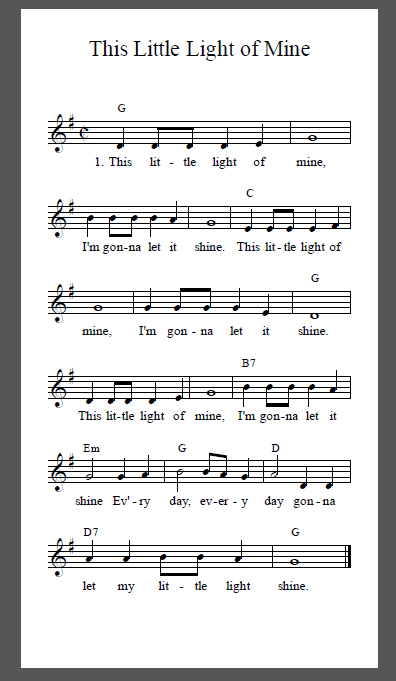
Song: “This Little Light of Mine” see below
Stanza 2: Hide it under a bushel? No! I’m gonna let it shine…
Stanza 3: All around my neighborhood, I’m gonna let it shine…
Stanza 4: Let it shine ‘til Jesus comes, I’m gonna let it shine…
Repeat Stanza 1.
Prayer of Blessing
Response
Postlude
Worship Outline 3
Additional Scriptures
Joshua 24:1-3a, 14-25; Psalm 78:1-7; 1 Thessalonians 4:13–18
On Your Mark
Prelude
Praise Music
“Now Sing to Our God” CCS 108
“I Will Sing, I Will Sing” repeat as desired CCS 112
Encourage participants to sing in languages other than their own.
Welcome
Call to Worship Responsive Reading
Leader: O, my people, how have you prepared?
People: We stand here in a holy place, fresh prayer on our lips, new songs in our hearts, contrite souls awaiting your grace.
Leader: Are you ready to meet me?
People: We have filled the lamps with oil; we have fed the hungry; we prepared enough and to spare, to seed and to share.
Leader: Have you let go of that which would separate us?
People: Yes, Lord, we are free of doubt, free of greed, We are in the place you would have us be.
Leader: Welcome home, my beloved.
Gathering Hymn
“Called to Gather as God’s People” CCS 79
OR “Meet Me in a Holy Place” CCS 162
Prayer of Presence
Response
Focus Moment: On Your Mark
see script following this worship outline
Get Set
Scripture Reading: Matthew 25:1-13
Ministry of Music OR Community Hymn
“Keep Your Lamps Trimmed” CCS 633
OR “We Wait in Hope for the Lord” CCS 267
Sermon
Based on Matthew 25:1–13
Reflection Music
Prayer for Peace
Light the peace candle
Prayer
God of Peace,
Teach us to live with hearts prepared for You, with faith that endures the wait and light that doesn’t go out. May we be among those who share peace through our words and actions. Let there be peace on earth. Amen.
Disciples’ Generous Response
Generosity Hymn: “I Am Standing Waiting” CCS 298
Scripture Reading
Now, revere the Lord and serve in sincerity and in faithfulness; …choose this day whom you will serve ….as for me and my household, we will serve the Lord.
—based on Joshua 24:14-15
Blessing and Receiving of Local and Worldwide Mission Tithes
Go!
Hymn
“Now Go in Joy” CCS 659
OR “Bring Forth the Kingdom” CCS 387
Benediction
Sending Out
Send us now forth, the practiced and ready
To find those in need and the burdens they bear.
Blessed by our calling, our mission, our purpose,
Send us now forth as disciples who care.
Postlude
On Your Mark
How many of you have been in a race? When the announcer says, “On your mark!” what does that mean? There is a starting line and sometimes lanes for those who race. The racers may not be on the course, but off to the side to mentally prepare or stretch their muscles for the burst of movement to come. When the announcement is made, the racers know they need to go get on their spot to begin. Many times this is an actual mark on the ground. “On your mark!” is a call to come join the race!
Once the racers are in place, the announcer says, “Get set!” This means they are to get into the starting position. For a sprint that means down in the “blocks” with their hands on the ground, ready to push off with a burst; or for a longer race the runners will put one foot at the line and bend down a bit—prepared—so no time is lost. Their attention is focused.
These two commands are to prepare the runner to be ready to race…to GO!
It is important for us to be ready, to prepare ourselves to do our best not only in the race, but also in life. What are some good ways to prepare ourselves to live at our best—to be all that God has purposed us to be?
Sacred Space: Small-Group Worship Outline
Gathering
Welcome
Ordinary Time is the period in the Christian calendar from Pentecost to Advent. This part of the Christian calendar is without major festivals or holy days. During Ordinary Time we focus on our discipleship as individuals and as a faith community.
Prayer for Peace
Ring a bell or chime three times slowly.
Light the peace candle.
O God of peace, we gather today to rest for a few moments in your peaceful presence. We are grateful for the opportunity to do so, and we pray that your Holy Spirit will attend to us as we focus our attention on these things that make for peace.
We know, O God, that you have made us for yourself, and for each other. We ask that we might have the courage and the wisdom to be present to the needs of others—that we might be willing to listen, and to share our concern with those who are in need. We ask that we might be compassionate people—that we might understand the needs of others deeply within ourselves.
For we know you have been compassionate with us through the sharing of your son, Jesus Christ, who came and lived among us as one who lived as we live and who felt as we feel. We know that he entered into human life fully, and he experienced our own lack of peace even as he brought to us the possibility of peace.
Throughout the world today, O God, there are many who need your peace. Through war, persecution, and famine, there are many who are in great need. We pray for them your blessing. There are others who are in need because of spite or broken relationships. We pray for them your healing. There are still others who are in despair because they sense their own incompleteness. We pray for them your wholeness.
As we gather together today in the peace and quietness of this moment, we are aware of the great needs throughout our world and within our own hearts. May our unease become an occasion for renewed commitment, and may your Holy Spirit call us to be agents of your peace. Teach us peace; bring us peace; make us agents of peace. In the name of your son, Jesus Christ, Amen.
—Bruce Lindgren
Spiritual Practice
Holding in the Light
Read the following:
Our Enduring Principle focus this week is on Blessings of Community. We are taught to create communities of peace in our families, neighborhoods, congregations, nations, tribes, and around the world. One spiritual practice that helps us feel connected to our communities is called holding in the light. It is a form of intercessory prayer/meditation adapted from the Quaker movement.
Share the following instructions:
We will stand in a circle. I will light the candle that I hold. The rest of you will hold your hands in front of you as if you are helping me hold the light.
Allow time for the group to get situated.
Look at the candlelight and become aware of your own breathing. Begin to center yourself with breath prayer. Breathe in the word love. Breathe out the word light. Repeat this three more times.
Call to mind names of those loved ones, communities, or countries you wish to pray for as we hold the light. You may name them aloud or hold them silently in your heart.
Pause to allow time for people to share names aloud as they desire.
Now imagine those you named being surrounded by light as bright as the candle. Continue breathing and meditating on the names of those you hold in the light in our circle.
After three minutes of silent meditation and holding in the light, share the following:
Offer a moment of gratitude for your loved ones, your communities, and this experience of holding in the light. Next time you see the light of a sunset or sunrise, may it remind you to pause and prayerfully hold someone you love in the light. Amen.
Sharing Around the Table
Matthew 25:1–13 NRSVue
“Then the kingdom of heaven will be like this. Ten young women took their lamps and went to meet the bridegroom. Five of them were foolish, and five were wise. When the foolish took their lamps, they took no oil with them, but the wise took flasks of oil with their lamps. As the bridegroom was delayed, all of them became drowsy and slept. But at midnight there was a shout, ‘Look! Here is the bridegroom! Come out to meet him.’ Then all those young women got up and trimmed their lamps. The foolish said to the wise, ‘Give us some of your oil, for our lamps are going out.’ But the wise replied, ‘No! there will not be enough for you and for us; you had better go to the dealers and buy some for yourselves.’ And while they went to buy it, the bridegroom came, and those who were ready went with him into the wedding banquet, and the door was shut. Later the other young women came also, saying, ‘Lord, lord, open to us.’ But he replied, ‘Truly I tell you, I do not know you.’ Keep awake, therefore, for you know neither the day nor the hour.
—Matthew 25:1–13 NRSVue
Who doesn’t love a good wedding? These days, there is usually plenty of time to prepare for the big event. From the “Save the Date” announcement to the carefully planned event, there are few surprises.
The community addressed in the Gospel of Matthew, was waiting for Christ’s promised return. The parable of the 10 bridesmaids reminded them that Jesus’ return might come unexpectedly. It was a call for Jesus’ followers to ready themselves, always living in expectation of Jesus “showing up.”
One way to understand the parable is that the bridegroom is Jesus, the bridesmaids are the church, and the oil symbolizes acts of love and mercy in our everyday lives. This is not something that can be borrowed from someone else (like the unprepared bridesmaids trying to borrow oil); rather our expectation is present through our own faithful response of loving and serving others. By preparing ourselves as humble servants, we can always be ready to offer the ministry and message of Jesus.
Questions
- When have you unexpectedly encountered Christ through an interaction with someone else?
- How has the mercy and compassion you received helped shape your life as a disciple?
- In what ways do you ready yourself to see the face of Jesus Christ in others?
Sending
Generosity Statement
Note: If you are using Thoughts for Children, now is a good time for the kids to share with the group their representations of God.
Faithful disciples respond to an increasing awareness of the abundant generosity of God by sharing according to the desires of their hearts; not by commandment or constraint.
—Doctrine and Covenants 163:9
The offering basket is available if you would like to support ongoing, small-group ministries as part of your generous response. This offering prayer is adapted from A Disciple’s Generous Response:
God of our discipleship,
As we navigate our world of debt and consumerism, help us to save wisely, spend responsibly, and give generously. In these ways may we prepare for the future and create a better tomorrow for our families, friends, the mission of Christ, and the world.
Amen.
Invitation to Next Meeting
Closing Hymn
Community of Christ Sings 633, “Keep Your Lamps Trimmed”
Closing Prayer
Optional Additions Depending on the Group
- Communion
- Thoughts for Children
Sacrament of the Lord’s Supper
Communion Scripture
Choose one scripture to read from this selection: 1 Corinthians 11:23–26; Matthew 26:17–30; Mark 14:12–26; Luke 22:7–39.
Invitation to Communion
All are welcome at Christ’s table. The Lord’s Supper, or Communion, is a sacrament in which we remember the life, death, resurrection, and continuing presence of Jesus Christ. In Community of Christ, we also experience Communion as an opportunity to renew our baptismal covenant and to be formed as disciples who live Christ’s mission. Others may have different or added understandings within their faith traditions. We invite all who participate in the Lord’s Supper to do so in the love and peace of Jesus Christ.
We share in Communion as an expression of blessing, healing, peace, and community. In preparation let’s sing from Community of Christ Sings (select one):
- 515, “In These Moments We Remember”
- 516, “Coming Together for Wine and for Bread”
- 521, “Let Us Break Bread Together”
- 525, “Small Is the Table”
- 528, “Eat This Bread”
Bless and serve bread and wine.
Thoughts for Children
Materials: play dough, clay, or model magic
Say: Our scripture story today reminds us that it is important to be ready to encounter Jesus on a daily basis. One way we can prepare is through spiritual practices. Just like going to sports or music practice is important for us to be able to play or perform better, spiritual practice is important because it helps us be more aware of where God is and what God is doing in the world around us. There are many spiritual practices and not every spiritual practice will work for everyone.
Today, we are going to try a spiritual practice using play dough.
Use your play dough to create something that expresses what you think God is like. Whatever that looks like or feels like to you. Can you represent God’s love? Can you make God’s peace?
Use your play dough. Create something that represents God to you. I hope you will be willing to share what you create with our group before our time together ends.
Before your small group finishes meeting, allow time for the kids to share with the group their representations of God.
Sermon Helps
Exploring the Scripture
Who doesn’t love a good wedding? Even during Jesus’ time, weddings were very special events. So special that even important leaders like scribes were allowed the day off to celebrate.
The parable Jesus shares in Matthew would have been a story familiar to people during this time, coming out of their own experiences with weddings. The parable begins with 10 bridesmaids who took lamps and went to meet the bridegroom. Their job was to escort him and the bride from her house to his house, where they would start their lives together. (You will note in your Bible that some ancient authorities add and the bride at the end of verse 1. The main text omitted it, perhaps to make a stronger symbolic point of Jesus being the bridegroom.) It was common for such processions to happen in the middle of the night. The bridesmaids did not know exactly when the couple would make the celebrated journey to their new home.
Half of the bridesmaids took lamps with no oil in them, which left them unprepared if the bridegroom should arrive during the night. The wise ones were prepared and brought along oil for their lamps. As everyone started to fall asleep—around midnight—the bridesmaids were alerted that the bridegroom was coming. Those without oil begged those with oil to share, but were told there would not be enough for everyone and those without oil should find a dealer to sell them some. While five went to search for oil, the bridegroom came and those who were prepared and waiting went with him to the wedding banquet. When the rest returned, Jesus did not recognize them, and cautioned them to keep awake “for you know neither the day nor the hour” (Matthew 25:13).
This is a parable with rather clear, undisputed symbolism. The bridegroom is Jesus; the bridesmaids represent the church. The bridegroom’s arrival is the Second Coming of Christ (also known in Greek as the Parousia). Having oil represents what will be most important at the Parousia, deeds of love and mercy (see Matthew 25:31–46). Jewish traditions used oil as a symbol for good deeds, as well as representing the Torah, so this, too, would have been a familiar symbol to early Jews.
To summarize the symbolic meaning of this parable, we could say the church is called to be prepared for Christ coming again through responsible acts of love and mercy. This is not something that can be borrowed from someone else (like the unprepared bridesmaids trying to borrow oil); rather it is our responsibility to respond, for we know not when we will see Jesus again. We are called to be prepared by loving God and loving our neighbor. This cannot be done at the last minute. Rather it forms who we are and shapes our faith and how we understand God’s kingdom. This is what it means to “be ready.”
When something is important to us, we prepare. Imagine you are going on a much-expected vacation. Do you get your bus or airline tickets the day of the trip? Do you pack your bag the morning you are going to leave? Do you not spend time thinking about what you are going to do, and what you need to take with you? No, you take time to prepare. Do we take time to prepare ourselves for the coming of God’s kingdom? When we respond to the call to serve others—to display acts of love and mercy—we are preparing our hearts and minds for the coming of the kingdom, to be able to see Christ again.
Central Ideas
- This parable of Jesus is rich with symbolism and uses an example with which Jews during Jesus’ time would have been familiar.
- We are called to be prepared for the coming of God’s kingdom.
- Preparation for the kingdom involves genuine acts of discipleship, which includes acts of love and mercy.
Questions for the Speaker
- Have you ever found yourself unprepared for an important event? What were the results?
- What does it mean for you or your congregation to “be ready”?
- Can you think of some acts of mercy and love that have prepared you on your journey? How have these acts shaped your life as a disciple and ability to see the face of Jesus Christ in others?
Lessons
Adult Lesson
Focus Scripture Passage
Matthew 25:1–13
Lesson Focus
Be prepared.
Objectives
The learners will…
- explore the symbolism in the parable.
- identify ways to prepare and fully live the identity, message, and mission of Jesus.
- reach beyond the comfort zone to where God is calling.
Supplies
- Bible
- Community of Christ Sings (CCS)
Notes to teacher
In preparation for this lesson, read “Exploring the Scripture” for Matthew 25:1–13 in Sermon & Class Helps, Year A: New Testament (with focus on the Gospel according to Matthew), pp. 116–117, available through Herald House.
Gather
Read aloud this scripture passage from Amos 5:18, 20–24.
18 Alas for you who desire the day of the LORD!
Why do you want the day of the LORD?
Is not the day of the LORD darkness, not light,
and gloom with no brightness in it?
I hate, I despise your festivals,
and I take no delight in your solemn assemblies.
Even though you offer me your burnt offerings and grain offerings,
I will not accept them;
and the offerings of well-being of your fatted animals
I will not look upon.
Take away from me the noise of your songs;
I will not listen to the melody of your harps.
But let justice roll down like waters,
and righteousness like an ever-flowing stream.
Discuss:
- What images captured your imagination?
Read a second time.
- What is the primary message you hear?
Offer a prayer for deeper understanding of today’s gospel passage from Matthew.
Engage
Just as in our day, weddings were special events in Jesus’s culture. To grasp the meaning of the scripture in Matthew, it’s helpful to understand wedding customs of that day. Parents of the bride entertained guests gathered at the bride’s home while awaiting the arrival of the bridegroom. As the bridegroom approached, bridesmaids and other guests lit torches and hurried outside to meet him. The entire party journeyed through the streets to the groom’s home. The ceremony and feast that followed continued for several days.
In this parable, for whatever reason, the groom does not show up when expected. As hours pass the bridesmaids fall asleep. A shout of “He is coming” awakens them at midnight. Ten bridesmaids jump up to light their lamps to meet him. Five are prepared with sufficient oil. With the delay in the arrival of the groom, five bridesmaids have run out of oil and have no reserves. By the time they rush about in the middle of the night to find oil, they miss the festivities at the groom’s home.
Previous chapters in Matthew taught principles of living as a follower of Christ. Now, Jesus begins speaking of preparing for end times. In this parable, Jesus is the bridegroom. Early disciples anticipated Jesus’s return to earth in their lifetime, but it did not happen. Even today Jesus has not physically returned. However, deeper insights help us relate this parable to our day and age.
The bridesmaids represent the church or followers of Christ. The oil that makes the lamps operational includes responsible acts of love, mercy, and justice required of all disciples. Remaining awake and alert requires constant preparation through study, prayer, and service. These are not things that can be “borrowed” by another who is less prepared. It takes whole-life discipline and discipleship.
Consider these questions:
- How does this parable disrupt our comfort zone?
- What does the parable say about waiting for Jesus’s return?
Respond
Community of Christ Basic Beliefs statement about the End Time states:
We press forward together in service to God, knowing that our labor is not in vain. The future of the creation belongs to the Prince of Peace, not to those who oppress, dominate, or destroy. As we anticipate that future, we devote ourselves to seek Christ’s peace and pursue it. We do not know the day or hour of Christ’s coming but know only that God is faithful. With faith in God, Christ, and the Holy Spirit, we face the future in hopeful longing, and with the prayer that Jesus taught us to pray: “Thy kingdom come! Thy will be done, on earth as it is in heaven.”
—Sharing in Community of Christ, 4th Edition, p. 38
Each time we bear each other’s burdens, work for justice, advocate for the poor or oppressed, reach out to the friendless, and extend mercy or work in any way to make the world a better place, we experience the living Christ.
It’s easy to become weary of well doing, frustrated by lack of visible change, disheartened by cruelties in the world around us, or distracted by the busyness of life. Always being prepared, having lamps filled with “oil and reserves” on hand can be daunting. At times, we all become a “foolish bridesmaid.” But in community, we lift each other up, provide encouragement, and gain renewed hope and strength to continue the journey.
Dietrich Bonhoeffer wrote, “We have learned a bit too late in the day that action springs not from thought but from a readiness for responsibility” (Letters and Papers from Prison [New York: Touchstone, 1953]).
- Share a time when you were unprepared for service. What/who helped you?
Send
Examine ways you and your congregation have “oil ready” and “lamps prepared” for service.
- Who is someone who would benefit from your help this week? Try to provide ministry to this person.
- Name ideas that are ready for action in your congregation. How can your lamp light the way for others to follow?
Bless
Offer this prayer:
You know the time; it is the hour now for you to awake from sleep. For our salvation is nearer now than when we first believed; the night is advanced, the day is at hand (Romans 13:11–12).
Lord, help us use our time wisely, recognizing today is the day we must make a difference in your world. Amen.
Youth Lesson
Focus Scripture Passage
Matthew 25:1–13
Lesson Focus
We prepare to be disciples of Jesus Christ.
Objectives
The learners will…
- respond to the call to prepare for Christ’s coming.
- understand the importance of being ready.
- discover qualities of a disciple.
- design a message that communicates what it means to be a disciple of Jesus.
Supplies
- Bible (NRSVue recommended and other versions to compare)
- Community of Christ Sings (CCS)
- Sharing in Community of Christ, 4th Edition, Herald House, 2018
- Chart paper (2 pieces), tape
- Markers
- Paper and pens
- Supplies for “Mission Possible”
Note to teacher
In preparation for this lesson, read “Exploring the Scripture” for Matthew 25:1–13 in Sermon & Class Helps, Year B: New Testament (with focus on the Gospel according to Matthew), pp. 116–117, available through Herald House.
Gather
Oops! I’m Not Ready!
Ask group members to share stories about when they’ve been late for an event or unprepared for an assignment or test.
When we get ready for a party, a game, or a test, we usually do certain things to prepare ourselves for what is about to happen. What do we do to prepare?
Engage
Ready or Not, Here I Come!
Read Matthew 25:1–13 from several Bible versions.
This passage is a parable, one of the stories told by Jesus to illustrate and teach a spiritual lesson. Consider these questions:
- What was the situation in this scripture?
- What was the job of the bridesmaids?
- Why did some bridesmaids go with the bridegroom and the bride to the banquet and others did not?
- What if the five bridesmaids who had enough oil shared their oil? What were the possibilities?
- Does this mean we shouldn’t share?
- What new understanding do you think each group of bridesmaids gained?
- To whom do you think Jesus was telling this story? (Jesus’s audience was Jewish. The disciples would be very familiar with the images and traditions in this story.)
- What was Jesus describing? Look to Matthew 24 to see why this parable was told.
- This parable is very symbolic. Whom does the bridegroom represent? (Jesus)
- Whom do the bridesmaids represent? (the church)
- What does the bridegroom’s coming represent? (the Second Coming of Christ)
- What does the oil symbolize? (deeds of love and mercy) (See Matthew 25:31–46. Jewish tradition used oil as a symbol of good deeds.)
- What do you think was Jesus’s lesson?
Respond
Time to Prepare
In the scripture story of the ten bridesmaids and the oil lamps, all the bridesmaids anticipated the bridegroom’s arrival and all brought their lamps. However, some anticipated the need to be more prepared. They were wise and brought extra oil with them. If they ran out of oil in the lamp, they at least had some to spare. Others were distracted by the excitement and did not consider what would happen if the bridegroom was late arriving. But because they had to go buy more oil, they missed the wedding feast. They could not understand why they were not allowed to enter because, after all, they had done what was expected of them. Their lack of preparation caused them to fall short of their goal. The lesson here is—good intentions don’t always get good results.
If we learn anything from the bridesmaids, it should be that even though we have a purpose or goal, we must take responsibility for our actions and be ready for anything that may come our way. We need to be wise with the use of our talents, time, and money. We need to prepare, learn, and study as much as possible so we can deal with any situation that may arise—even those we cannot foresee.
Brainstorm ideas and activities that we, as God’s people, need to do to be wise and be ready. Write the ideas on a chart. Have each group member select one item from the chart and create a plan they think would prepare a person for Christ’s mission. Share plans.
Send
Mission Possible
Select one or two of the plans created above and choose a method to communicate the need to prepare for Christ’s mission from the list below.
- Social media
- Television, radio, or newspaper advertisement
- Poster, pamphlet, or flyer
- Poem, short story, or lyric
- Motivational speaker, minister, or coach
Have paper, pens, markers, scriptures, art supplies, and additional items available for group members to use to create their message. Ask those who would like to share with the group to present their message. If group members would like to share their presentations with the congregation, check with the worship coordinator about using their products in future worship services.
Going Deeper: Discipleship
Being a Christian is more than holding a list of right ideas, it is about radical obedience to Jesus in every part of life. God’s boundless love sets us free for lives of responsible stewardship in which we generously offer our lives in service to God’s reign. Discipleship is both an inward and outward journey. Jesus calls us to follow him and to invite others to experience the transforming power of his grace.
—Sharing in Community of Christ, 4th Edition, p. 37
Matthew tells how one who is committed to serving must be prepared and live expectantly for each opportunity to serve. It is not a passive commitment, but an active one. Preparation consists of whatever it takes: study, prayer, fasting, and service. In the parable of the ten bridesmaids, the groom did not arrive at the expected time. Only those who prepared with extra oil were there to greet him.
- How would you persuade someone to become a disciple of Jesus Christ?
- Evaluate the significance of the parable of the ten bridesmaids and commitment of discipleship for today.
Bless
Be Wise, Be Ready
Read Doctrine and Covenants 162:7.
7a. There are many lives waiting to hear the redeeming words of the gospel, or to be lifted from hopelessness by the hands of loving servants. But they will be lost to you without the generous response of disciples who share from their own bounty that others may know the joys of the kingdom.
b. Many are fearful and believe their security is to be found in the accumulation of possessions. The answers you seek are not inherent in the things of this world but in a faith that places its trust in the promises given to all who would follow Jesus Christ.
c. You have been given the principles of generosity, rightly interpreted for a new time. These principles call every disciple to tithe faithfully in accordance with means and capacity. Those values, deeply rooted in the Restoration faith, affirm that stewardship and discipleship cannot be divided and are dependent upon each other.
d. The call to respond is urgent. Look to the needs of your own congregations, but look also beyond your walls to the far-flung places where the church must go. Each disciple needs a spiritual home. You are called to build that home and care for it, but also to share equally in the outreaching ministries of the church. In that way the gospel may be sent to other souls also yearning for a spiritual resting place.
Challenge group members to be wise, be ready, prepare their hearts and minds, and shape their lives as disciples of love and mercy. Sing “What Is the World Like” CCS 385 or “Jesu, Tawa Pano” CCS 71. Close with prayer.
Children’s Lesson
Focus Scripture Passage
Matthew 25:1–13
Lesson Focus
We are called to be prepared for the coming of God’s kingdom. Preparation for the kingdom involves genuine acts of discipleship, which include acts of love and mercy.
Objectives
The learners will…
- describe how to be prepared.
- understand that we are called to be prepared by loving God and loving our neighbor.
- explain ways to share acts of love with others.
Supplies
- Bible or Lectionary Story Bible, Year A, by Ralph Milton, illustrated by Margaret Kyle (Wood Lake Publishing, 2007, ISBN 9781551455471)
- Undecorated cookies
- Items needed to decorate cookies (frosting, sprinkles, plates, plastic knives, napkins, etc.)
- Paper
- Pencils
- Tablecloth and paper towels for cookie decorating
Notes to teacher
In preparation for this lesson, read “Exploring the Scripture” for Matthew 25:1–13 in Sermon & Class Helps, Year A: New Testament, pp. 116–117, available through Herald House.
Gather
Before class begins, make sure you have the decorating supplies out of sight.
Welcome children to the group and gather them in a circle. Let the children know that you are going to be having a cookie decorating party this week and would love their help to figure out exactly what you are going to need. Give each child a sheet of paper and a pencil and ask them to write a list of what you will need. Most children will write cookies, frosting, perhaps even sprinkles, but they might forget knives, plates, or napkins. Once everyone has completed their list, gather them up and thank the children for their help in making sure you were prepared for your cookie party.
Optional Activity:
Instead of cookies and decorating supplies, gather supplies for a different snack or possibly a craft project—anything that students would be familiar with.
Engage
Share with children that in today’s scripture passage Jesus told a story about being prepared for a wedding. Read “The Wedding Party” based on Matthew 25:1–13 from Lectionary Story Bible, Year A, pp. 236–237.
Ask:
- Have you ever found yourself unprepared for an important event? (If children are having a hard time with the question, you might suggest a couple of examples: school assignment, sporting event, or party.)
- What happened?
Let the children know that your cookie party is happening now! Return the preparation lists for the cookie party and have them take their lists to the table. Give each child the things that were on their list and nothing more. Allow them to start decorating the cookies. If someone doesn’t have something they need, they might want to borrow from someone else. Don’t allow that at this point. Smile and let them know that they can only use what is on their list.
Respond
After the students have had some time to decorate their cookies, pause the “party.” Gather them back in a circle and discuss these questions:
- Was there anyone who wasn’t quite prepared for the cookie party? How did that feel?
- What did you think when I said you couldn’t share supplies with one another?
- What do you think Jesus is teaching us in today’s parable?
Share with the children this statement adapted from Sermon & Class Helps, p. 116:
The church is called to be prepared for Christ coming again through responsible acts of love and mercy. This is not something that can be borrowed from someone else; rather it is our responsibility to respond, for we do not know when we will see Jesus again. We are called to be prepared by loving God and loving our neighbor. This cannot be done at the last minute. Rather it forms who we are and shapes our faith and how we understand God’s kingdom. This is what it means to “be ready.”
Ask: Has anyone ever experienced someone being mean to them, but as soon as an adult shows up, they turn nice? Or you asked someone to borrow a pencil and at first they say no, but when the teacher comes over, they say yes? What does last-minute help feel like?
Allow children to return to the tables and ask them how they could act out of love to take care of their neighbor and make sure everyone enjoys the cookie party. Help them generate ideas to make sure everyone has what they need to finish decorating their cookies. Once they are done, the children can eat their cookies. Encourage acts of love that also include cleaning up the party once it is finished.
Send
Discuss ways that the children could take acts of love into the congregation today. If there are additional cookies, perhaps they could prepare some to share with others. Whatever ideas they generate, encourage the children to do them as they leave class.
Bless
Sing this song to the tune of “Sarasponda” as your closing prayer. If you chose the optional activity, substitute “cookies” with the items you created.
These are cookies, these are cookies, these are cookies made with love.
These are cookies, these are cookies, these are cookies made with love.
We will share them, with people that we love.
Christ called on us to be prepared, and share our love with all.