

Worship Tools
Worship Outline 1
Additional Scriptures
Genesis 9:8–17, Psalm 25:1–10, 1 Peter 3:18–22
Preparation
Review the Focus Moment for the supplies needed.
Prelude
Call to Worship Responsive Reading
Voice 1: Hear, O my people of the church!
People: I am Jesus Christ of whom you have sung and testified and in whose name you pray.
Voice 2: I am the spirit of love and peace which is in the world and yet not known by the world.
Voice 3: I have heard your prayers which have been raised to me without ceasing, and I have sent my healing ministry as a dove to be in your midst.
People: Therefore, lift up your hearts and rejoice!
Voice 1: Rejoice in the promises which have been given for your assurance.
Voice 2: Have I not said it is the Creator’s good pleasure to give you the kingdom?
Voice 3: Hear, O my people of the church.
People: Lift up your hearts and rejoice!
—Doctrine and Covenants 157:11–12, adapted
Hymn of Rejoicing
“God Is Here!” CCS 70
OR “Bring Forth the Kingdom” CCS 387
OR “Redeemer of Israel” CCS 388
Encourage participants to sing in languages other than their own.
Prayer of Invocation
Response
Prayer for Peace
In silence, a person walks from the back of the sanctuary to the front carrying a small candle that will be used to light a larger peace candle, after which the small candle will be extinguished. The candlelighter moves into a physical attitude of prayer – kneeling with hands folded, standing with hands uplifted, whatever is visually effective and meaningful and comfortable, since the position will be held for several moments.
Prayer
While the candlelighter holds the prayer pose, a soloist or small group or community sings:
“O God of Love, Grant Us Your Peace” CCS 316
OR “Let There Be Peace on Earth” CCS 307
Encourage participants to sing in languages other than their own.
Responsive Meditation for Confession and Reconciliation
One Voice: O God, we know you are always near us,
People: …but sometimes we are too distracted to see you.
One Voice: O God, we know you are always near us,
People: …but sometimes we push you away and try to stand on our own.
One Voice: O God, we know you are always near us,
People: …but sometimes we harden our hearts and refuse to let you in.
One Voice: Forgive us, O God, for the times when we separate ourselves from you.
People: Help us open ourselves to your presence, so we may feel you near us always, and live at one with you. Amen.
Hymn
“Dios está aquí/God Is Here Today” repeat several times CCS 150
Encourage participants to sing in languages other than their own.
OR “Open My Heart” CCS 171
OR “Soften My Heart” repeat several times CCS 187
Focus Moment
Display a bowl of water and discuss whether water is powerful. Demonstrate how water can act on various things to change them—such as drop a hard (dry) sponge in the water and it becomes soft; pour water into a dish of sand and it makes a well, use water to wash a dirty item and it becomes clean, dip a paintbrush in water and dry watercolors become colorful paints. Finally, show a picture of the Grand Canyon or other natural feature created by erosion and discuss how, over time, water can cause huge changes in the world.
Read Mark 1:9–11 which tells about Jesus being baptized. Discuss how when people are baptized, the water doesn’t physically change them the way water changes a sponge or the Grand Canyon, but it changes the person inside because being baptized means making a commitment to follow Jesus. If we truly try to be like Jesus, the way we act and decisions we make change in a way other people can see. Briefly discuss ways following Jesus in our daily lives might create a visible change in us (for example, we are kinder, happier, or more helpful).
Proclaiming the Word
Based on Mark 1:9–15
Scripture and Song
Scripture Reading: 1 Peter 3:18–22
Song
“My Savior Said That I Should Be” stanza 1 CCS 589
OR “Beloved Community of God” stanza 1 CCS 588
OR “Make Me a Servant” CCS 597
Scripture Reading: Mosiah 9:35–42, adapted
After many days, a good number gathered together to the place of Mormon, to hear the words of Alma.
All were gathered together that believed on his word, to hear him.
And he taught them, and preached repentance, redemption, and faith on the Lord.
He said to them, Behold, the waters of Mormon.
And now, if you desire to come into the fold of God, and to be called a child of God, and are willing to bear one another’s burdens, that they may be light; and are willing to mourn with those that mourn; and comfort those that stand in need of comfort, and to stand as witnesses of God at all times, and in all things, and in all places, even until death, that you may be redeemed of God, and be numbered with those of the first resurrection, that you may have eternal life:
Now I say to you, If this is the desire of your hearts, what have you against being baptized in the name of the Lord, as a witness before God that you have entered into a covenant with him that you will serve him and keep his commandments, that he may pour out his Spirit more abundantly upon you?
And now when the people had heard these words, they clapped their hands for joy, and exclaimed, This is the desire of our hearts.
Song
“My Savior Said That I Should Be” stanza 3 CCS 589
OR “Beloved Community of God” stanza 3 CCS 588
OR “Make Me a Servant” CCS 597
Scripture Reading: Doctrine and Covenants 164:5
Song
“My Savior Said That I Should Be” stanza 5 CCS 589
OR “Beloved Community of God” stanza 5 CCS 588
OR “Make Me a Servant” CCS 597
Lenten Examen: Meeting Challenges in New Ways
Lent invites us to slow down, and pay attention, making room for transformation. The Examen is a simple prayer practice reviewing the day or week with God, noticing what brought life, what was difficult, and where we might meet the challenges of life in new ways.
We trust that the Spirit is present in our joys and our challenges.
I invite you to pause for a moment, and take a few deep breaths, turning your attention inward as I ask these reflective questions:
What are you grateful for today? Notice the people, moments, and gifts that brought you life.
Invite God to help you look back on your day or week with honesty, compassion, and curiosity.
What moments were difficult, challenging, uncomfortable, or unexpected? What did they stir in you?
Where did you experience love, connection, courage, peace, or hope? Where did you see the Spirit at work?
Where might you have responded differently? What new way of meeting a challenge might be possible?
Release what you need to let go of: hurt, regret, fear, or old patterns. Allow grace in and the possibility of beginning again.
Offer the day ahead to God. Ask for openness to new possibilities and courage to meet whatever comes with love, compassion, and hope.
Prayer
God of new possibilities,
Help us see our lives with compassion and honesty.
Show us where new ways of responding are possible.
Help us release what no longer gives life and open us to your peace.
Give us courage to meet tomorrow with love, hope, and imagination.
Amen.
Disciples’ Generous Response
Statement
In words of counsel shared with the church at the 2013 World Conference, we were challenged with these words: “Beloved Community of Christ, do not just speak and sing of Zion. Live, love, and share as Zion: those who strive to be visibly one in Christ, among whom there are no poor or oppressed.” This challenges us by defining Zion as a people—a people who strive to be visibly one in Christ; a people among whom there are no poor or oppressed. These words challenge us by calling us to be that people.
This morning, we have spoken and sung of Zion. Now we have an opportunity to share as Zion, by responding to this challenge as generous disciples. Our gifts to local and world ministries are one important way we can work toward becoming a people among whom there are no poor or oppressed—a people who live, love, and share Zion—a people of God’s kingdom.
Blessing and Receiving of Local and Worldwide Mission Tithes
Hymn
“Rain Down” CCS 260
OR “Come Now, Sound the Call of Zion” CCS 381
OR “To Be Your Presence” CCS 351
Benediction
Response
Postlude
Worship Outline 2
Additional Scriptures
Genesis 9:8–17, Psalm 25:1–10, 1 Peter 3:18–22
Invite People to Christ
Prelude
Lenten Welcome
In thinking about Lent it is helpful to consider the first point in Community of Christ’s statement on Christology “We Proclaim Jesus Christ”:
As members of Community of Christ, we are bound together with Christians in every place and in every time by our confession of Jesus Christ, Son of the Living God, author of our salvation, and head of the church.
—Sharing in Community of Christ, 4th Edition, Herald Publishing House, 2018, p. 58
This statement forms the foundation for our faith community’s observance of Lent, joining with other Christians who for many centuries have observed it as the 40 days between Ash Wednesday and Easter, not counting Sundays. This time interval is a means of moving from the anticipation and excitement of Advent and Christmas, through the heightened awareness of Jesus’ earthly life as the Light of the World during the season of Epiphany, to a focused review of Jesus’ life, death, and resurrection in the Lenten and Easter seasons.
During Lent, we are helped to center our attention on Jesus as we remember his life and ministry. Lent provides a means to also sharpen our focus on our own lives in relationship to Jesus. And the Lenten season encourages us to turn away from whatever distracts or blocks our commitment to discipleship. May the season of Lent help us walk with Jesus even though the path leads to the cross.
Praise Hymn
“God Is Here!” CCS 70
OR “Now Sing to Our God” CCS 108
OR “Oh, Sing to the Lord/Cantad al Señor” CCS 88
Encourage participants to sing in a language other than their own.
Invocation
Response
Jesus’s Baptism
As you listen to the scripture of Jesus’s baptism, reflect on your own baptism and confirmation. Who invited you to Christ? How can you invite others to Christ?
Scripture Reading of the Gospel Text: Mark 1:9–15
Spiritual Practice: Personal Reflection
Prayerfully consider the following statement. In light of today’s scripture from Mark, how does this statement help you enter the Lenten season?
Print or project the quoted paragraph.
Jesus was betrayed by his own friends, accused of blasphemy and treason, and sentenced by Pontius Pilate to die on a cross between two common criminals. By forgiving his murderers and choosing to take on the sin, pain, and suffering of the whole world, he reconciled all of humanity to God.
—Sharing in Community of Christ, 4th Edition, (Herald Publishing House, 2018), 59.
End the reflection time by sounding a chime or bell.
OR Lenten Examen: Meeting Challenges in New Ways
Lent invites us to slow down, and pay attention, making room for transformation. The Examen is a simple prayer practice reviewing the day or week with God, noticing what brought life, what was difficult, and where we might meet the challenges of life in new ways.
We trust that the Spirit is present in our joys and our challenges.
I invite you to pause for a moment, and take a few deep breaths, turning your attention inward as I ask these reflective questions:
What are you grateful for today? Notice the people, moments, and gifts that brought you life.
Invite God to help you look back on your day or week with honesty, compassion, and curiosity.
What moments were difficult, challenging, uncomfortable, or unexpected? What did they stir in you?
Where did you experience love, connection, courage, peace, or hope? Where did you see the Spirit at work?
Where might you have responded differently? What new way of meeting a challenge might be possible?
Release what you need to let go of: hurt, regret, fear, or old patterns. Allow grace in and the possibility of beginning again.
Offer the day ahead to God. Ask for openness to new possibilities and courage to meet whatever comes with love, compassion, and hope.
Prayer
God of new possibilities,
Help us see our lives with compassion and honesty.
Show us where new ways of responding are possible.
Help us release what no longer gives life and open us to your peace.
Give us courage to meet tomorrow with love, hope, and imagination.
Amen.
Pursue Peace on Earth
Ministry of Music OR Community Hymn
“The Lord Be with You” CCS 74
Arrange for two singers to sing “The Lord Be with You.” One person will sing the first phrase: “The Lord be with you,” followed by the second person singing the second phrase: “and also with you.” Both sing the remainder of the hymn in unison or parts.
OR Sing together as a community.
Passing the Peace
Following the hymn, invite participants to greet one another, speaking the two phrases from the hymn: “The Lord be with you” and the reply, “And also with you.” Draw participants back by sounding a chime or bell.
Prayer for Peace
Light the peace candle
Prayer
Read one of the following hymns as the prayer and end with an Amen.
“Gentle God, When We Are Driven” stanza 1 solo; stanzas 2–4 community CCS 222
OR “O God of Love, Grant Us Your Peace” CCS 316
Develop Disciples to Serve
Sermon
Based on Mark 1:9–15
Lenten Hymn
“Jesus, Tempted in the Desert” CCS 449
OR “O God We Call” sing three times CCS 195
Responsive Confession
Leader: To you, O Lord, I lift up my soul.
People: Lead me in your truth, and teach me.
Leader: Be mindful of your mercy, O Lord, and of your steadfast love.
ALL: For you are the God of my salvation.
—based on Psalm 25
Abolish Poverty, End Suffering
Disciples’ Generous Response
Scripture Reading: Genesis 9:8–9, 13
Statement
After reading the scripture, remind the group that the covenant was universal. It included all of creation, not just people. We can respond to God’s all-encompassing covenant by dedicating our time, talent, testimony, and treasure to help create God’s kingdom of love and peace here on Earth.
Blessing and Receiving of Local and Worldwide Mission Tithes
Experience Congregations in Mission
Hymn of Commitment
“Christ Has Called Us to New Visions” CCS 566
OR “My Savior Said That I Should Be” CCS 589
OR “God Forgave My Sin in Jesus’ Name” CCS 627
Encourage participants to sing in languages other than their own.
Benediction
Sending Forth: Doctrine and Covenants 158:11a
Postlude
Worship Outline 3
Additional Scriptures
Genesis 9:8-17; Psalm 25:1-10; 1 Peter 3:18-22
Preparation
Distribute paper and something to write with to each participant as they enter the worship space.
For the Focus Moment, find an empty backpack or shopping bag and several large, heavy stones, plus small paper bags, one for each participant, paper hearts and small candles or tealights.
Prelude
Welcome
Call to Worship
Leader: To you, O Lord, we lift our souls.
People: Our God, in you we trust.
Leader: Do not let us be put to shame.
People: Make us know your ways, O Lord.
Leader: Teach us your paths.
People: Lead us in your truth.
Leader: Be mindful of your mercy, O Lord.
People: According to your steadfast love remember us.
ALL: We come with open hearts and trust in your faithfulness.
—Psalm 25:1-10, adapted
Hymn of Praise
“Great Is Thy Faithfulness” CCS 11
Encourage participants to sing in languages other than their own.
OR “Blessed Be Your Name” CCS 252
Opening Prayer
Response
Lent Reflection
Statement
We are at the start of our Lenten journey with a focus on Jesus’s baptism and forty days of fasting in the wilderness. Lent is a time of journeying inward and going deeper as we prepare to live our lives in service to Christ’s mission. As you journey through Lent, consider how you will focus on Jesus Christ and the things of the spirit. What practices, habits or approaches will you include in your day-to-day life to ensure you are more in-tune with the spirit.
Lenten Ministry of Music OR Community Hymn
“When We Are Tested” CCS 453
“How Long, O God, How Long?” CCS 455
Prayer for Peace
Light the peace candle
Prayer
Dear God,
The Earth groans under the weight of violence and excess that is sapping your creation of vitality and humanity of hope. The Earth seems to chase after peace and fails to find it. May your church be prepared to respond to the need we see all around us.
May we take this period of Lent as a time to practice simple and gentle living as your son, Jesus Christ, did during his forty-day fast. May we prepare to go out in mission to serve all of your creation. God bless our efforts as we seek to build peace in our own hearts and mind and let that peace flow through the actions of our hands and feet in your world that you have created for all of us. In the name of Jesus Christ. Amen.
Scripture, Song, and Story
Lectionary Scripture Reading: Mark 1:9-12
Story through Song
“When Jesus Came to Jordan” CCS 442
OR “Jesus, Promise of an Angel” stanzas 1 and 2 CCS 32
Story
Ask someone to tell the story of their baptism.
Lectionary Scripture Reading: Mark 1:13-15
Story through Song
“Jesus, Tempted in the Desert” stanzas 1 and 4 CCS 449
“Lead Me, Lord” sing twice CCS 450
Story
Ask someone to tell a story of being tempted and feeling God’s presence and support.
Lent Reflection: Our Personal Fast
A traditional practice during Lent is to fast from something that we indulge in perhaps too much or something that makes us feel separated from God. Examples include: a specific food, TV time, impulse buying, and so on.
Let us consider fasting in a deeper sense. Lent is a period where we follow Jesus into the wilderness in preparation for our own ministry. To go on this journey inward, it’s important we shed those things that may distract us or cause us to focus on other things than our committed discipleship. Use the paper provided and consider these questions. What you write is for your eyes only; take it home with you as a reminder. Print or project the questions for all to see.
Question 1: What is something that you often feel distracted by in your life? Write a list of distractions that you might fast from during Lent. Choose a distraction from your list.
Allow a few minutes of silent reflection and writing.
Now that you have considered what to give up, there is now space to reengage our time and focus.
Question 2: How will you best use this opened space in your life? Write of what speaks to you as a way to deepen your Lenten journey.
Allow a few minutes of silent reflection and writing.
To end this time move to the next song.
Lenten Song
“Bless the Lord” CCS 575
OR “Into My Heart” CCS 573
Encourage participants to sing in languages other than their own.
Continue singing until everyone has returned their attention to the room.
Sermon
Based on Mark 1:9-15
Hymn of Opening Ourselves to the Journey
“Bless Now, O God, the Journey” CCS 559
OR “The Glory of These Forty Days” stanzas 1 and 4 CCS 451
OR “De noche iremos/By Night, We Hasten” repeat several times CCS 551
Encourage participants to sing in languages other than their own.
Focus Moment: What to Bring on the Journey?
If we’re going to go on a journey, we need to pack items to take along. Here, I have some heavy stones. Place the stones in backpack. It should be very heavy. Ask several to try to lift it.
Is it really easy or kind of hard to lift that pack?
Remove the stones and place a paper heart and a candle/tea light in the pack.
Now lift the pack. Easy or hard?
Sometimes we carry heavy stuff around inside us, like stones. Worry, anger, shame can weigh us down. During Lent we focus on removing these weights, just like we took the stones out of the backpack.
Distribute empty bags to each participant.
With the weights gone, we can repack with the love of God and the light of Jesus
Place a heart and candle/tea light in each bag.
Encourage participants to take the bag home with them as a reminder of unpacking the things that weigh us down, replacing them with love and light.
Lenten Examen: Meeting Challenges in New Ways
Lent invites us to slow down, and pay attention, making room for transformation. The Examen is a simple prayer practice reviewing the day or week with God, noticing what brought life, what was difficult, and where we might meet the challenges of life in new ways.
We trust that the Spirit is present in our joys and our challenges.
I invite you to pause for a moment, and take a few deep breaths, turning your attention inward as I ask these reflective questions:
What are you grateful for today? Notice the people, moments, and gifts that brought you life.
Invite God to help you look back on your day or week with honesty, compassion, and curiosity.
What moments were difficult, challenging, uncomfortable, or unexpected? What did they stir in you?
Where did you experience love, connection, courage, peace, or hope? Where did you see the Spirit at work?
Where might you have responded differently? What new way of meeting a challenge might be possible?
Release what you need to let go of: hurt, regret, fear, or old patterns. Allow grace in and the possibility of beginning again.
Offer the day ahead to God. Ask for openness to new possibilities and courage to meet whatever comes with love, compassion, and hope.
Prayer
God of new possibilities,
Help us see our lives with compassion and honesty.
Show us where new ways of responding are possible.
Help us release what no longer gives life and open us to your peace.
Give us courage to meet tomorrow with love, hope, and imagination.
Amen.
Disciples’ Generous Response
Statement
A common practice when fasting is to consider ways to be more generous with your resources to give to those in need. If you are fasting for Lent, consider ways you can donate the money you save. Whether it is coffee at your favorite coffee shop or something else. Consider ways you can use your treasure this fasting period to help make your community a better place for all to live.
Blessing and Receiving of Local and Worldwide Mission Tithes
Hymn of Pilgrimage
“Jesus Walked This Lonesome Valley” CCS 452
OR “There’s an Old, Old Path” CCS 244
Encourage participants to sing in languages other than their own.
Closing Prayer
Sending Forth
Put your trust in that Spirit which leads to do good, to do justly, to walk humbly, to judge righteously; this is my Spirit.
—Doctrine and Covenants 10:6, adapted
Go and walk with assurance that God’s loving Spirit is at your side.
Postlude
Sacred Space: Small-Group Worship Outline
Gathering
Welcome
Today is the first Sunday of Lent. We join with other Christians who for many centuries have observed it as the 40 days between Ash Wednesday and Easter, not counting Sundays.
During Lent, we are helped to center our attention on Jesus as we remember his life and ministry. Lent provides a means to also sharpen our focus on our own lives in relationship to Jesus. The Lenten season also encourages us to turn away from whatever distracts or blocks our commitment to discipleship.
May the season of Lent help us walk with Jesus even though the path leads to the cross.
Prayer for Peace
Ring bell or chime three times slowly.
Light Peace Candle
Loving Creator and Provider,
We praise you for your unconditional grace and generosity that extends to all inhabitants of the Earth, to every facet of your vast creation. We are aware of the great need for peace in so many countries including the country we each call our own. Be with all leaders in every land that they may make wise decisions as they confront the challenges of good governance. Increase their understanding so that they may realize the value of compromise and reconciliation rather than force and violence. May they fully comprehend your vision for all humankind and strive for peace among all nations.
In the name of your dear son Jesus Christ, we ask, Amen.
—Mildred Jordan
Spiritual Practice
Prayerfully consider the following statement in silent reflection (one minute):
Jesus was betrayed by his own friends, accused of blasphemy and treason, and sentenced by Pontius Pilate to die on a cross between two common criminals. By forgiving his murderers and choosing to take on the sin, pain, and suffering of the whole world, he reconciled all of humanity to God.
—Sharing in Community of Christ, 3rd ed.,
(Herald Publishing House, 2012, ISBN 9780830915736), 23.
End the reflection time by sounding a chime or bell.
Sharing Around the Table
Mark 1:9-15 NRSVue
9 In those days Jesus came from Nazareth of Galilee and was baptized by John in the Jordan. 10 And just as he was coming up out of the water, he saw the heavens torn apart and the Spirit descending like a dove upon him.11 And a voice came from the heavens, “You are my Son, the Beloved; with you I am well pleased.”
12 And the Spirit immediately drove him out into the wilderness. 13 He was in the wilderness forty days, tested by Satan, and he was with the wild beasts, and the angels waited on him.
14 Now after John was arrested, Jesus came to Galilee proclaiming the good news of God 15 and saying, “The time is fulfilled, and the kingdom of God has come near; repent, and believe in the good news.”
—Mark 1:9-15 NRSVue
Jesus came to John the Baptist to be baptized. As Jesus came out of the water the heavens tore apart and the Spirit descended on him. The Spirit confirmed God was present in that moment.
After his baptism, Jesus was taken into the wilderness where he was tempted for 40 days. Later John was arrested and then Jesus appeared in Galilee and proclaimed “the good news of God.”
People were yearning for “good news.” In this scripture we hear God in the form of Jesus proclaim to us the good news. The kingdom is near. This kingdom was something new where God is at work. The people were looking for good news and here it was.
It is time for us to share that the good news the kingdom of God can be a reality today. We live the good news when we engage in Christ’s mission. The reign of God is near when we invite people to a relationship with Christ, work to abolish poverty and end needless suffering, and pursue peace on Earth.
Questions
- Share how you have experienced the presence of the Holy Spirit.
- What expression of the kingdom of God are you beginning to see?
- What can you do to make the peaceable reign of God a reality in your neighborhood?
Sending
Generosity Statement
“Sharing for the common good is the spirit of Zion” (Doctrine and Covenants 165:2f).
We receive God’s grace and generosity. The offering basket is available if you would like to support ongoing small-group ministries as part of your generous response.
The offering prayer for Lent is adapted from A Disciple’s Generous Response:
Constant God, May we be dependable disciples. Your unconditional love for each of us is expressed through the life and ministry of Jesus Christ. May we faithfully respond to that ministry as we are accountable to one another, to you, and ourselves. Amen.
Invitation to Next Meeting
Closing Hymn
Community of Christ Sings 450, “Lead Me, Lord (Sing twice)
Closing Prayer
Optional Additions Depending on Group
Sacrament of the Lord’s Supper
Choose one scripture to read from this selection: 1 Corinthians 11:23–26; Matthew 26:17–30; Mark 14:12–26; Luke 22:7–39.
Invitation to Communion
All are welcome at Christ’s table. The Lord’s Supper, or Communion, is a sacrament in which we remember the life, death, resurrection, and continuing presence of Jesus Christ. In Community of Christ, we also experience Communion as an opportunity to renew our baptismal covenant and to be formed as disciples who live Christ’s mission. Others may have different or added understandings within their faith traditions. We invite all who participate in the Lord’s Supper to do so in the love and peace of Jesus Christ.
During this Lenten Season let us share in Communion as an expression of blessing, healing, peace, and community.
In preparation let’s sing from Community of Christ Sings 527, “Bread of the World.”
Blessing and serving of bread and wine.
Thoughts for Children
This activity will continue through the season of Lent.
You will need:
- Pencils
- Copy paper
- Coloring supplies
Throughout Lent, participants will build a piece of art that reflects their Lenten journey. Be prepared to collect the progressing artwork each week. Make certain to have extra pieces of artwork in various stages of completion for participants who miss a week or two.
Say: Today is the first Sunday in Lent. Lent is a time when we prepare for Easter by intentionally taking time to grow our relationship with God. We can deepen our relationship with God in many ways, but three are especially important: fasting, praying, and almsgiving. Over the next few weeks, we will talk about each of these in more detail.
This week, we are going to talk about fasting. When we fast, we give up something to create more room in our lives for God. Think about things that take up a lot of your time or attention. Maybe playing video games or eating sweets takes a lot of your focus. Write down a few things you could stop doing or that you could do less to create more time and space for God. Write these things all over your paper. You don’t have to completely remove these things from your life, but, you might want to consider how much of your time these things take up.
Once you have written these things down, begin to color over them using earth tones—greens, tans, and browns—until your entire paper is covered. Once it is covered, give your paper to me so we can use it next week.
This week, as you go about each day, intentionally look for times and places where you can create more space for God.
Sermon Helps
Exploring the Scripture
Is there any good news? We are desperate for some good news. What is the good news? We need to hear good news. The people in today’s story were desperate for good news. In 70 CE Galilee, radical Jews were revolting against the Roman oppressors. Jerusalem was under siege. People were stressed, caught between those who resented the intimidating, brutal oppressors and those who were homegrown terrorists. Probably the prices of basic life commodities were rising beyond the reach of ordinary people. Tensions were high and God was about to do something! According to Mark “In those days Jesus came…” (v. 19). The clear intent of God is about to be revealed.
Jesus came to John the Baptist to be baptized. As Jesus came out of the water the heavens tore apart and the Spirit descended on him. The Spirit confirmed God was present in that moment. Were these spectacular happenings in fulfillment of ancient prophetic events, or is this account based on what Mark wanted us to know about Jesus? Three times Mark dramatically tells us who Jesus is—the Son of God (vv. 1:11, 9:7, and 15:39). This is a key message of Mark’s Gospel. In the baptism of Jesus we see his obedience to God’s will and the suffering that will lead to the cross. What does it mean for us to understand Jesus is the Son of God and follow his example of obedience to God?
After his baptism, Jesus was taken into the wilderness where he was tempted for 40 days. Later John was arrested and then Jesus appeared in Galilee and proclaimed “the good news of God” (v. 14). Jesus, who has been declared the Son of God, is the good news.
Amid life’s struggles and the stresses they cause, God in the form of Jesus says to us there is good news. Life can be hard and people can think there is no hope. Now is the time for God to speak and act. “The time is fulfilled, and the kingdom of God has come near, repent, and believe in the good news” (v. 15). The kingdom is something new. It is a different way to live. People had heard of repentance for the remission of sins (John’s baptism). Here Jesus is saying the presence and reign of God is here. God is at work and you need to turn away from what you are doing and believe this reality. The people were looking for good news and here it was.
For us today, the peaceable reign of God can be a reality if we believe and work toward it. It can demand sacrifice (changing our priorities) from us, but the kingdom is calling. It is time to share the good news the kingdom of God can be a reality today. To make this happen we engage in Christ’s mission. How do you invite people to a relationship with Christ? How can we abolish poverty and end needless suffering? How can we pursue peace on Earth? How do we develop disciples to serve? How do we experience our congregations in mission? As we find answers to these questions and respond in Christ’s mission, the reign of God will be a reality. God is near.
Throughout the Gospel of Mark we are shown what it means to follow Jesus, the Son of God, the Messiah. It leads to suffering, death, and resurrection. It is not easy to follow Jesus but the goal is worth the cost.
Central Ideas
- Jesus is the Son of God. God’s beloved, whom we should follow.
- Jesus’ baptism experience confirmed his obedience to surrender his will to God.
- Now is the time to share the good news of the kingdom of God.
- We need to look at our priorities if the reign of God is to be reality.
Questions for the Speaker
- What is the setting of your neighborhood? What is the conversation you are drawn to hear?
- What actions will you take to declare Jesus is the Son of God?
- How will you invite people to baptism, which transforms people into disciples of Jesus?
- What expression of the kingdom of God are you beginning to see?
- What can you do to make the peaceable reign of God a reality in your neighborhood?
Lessons
Adult Lesson
Focus Scripture Passage
Mark 1:9–15
Lesson Focus
Covenant Relationship
Objectives
The learners will…
- begin the Lenten journey.
- explore Mark’s account of the beginnings of Jesus’ ministry.
- discuss how the peaceful reign of Christ can become a reality.
Supplies
- Bibles
- Community of Christ Sings (CCS)
Note to Teacher
In preparation for this lesson, read “Exploring the Scripture” for Mark 1:9–15 in Sermon & Class Helps, Year B: New Testament, pp. 48–49, available through Herald House.
Gather
Today is the first Sunday in the season of Lent. We journey with Christ in a 40-day fast to refocus and re-center our lives in God. It is a time to rethink life priorities and open ourselves to spiritual awakening.
Sing or read “The Glory of These Forty Days” CCS 451.
Share a “desert” moment experienced by ancestors in the faith or in your own life. How did God’s presence make a difference?
Engage
The world was in turmoil in 70 CE. The Jewish people were caught between Roman oppressors and Jewish terrorists. These tensions caused rising prices, fewer securities, and unsettledness. People were ready for good news, and God was about to do something radical!
Mark relates the beginning of Jesus’ ministry in a few concise, straightforward verses. Scene one is Jesus’ baptism in the Jordan River by John the Baptist. The Spirit descends as a dove declaring Jesus as the beloved Son of God. This is good news! God who once seemed so far away has drawn near. God’s heart has opened to love, becoming vulnerable to pain and loss in a visible way.
Immediately, the same Spirit that fell as a gentle dove drives Jesus into the wilderness with a different force. It is in the struggle of temptations that Jesus is prepared for the ministry before him. Forty days of hunger, pain, and personal desire versus the call of God mold him. Rather than rely on his own personal strength, he relies on God’s promises.
As the third scene unfolds, John has been imprisoned. His ministry is diminishing as Jesus’ ministry begins. Jesus proclaims, “The time is fulfilled, and the kingdom of God has come near; repent, and believe in the good news.” This proclamation invites the hearers to repent or turn around and see with new eyes God’s grace and love. It is time for the peaceful reign on earth to become a reality in the hearts and minds of believers.
- How is the faithfulness of Jesus in submitting to baptism and enduring temptations also a call to follow Jesus?
- Where are our wilderness places and how do we rely on God in those times?
- What might we desire in the next 40 days of our personal Lenten journey? What might we expect in the congregational Lenten journey?
Respond
God’s revelation in Jesus Christ and continuing presence through the Holy Spirit, as proclaimed by scripture, is the foundation of our faith, identity, mission, message, and beliefs.
Early in its history, the church, often referred to as the Restoration movement, perceived the call to share the fullness of the gospel throughout the world (Doctrine and Covenants 1:4) and to “seek to bring forth and establish the cause of Zion” (Doctrine and Covenants 6:3). Today, we understand this as the call to share the peace of Jesus Christ in all of its personal, interpersonal, community, and worldwide dimensions.
Sharing the peace of Jesus Christ involves generously and compassionately offering witness, ministry, sacraments, and community life that reconciles and restores people to right or righteous relationships with God, themselves, others, and creation. This holistic approach to proclaiming and demonstrating the gospel is faithful to our best understanding of God’s will. This approach is the fullest meaning of restoration.
—Sharing in Community of Christ, 4th Edition, pp.13–14
God calls us into relationship with the world. Mark’s Gospel theme is “Proclaiming the Good News.”
- How is God continuing to be present and restorative in the world today?
- What good news should we declare?
Send
Read Doctrine and Covenants 157:11, 12, 16–17.
11. Hear, O my people of the church, I am Jesus Christ of whom you have sung and testified and in whose name you pray. I am the spirit of love and peace which is in the world and yet not known by the world.
12. I have heard your prayers which have been raised to me without ceasing, and I have sent my healing ministry as a dove to be in your midst. Therefore, lift up your hearts and rejoice in the promises which have been given for your assurance. Have I not said it is the Father’s good pleasure to give you the kingdom?
16a. In the many places where you are called to labor, the forces of darkness and destruction are active indeed, and seem to hold sway. Your hearts are burdened by the magnitude of the tasks that are yours in bringing the light of my gospel into such darkness.
16b. Nevertheless, I have heard your prayers when you have cried out to me, and I have been with you in the places where you occupy. I am aware of your desires to serve me and my assurance is that as you go forth, your offerings of faith and service are acceptable to me.
17. In all your efforts, therefore, continue to trust in my grace and respond in love to the leadings of my Spirit. If you will come before me in unity and love I will bless you with a great outpouring of compassion, both for one another and for the world into which you are sent. Amen.
Discuss:
- Who is waiting in a wilderness in need of the peace of Jesus Christ?
- How will you respond?
- Consider beginning a Lenten journal to capture your experiences and insights.
Bless
Read Ephesians 2:14, 17.
For he [Jesus Christ] is our peace, in his flesh he made both groups into one, and has broken down the dividing wall, that is, the hostility… So he came and proclaimed peace to you who were far off and peace to those who were near…
Offer a closing prayer of enlightenment for opportunities to live or declare peace in your world.
Youth Lesson
Focus Scripture Passage
Mark 1:9–15
Lesson Focus
Jesus, in his total obedience to God, is baptized, and his identity as the Son of God is revealed. The Gospel of Mark declares that Jesus is the Son of God, the good news for the world.
Objectives
The learners will…
- identify key details of the story, including Jesus’s baptism, time in the wilderness, and proclamation of the kingdom of God.
- describe how in baptism we see Jesus’s obedience to God’s will and what this means for us as we follow Jesus’s example.
- share their understanding of the kingdom of God as a different way to live.
- evaluate how the Mission Initiatives help build the kingdom of God.
Supplies
- Bibles
- Paper (half sheets and small slips)
- Board or chart paper and markers
- A bowl
- Pens or pencils
- Sharing in Community of Christ, 4th Edition, Herald House, 2018
Note to Teacher
In preparation for this lesson, read “Exploring the Scripture” for Mark 1:9–15 in Sermon & Class Helps, Year B: New Testament (with focus on the Gospel according to Mark), pp. 48–49, available through Herald House.
Gather
Welcome students and give each one a half sheet of paper and a pen or pencil. Explain that today is the First Sunday in Lent, and you are interested in what they know about Lent. Allow two minutes for students to list or draw everything they know about Lent. You may choose to have students work in pairs. Invite each student to silently act out something on their list for the rest of the group to guess. Discuss the students’ responses, using the following information to guide discussion.
Lent is a season of 40 days, not counting Sundays, which begins on Ash Wednesday and ends on Holy Saturday. Lent comes from the Anglo-Saxon word lencten, which means “spring.” These 40 days represent the time Jesus spent in the wilderness, being tempted by Satan, and preparing to begin his ministry. Lent is a time of repentance, self-examination, reflection, and preparation for the coming of Easter. In the early church, Lent was a time to prepare new converts for baptism. Today, Christians focus on deepening their relationship with God.
We will spend a few moments of class during Lent to engage in spiritual practice. This week we will examine the practice of fasting. To fast is to empty oneself intentionally in a way that makes space for God. During Lent, fasting is for 40 days (minus Sundays) remembering Christ’s own fast in the wilderness. It is a time to focus on what matters most in your life as a disciple of Jesus.
On the back of their papers have students write or draw something from their everyday lives they would noticeably miss. This could be a food item, an electronic device, an activity, or something they buy daily or weekly. It could also be intentionally changing their daily routine. If they are willing to fast from this object, activity, or routine, they can also choose to replace it with an intentional act of kindness, generosity, or prayer.
- Have you ever practiced fasting? If so, what was your experience?
- In this season of Lent, what will you do in place of what you will give up?
- How might this practice benefit your spiritual life?
If you choose to fast during Lent this year, pay attention to what is going on within you. Intentionally reflect on your experience. Is your craving from what you have given up increasing or decreasing? What is the depth of your prayer life during this time? Are you feeling more focused?
Engage
Have a student read Mark 1:9–15.
Ask students to identify some important signs about Jesus in today’s scripture passage.
- What locations are named? (Nazareth, Galilee, Jordan)
- Why would Jesus have gone to John to be baptized? (to model repentance and baptism for others)
- How does the writer identify Jesus? (Son, Beloved)
- If you were present as Jesus was being “driven by the Spirit into the wilderness,” how would you respond?
- What does the passage reveal about Jesus’s commitment to God?
The author of the Gospel of Mark gets right to the point. There is no story of Jesus’s birth. There is no account of his childhood. Instead, the writer begins with the words:
The beginning of the good news of Jesus Christ, the Son of God.
As it is written in the prophet Isaiah,
“See, I am sending my messenger ahead of you,
who will prepare your way;
the voice of one crying out in the wilderness:
‘Prepare the way of the Lord,
make his paths straight.’”—Mark 1:1–3
The writer wants us to understand this messenger Isaiah describes is John the Baptist, who was first to encounter Jesus in this Gospel. Though Jesus and John spoke no words to each other in this scene, Jesus’s obedience in baptism dramatically underscores Mark’s message heard in the voice from the heavens, “You are my Son, the Beloved; with you I am well pleased.”
- What does it mean for us to understand Jesus is the Son of God?
- What does it mean to follow Jesus’s example of obedience to God?
In his obedience and continuing to trust and follow God, Jesus goes into the wilderness, turns from temptation, and lives peacefully with the wild beasts. Repeatedly the Gospel of Mark holds up Jesus as the Son of God, living fully as one with God.
- Form groups of two or three. Invite the students to imagine what it would be like if the account of Jesus going into the wilderness and being tempted was recorded today. Have each group create a modern-day scenario of this account. What would be the wilderness? What would be the temptations? How would Jesus respond? Share and discuss scenarios with the larger group.
Life can be hard at times. People can quickly lose hope in times of struggle. Today’s passage tells us a different story: “Jesus came to Galilee, proclaiming the good news of God and saying, ‘The time is fulfilled, and the kingdom of God has come near; repent, and believe in the good news.’” Jesus tells us God is here; God is at work! There is hope. There is a way forward when we follow him.
Jesus’s relationship with God is our example for creating our own covenant relationship with God.
Respond
Baptism is one of the most significant choices we can make. It affirms a life calling as a disciple and opens us to the many blessings of community, God’s grace, and Christ’s mission.
The good news of the kingdom of God can be a reality today when we make a covenant to live Christ’s mission. Explore “We Share a Mission,” Sharing in Community of Christ, 4th Edition, pp. 20–24.
Have each class member pick one question to answer about the five Mission Initiatives:
- How do you invite people to a relationship with Christ?
- How can you abolish poverty and end needless suffering?
- How can you pursue peace on and for the Earth?
- How can you help develop disciples to serve?
- In what ways can you experience congregations in mission?
Send
Explore with the group what it means to live as a disciple in the circumstances of life. Have the group write on slips of paper different scenarios that challenge them as disciples to make responsible choices. Put these slips of paper into a bowl to be drawn and discussed in groups of two or three, or with the full group.
Examples of scenarios:
- A group of friends is out for lunch and notice one of their classmates eating alone. How can you invite your classmate to feel included?
- You’ve noticed your family uses too much water and wastes food. What can you and your family do to uphold the Enduring Principle, Sacredness of Creation?
- You notice a friend is having a hard time with circumstances in life. As a disciple, how can you help your friend?
Optional activity: Have students write on slips of paper their concerns about making responsible choices. Place the slips in a bowl and have each student draw a slip of paper, which should not be their own. Invite them to pray for the person’s concern they have drawn, even if they do not know the name of the person.
Bless
Read the following prayer or invite one or more students to offer a closing prayer.
God, life at times is hard and sometimes even tragic, but you bring the good news. With you we work to bring peace and justice. We recognize our faults, yet know your kingdom is near when we live in covenant relationship with you.
Following Jesus is not a salvation scheme or a means for creating social order but is our calling to share the fate of your Son for the life of the world. We accept Christ’s invitation to follow him into personally bearing the mystery of human life, death, and resurrection. Lord, we agree to carry and love what you love, both good and bad, and to pay the price for reconciliation.
God, may we be the leaven, the salt, the remnant, the mustard seeds you can use to transform the world, remembering the cross is a dramatic image of what it takes to be such a usable people for God. Amen.
—based on the writings of Richard Rohr, https://cac.org/following-jesus-2016-07-27/
Children’s Lesson
Focus Scripture Passage
Mark 1:9–15
Lesson Focus
Jesus’s role was to show us how to live and bring about God’s shalom.
Objectives
The learners will…
- read about Jesus’s baptism.
- discuss shalom and God’s vision for creation.
- learn about covenant relationship with God.
- brainstorm ways to share the good news.
Supplies
- Bible (NRSV recommended) or Lectionary Story Bible, Year B, by Ralph Milton, illustrated by Margaret Kyle (Wood Lake Publishing, 2008, ISBN 9781551455648)
- Marker board, chalk board, or chart paper
- Colored construction paper or card stock, one for each child
- White paint
- (Optional) dove template, included with lesson, and glue
- Markers or crayons
- Pens or pencils
Notes to Teacher
In preparation for this lesson, read “Exploring the Scripture” for Mark 1:9–15 in Sermon & Class Helps, Year B: New Testament (with focus on the Gospel according to Mark), pp. 48–49, available through Herald House.
Gather
Greet children as they enter and have them form a circle. Sing “This Is the Day.”
Have children share good news in their lives.
- How do you feel when you hear or share good news?
- If you are having a bad day, how does hearing good news help?
Engage
The people in today’s story were desperate for good news. The story takes place in Galilee in the year 70. A group of Jews were revolting against the Romans (the government that ruled them). Jerusalem was surrounded by an army. People were stressed and caught between those who didn’t like the government and those who were trying to take control for themselves. More than likely the prices of food and essential items were rising because the city was surrounded. But God was about to do something!
Read together Mark 1:9–15 or “You Are Chosen” from the Lectionary Story Bible, Year B, pp. 78–79.
- Who is Jesus? (God’s son)
- What good news did Jesus bring? (God is here now. God has a plan.)
Jesus is saying that the kingdom of God is here. God’s kingdom is something new. The kingdom is not a place, but it is a different way to live (Sermon and Class Helps, p. 48). “Community of Christ understands that God’s vision for how we should live is captured in the word shalom. Shalom is a Hebrew word which means a fullness or completeness of peace. Jesus showed his disciples and others how to live a life of shalom in community. It involves living God’s way instead of our own way (Of Water and Spirit, pp. 29, 56).
- What does shalom look like to you?
On a board or chart paper write the words “Create Shalom.” Have the children create a description under the words.
Respond
It is hard to always do what is right or to know how to act, but we have Jesus as a model. God invites us to follow Jesus, which is to be in covenant relationship with God. Covenant is “when we are in a community that loves God and follows Jesus” (Of Water and Spirit, p. 58). One way we can respond to God’s invitation is to be baptized. When you are baptized you make a promise to follow Jesus.
Community of Christ believes that baptism is for those who are old enough (age 8 and older) to decide for themselves to make that covenant (Of Water and Spirit, p. 59). A priesthood member and the baptismal candidate stand together in water, and the priesthood member states the baptism prayer from Doctrine and Covenants 17:21c: “Having been commissioned of Jesus Christ, I baptize you in the name of the Father, and of the Son, and of the Holy Ghost, Amen.” The baptismal candidate is gently lowered completely under the water and then quickly raised back up. Today’s scripture passage tells the story of when John baptized Jesus.
- What symbol did God send after Jesus was baptized? (dove)
God is always with us, and we have Jesus as a guide to know how to act and what choices to make. A dove is also a symbol of God’s Spirit and of peace, or God’s shalom.
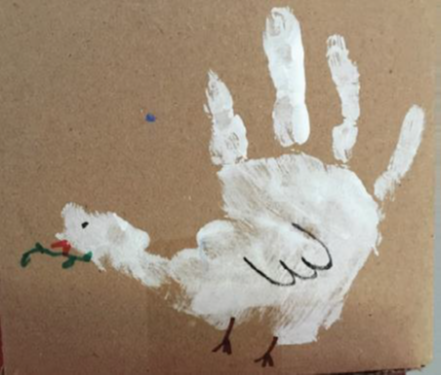
Give each child a piece of colored construction paper or card stock. Invite them to create a handprint dove.
To make a dove, paint the palm of one hand white and place it with fingers spread on the poster paper. Once the paint dries, draw feet, eyes, a wing, and a beak with markers. Alternatively, you can cut a handprint out of white paper and add details. Or print out the dove template at the end of this lesson for the children to color.
Send
The stories in the Gospel of Mark show us how to follow Jesus. It is not always easy to follow Jesus’s teachings, but the Holy Spirit can help us along the way.
- What can you do to help create a community of shalom around you?
- With whom can you share the good news of Jesus?
Have each student brainstorm something they can do this week to create shalom or share the good news (sit with someone new at lunch, invite a friend to church, offer to help a parent with a household task). Each can write and finish the following sentence under their dove: “This week I will…”
Bless
Invite the children to state what they will do this week to bring about shalom.
Offer a prayer to thank Jesus for showing us how to create shalom.
All together shout, “God is here NOW! Share the good news!”