

Worship Tools
Worship Outline
Additional Scriptures
Psalm 19; Matthew 21:33–46; Philippians 3:4b–14
Prelude
Welcome
Call to Worship: Psalm 19:1, 7–9, 14
Hymn
“We Are the Ones the World Awaits” CCS 306
OR “Redeemer of Israel” CCS 388
Encourage participants to sing in languages other than their own.
Prayer of Confession
Loving God, our lives are full of mistakes and wrong choices. More than once our integrity has been lost—embarrassing choices made, things said, and things done. But we cannot give up on life, goodness, or you, O Lord. We will work to do better and live honorable lives.
Today, the choices and actions we make might not seem too terrible. Occasionally we talk about someone behind their back. Or try to manipulate those around us to make things how we want them to be. But, no matter what our choices and actions, we want to do better, to be better, Lord. We want to know our actions bless those around us and on your creation.
At times we make mistakes, but enter our hearts, Lord, and help us strive to do better in the next action we take. We may not be able to change what we just did, but we can change what we are about to do. When we seek your guidance in our lives, the choices are clearer. Grant us obedient hearts and minds, sincerely choosing to follow your precepts. Amen.
Response
Scripture Reading
Someone dressed as Moses reads from a scroll.
I am the Lord your God, who brought you out of the land of Egypt, out of the house of slavery; you shall have no other gods before me.
You shall not make for yourself an idol, whether in the form of anything that is in heaven above, or that is on the earth beneath, or that is in the water under the earth.
You shall not make wrongful use of the name of the Lord your God, for the Lord will not acquit anyone who misuses his name.
Remember the Sabbath day, and keep it holy. Six days you shall labor and do all your work.
Honor your father and your mother, so that your days may be long in the land that the Lord your God is giving you.
You shall not murder.
You shall not commit adultery.
You shall not steal.
You shall not bear false witness against your neighbor.
You shall not covet your neighbor’s house; you shall not covet your neighbor’s wife, or male or female slave, or ox, or donkey, or anything that belongs to your neighbor.
Put down the scroll and narrate the rest of the story.
When all the people witnessed the thunder and lightning, the sound of the trumpet, and the mountain smoking, they were afraid and trembled and stood at a distance, and said to Moses, “You speak to us, and we will listen; but do not let God speak to us, or we will die.” Moses said to the people, “Do not be afraid; for God has come only to test you and to put the fear of him upon you so that you do not sin.”
—Based on Exodus 20
Hymn of Choices
“O Living God” CCS 183
OR “O for a World” CCS 379
Homily
Based on Exodus 20:1-4, 7-9, 12-20
OR Focus Moment
Statement
The focus scripture for today is from Exodus 20, the Ten Commandments. “Moral frameworks like the Ten Commandments can provide guidelines for reflection. They form a vision for what constitutes the good society—a society that honors God and neighbor. The problem comes with the obvious fact that human beings—even reflective and caring ones—don’t always act in a way that honors God and neighbor. We both flaunt and break the commandments on a regular basis.”
—From Progressive Revival
In Community of Christ, we gain additional guidance from our Enduring Principles. When reflected on, these principles also help with choices and actions in life. Choosing to do the right thing, instead of the thing that you desire, can be difficult. Often, we can come up with reasons to back something we desire. But there are times when if we truly took time to think about neighbor and checked our choices through the eyes of God, we would realize we are being asked to choose a different and perhaps more difficult path or decision.
Discussion or Activity
Share thoughts and activities based on “Guidance from God” at Sermons4Kids OR “Rules Are Cool or Rules Are Cruel?” at Sermons4Kids. Sermons4Kids is copyrighted, but the material is available at no cost to churches and other nonprofit organizations. See their website for more information.
Hymn of Love for God
“Santo, santo, santo/Holy, Holy, Holy,” CCS 159
Sing at least three times, encouraging participants to sing in languages other than their own.
Sacrament of the Lord’s Supper
Communion Scripture Reading: 1 Corinthians 11:23–26
Communion Message
Access the Inivation to Communion script
Hymn of Sacrament Preparation
“Bread of the World CCS 527
OR “Blessed Is the Body and the Soul CCS 238
Blessing and Serving of the Bread and Wine
Disciples’ Generous Response
Scripture: Doctrine and Covenants 163:9
Statement
All of giving begins and ends with God. If we will notice that and imitate it in our own lives, we’ll experience freedom from the kind of culture that drives us to always be afraid of whether we’ll have enough. It will free us to be generous disciples who give enthusiastically—and give joyfully for the sake of giving. That joy is multiplied when we see it transformed into ministries that bless people with the gospel…
—Steve Veazey, Presidential Q&A, Part II, July 2015 Herald
Blessing and Receiving of Local and Worldwide Mission Tithes
Hymn of Sending Forth
“O God of Love, Grant Us Your Peace” CCS 316
OR “Sent Forth by God’s Blessing CCS 648
Prayer for Peace
Light the peace candle
Statement of Sending Forth
We light the peace candle symbolizing our unrelenting pursuit of peace for a bruised and divided world.
Today—
Make every breath one of thanksgiving;
Make every deed a channel of justice;
Make every thought a peaceful one;
Go in peace.
Postlude
Sacred Space: Small-Group Worship Outline
Gathering
Welcome
Ordinary Time is the period in the Christian calendar from Pentecost to Advent. This part of the Christian calendar is without major festivals or holy days. During Ordinary Time we focus on our discipleship as individuals and as a faith community.
Prayer for Peace
Ring a bell or chime three times slowly.
Light the peace candle.
Silent God.
Sometimes we mistake your silence for absence, or we feel we have been ignored.
Instead, your silence is calling us to be silent and know you. In silence we hear you speak your message of peace. You move us from the measurement of life into living life.
The noise of conflict between people fills our world. It jars our nerves and confuses us with who is right. When we think we know what is right, we tend to turn the other into the enemy. Help us see the face of God in each one and recognize the worth of each person, even those with whom we disagree.
The noise of conflict between nations fills our world. Long and bitter disputes have resulted in the death and suffering of many. The resources of the world are wasted on armaments and wars while children and the poor continue to suffer. Help us be impatient for peace; help us demand that our leaders seek pathways of peace rather than reasons for war.
Lead us by the still, small voice into personal, community, and world peace. By your Spirit help us to be silent and know you. In the name of the Prince of Peace we pray.
Amen.
Spiritual Practice
Unity
Read the following:
Our Enduring Principle focus this week is Unity in Diversity. There is not one person on this earth that is exactly like another person. We are all shaped by our culture, genetics, upbringings, families, experiences, beliefs, and more. One thing we have in common is that we are all divinely made. Unity in diversity respects the differences while also honoring the divine in all voices.
… But God has so arranged the body…that there may be no dissension within the body, but the members may have the same care for one another. If one member suffers, all suffer together with it; if one member is honored, all rejoice together with it.
—1 Corinthians 12:24–26
Think back over the past week. Who showed compassion when you felt sad or were suffering? Who rejoiced with you in good things that happened for you this week? Invite people to share.
- Who do you know who endured suffering this week?
- How were you able to share this burden with them?
- Who had cause to rejoice this week?
- How did you celebrate with them?
Invite people to share.
Offer a short blessing of unity. Close with “Amen.”
Sharing Around the Table
Exodus 20: 1–4, 7–9, 12–20 NRSVue
Then God spoke all these words,
“I am the Lord your God, who brought you out of the land of Egypt, out of the house of slavery; you shall have no other gods before me.
“You shall not make for yourself an idol, whether in the form of anything that is in heaven above or that is on the earth beneath or that is in the water under the earth.
“You shall not make wrongful use of the name of the Lord your God, for the Lord will not acquit anyone who misuses his name.
“Remember the Sabbath day and keep it holy. Six days you shall labor and do all your work.
“Honor your father and your mother, so that your days may be long in the land that the Lord your God is giving you.
“You shall not murder.
“You shall not commit adultery.
“You shall not steal.
“You shall not bear false witness against your neighbor.
“You shall not covet your neighbor’s house; you shall not covet your neighbor’s wife, male or female slave, ox, donkey, or anything that belongs to your neighbor.”
When all the people witnessed the thunder and lightning, the sound of the trumpet, and the mountain smoking, they were afraid and trembled and stood at a distance 19 and said to Moses, “You speak to us, and we will listen, but do not let God speak to us, lest we die.” 20 Moses said to the people, “Do not be afraid, for God has come only to test you and to put the fear of him upon you so that you do not sin.”
—Exodus 20: 1–4, 7–9, 12–20 NRSVue
Today’s text walks us through the Ten Commandments, also known as the Mosaic covenant. These commandments are used by some as a literal list of things to do, and not to do, to live faithfully in community with God and others. For some Christian traditions, these commandments are part of the confessions of the church and have long represented a cultural code that is foundational to guiding the human community.
How is it that this list of Ten Commandments gets so much attention out of the 613 commandments recorded in the Hebrew Scriptures. And, if these are the top 10, why did Jesus make these statements in Matthew 22:37–39 NRSVue?
‘You shall love the Lord your God with all your heart, and with all your soul, and with all your mind.’ This is the greatest and first commandment. And a second is like it: ‘You shall love your neighbor as yourself.’
A closer look helps us see the Ten Commandments are not so far from Jesus’ top two. Both suggest an uncompromising, whole-life devotion to God above all else, and a mutual respect for one another in community. The people of God are to avoid behaviors and actions that would harm others or fail to honor their equal worth as children of God.
Whenever we respond to God’s invitation to the table of the Lord’s Supper, we renew the covenant we made with God in the waters of baptism. Subsequently, we renew the inherent covenant we share with those we journey with in the Body of Christ, and the whole of God’s creation. We see this covenant not as a list of dos and don’ts, but as a promise to remember God’s faithfulness to us. In return, we promise to live faithfully in relationship with God, others, and creation.
Questions
- When you read the Ten Commandments, what surprises you? What is left out that you see as important?
- In what ways do you seek to live faithfully in relationship with God, others, and creation?
- How do you understand the covenant you have made with God?
Sending
Generosity Statement
Faithful disciples respond to an increasing awareness of the abundant generosity of God by sharing according to the desires of their hearts; not by commandment or constraint.
—Doctrine and Covenants 163:9
The offering basket is available if you would like to support ongoing, small-group ministries as part of your generous response. This offering prayer is adapted from A Disciple’s Generous Response:
God of our discipleship,
As we navigate our world of debt and consumerism, help us to save wisely, spend responsibly, and give generously. In these ways may we prepare for the future and create a better tomorrow for our families, friends, the mission of Christ, and the world. Amen.
Invitation to Next Meeting
Closing Hymn
Community of Christ Sings 322 “Let the Truth Shine in Our Speaking”
Closing Prayer
Optional Additions Depending on the Group
- Communion
- Thoughts for Children
Sacrament of the Lord’s Supper
Communion Scripture
Choose one scripture to read from this selection: 1 Corinthians 11:23–26; Matthew 26:17–30; Mark 14:12–26; Luke 22:7–39.
Invitation to Communion
All are welcome at Christ’s table. The Lord’s Supper, or Communion, is a sacrament in which we remember the life, death, resurrection, and continuing presence of Jesus Christ. In Community of Christ, we also experience Communion as an opportunity to renew our baptismal covenant and to be formed as disciples who live Christ’s mission. Others may have different or added understandings within their faith traditions. We invite all who participate in the Lord’s Supper to do so in the love and peace of Jesus Christ.
We share in Communion as an expression of blessing, healing, peace, and community. In preparation let’s sing from Community of Christ Sings (select one):
- 515, “In These Moments We Remember”
- 516, “Coming Together for Wine and for Bread”
- 521, “Let Us Break Bread Together”
- 525, “Small Is the Table”
- 528, “Eat This Bread”
Bless and serve bread and wine.
Thoughts for Children
Materials:
- Crayons or other coloring utensils
- Enduring Principles coloring page found on page 36 of the publication.
Ask: What kinds of rules do parents or teachers have for you?
Affirm all answers.
Ask: Why do they have these rules?
Affirm all answers.
Say: Parents and teachers set rules for you because they love you, and they want you to have the best life possible. The same was true with the Israelites. God loved them and wanted them to have the best lives possible, so God gave Moses the Ten Commandments to help them form community.
Jesus shared with the disciples that it is important to love God and our neighbors. In fact, Jesus said loving God and others are the most important commandments. This helped early Christians form community. In Community of Christ, the Enduring Principles help us form healthy communities. [Show Enduring Principles coloring page.]
For young children, say: As followers of Jesus, we want to make responsible choices that bring goodness and kindness into the world. You make choices: like how and what you share, who you choose to play with, and how you choose to behave. Are there choices you can make that will bring kindness and goodness into the world? Affirm the responses.
For older children and teens, say: One of our Enduring Principles is Responsible Choices. It says that “God gives humans the ability to make choices about whom or what they will serve. Some people experience conditions that diminish their ability to make choices.” God gives us each the freedom to make choices. Sometimes things in our lives that are outside of our control limit the choices we have. Human choices can be good or bad. Human choices have caused some really bad things to happen in the world. At the same time, human choices have and can make really good things happen. As disciples, our job is “to make responsible choices within the circumstances of our lives that contribute to the purposes of God.”
Give each child a copy of the Enduring Principles coloring page. Point out the Enduring Principle of Responsible Choices.
Sermon Helps
Exploring the Scripture
The Ten Commandments represent the conditions of the covenant. Often referred to as the Decalogue, they represent unconditional duties to God and the community. Few texts have played as large a role in the church or public as the Ten Commandments. They are a part of the confessions of the church and have long represented a cultural code that is foundational to guiding the human community.
However, the Ten Commandments cannot play a significant role in the lives of the faithful unless they are taken to heart. Therefore, memorizing the commandments, the Lord’s Prayer, and the 23rd Psalm has historically had a special place in Christian piety.
The beginning of the Ten Commandments is foundational: “you shall have no other gods before me” (v. 3). The prologue offers the identity of the One who obligates the community: it is YHWH who commands. The first commandment is an acknowledgment there are always competing claims of supreme nature, “other gods,” that seek to be the center of meaning and value in people’s lives. Such “gods” are to be rejected.
The second commandment declares, “You shall not make for yourself an idol” (v. 4). The effort to control God, to try to seduce God to do our bidding is rejected. It is God who controls when, where, and how to be accessible.
Likely no commandment has the potential of being mistreated with callous casualness as the third commandment that has to do with the misuse of the name of God (v. 7). If the first commandment has to do with having no other gods, and the second with not replacing the Lord with images, the third commandment reinforces them. It is a warning against endangering the potential relationship with God through misappropriation and misuse.
“Remember the Sabbath day, and keep it holy” (v. 8). The Sabbath commandment is placed at the end of the first section, or “first tablet” of the Decalogue—the commandments that focus on the proper worship and love of God. It acts as a bridge between commandments having to do with the love of God and the love of neighbor. The Sabbath is a gift!
“Honor your father and your mother” (v. 12). Honoring one’s parents directs life toward the other who is not God and is related to the Sabbath commandment.
“You shall not murder” (v. 13). There is nothing so basic as the prohibition of taking another life. A priority is given to preserving life, avoiding harm to one’s neighbor.
“You shall not commit adultery” (v. 14). Like murder, adultery is a violation of intersocial behavior. The focus of this commandment on protecting the social order is complementary to honoring one’s mother and father and prohibiting murder. Protecting life is to be seen from the perspective of the rights of one’s neighbor, including the sanctity of marriage.
“You shall not steal” (v. 15). Stealing is condemned. It is in a sense an expression of false witness, of coveting. In taking from another, one violates the neighbor and compromises the self
“You shall not bear false witness against your neighbor” (v. 16). Concern for one’s neighbor is made clear in words and in speaking. More than just lying, it is about the capacity of words to injure or endanger another. One must speak truthfully
“You shall not covet…” (v. 17). Coveting has to do with want and its effects. Want distorts, affecting both self and neighbor.
Central Ideas
- The Ten Commandments have had a central place in the church’s confession and teaching from the earliest days of the tradition.
- The Ten Commandments have influenced the way society is organized and preserved and are at the heart of Christian witness.
- Faithful embodiment of the Ten Commandments in our lives and community fulfills God’s hope for human life.
Questions for the Speaker
- How do the Ten Commandments represent the conditions of the covenant? How is this displayed in the life of the community and the church?
- How does remembering the Sabbath day (v. 8) act as a bridge between the love of God and the love of one’s neighbor?
- Coveting (v. 17) distorts and affects the self and the neighbor; it dismembers the community and violates the purposes of God. How might you give witness to this?
- Which of the other commandments do you think are often disregarded in your culture? In today’s world?
Lessons
Adult Lesson
Focus Scripture Passage
Exodus 20:1–4, 7–9, 12–20
Lesson Focus
God desires right relationships with human beings and among humans, and has graced humankind with a pattern for living to enable that to happen.
Objectives
The learners will…
- compare what they remember to be the Ten Commandments with the words recorded in the focus scripture passage.
- explore the concept of two types of teachings split between a focus on God and a focus on neighbor and family.
- discuss the concepts in the focus scripture in correlation to the Enduring Principle Responsible Choices.
- create a personal affirmation for each of the 10 teachings (commandments).
Resources
For background into Old Testament scripture the following resources may be helpful.
- International Bible Commentary, Collegeville, MN: The Liturgical Press, 1998, 429–430
- Feasting on the Word, Year B, Vol. 2, Louisville, KY: Westminster John Knox Press, 2008, 74–79
- Any lectionary commentary series for Year A, 2019–2020
Supplies
- Bible or copies of Exodus 20:1–4, 7–9, 12–20.
- Board or flip chart; markers or chalk
- Handouts with the Ten Commandments in one column and space to write in a parallel column (end of lesson); alternatively, use blank paper
- Pens or pencils
Notes to teacher
In preparation for this lesson, read “Exploring the Scripture” for Exodus 20:1–4, 7–9, 12–20 in Sermon & Class Helps, Year A: Old Testament, pp. 113–114, available through Herald House.
Gather
Today’s focus scripture from Exodus narrates God’s instructions to the Israelites during the time they camped at the base of Mt. Sinai. This narrative tells about Moses receiving a set of instructions or teachings (which is what Torah means).
Ask class members to name what they remember among the instructions Moses received on Mount Sinai to relay to the Israelites. List them on board or chart.
Engage
Distribute Bibles or copies of Exodus 20:1–4, 7–9, 12–20. Ask for a few volunteers to read the scripture aloud.
Scholars have suggested there were two tablets: one dealt with theological issues, the other with ethical issues. Both were deemed important and interrelated. Both presupposed a history of a covenantal life before God.
- What has the focus of this scripture usually been named? (The Ten Commandments)
- Compare the list created earlier with the scripture text. What are the differences between the two?
- Which teachings can be thought of as theological? Which ones are ethical in nature?
- What short phrase can summarize each set of teachings? (One example: how to live before God; how to live with one another)
- When Jesus was asked to name the greatest commandment, how did he unite the teachings on the two tablets?
- Why would it be wrong to consider the teachings as simply a moral code?
- In what way are the teachings a protection for the community?
Respond
These teachings describe a way of life. They are not a means to earn God’s love or a ticket to salvation.
They are a gift from God to help us pattern our lives to honor God and respect each other.
Sometimes, those simple but profound truths are lost in the thunder of cultural arguments about keeping the Ten Commandments visible in public settings.
Discuss:
- What might be an issue when folks display placards advocating postings of the Ten Commandments in county courthouses or public schools?
- What principle of the teachings or commandments might that violate?
- How is posting them different from practicing them?
- Explore this quote: “…Christians recite the Commandments and teach them to their children in order to know how to live as God’s people. This way of understanding the Ten Commandments suggests they are not so much a list of moral imperatives as they are ways of living or forms of life” (George W. Stroup as found in Feasting on the Word, Year B, Vol. 2, Louisville, KY: Westminster John Knox Press, 2008, 78).
- What do you think that means for you today?
- How might this interpretation assist in living by the Enduring Principle Responsible Choices?
Send
Distribute pens or pencils and handouts printed in two columns: one column with a list of the 10 teachings/commandments and opposite it in a second column space for writing personal responses; or alternatively, use blank paper for personal responses, using as a reference the focus scripture handout that lists the 10 teaching/commandments.
Invite class members to rewrite each of the teachings/commandments as an affirmation of their response. For example: I will let God alone influence my life (not other gods such as electronics, golf, security, etc.). If time is limited, suggest they complete the task at home and encourage them to do so.
Bless
Invite class members to join in a “popcorn” prayer. Explain that you will begin and end the prayer and in between they are encouraged to say a short phrase in random order to add to the prayer. Focus the prayer on thanksgiving and praise for a God who provides directions for living.
The Ten Commandments—Exodus 20:3–16, NRSVue
| You shall have no other gods before me. (v. 3) | |
| You shall not make for yourself an idol, whether in the form of anything that is in heaven above or that is on the earth beneath or that is in the water under the earth. (v. 4) | |
| You shall not bow down to them or serve them, for I the Lord your God am a jealous God, (v. 5) | |
| You shall not make wrongful use of the name of the Lord your God, for the Lord will not acquit anyone who misuses [God’s] name. (v. 7) | |
| Remember the Sabbath day and keep it holy… For in six days the Lord made heaven and earth, the sea, and all that is in them, but rested the seventh day; therefore the Lord blessed the Sabbath day and consecrated it. (v. 8, 11) | |
| Honor your father and your mother. (v. 12) | |
| You shall not murder. (v. 13) | |
| You shall not commit adultery. (v. 14) | |
| You shall not steal. (v. 15) | |
| You shall not bear false witness against your neighbor. (v. 16) |
Youth Lesson
Focus Scripture Passage
Exodus 20:1–4, 7–9, 12–20
Lesson Focus
Making responsible choices
Objectives
The learners will…
- know the Ten Commandments and be able to apply them to modern-day situations.
- understand Jesus’s new commandment.
- explore the Enduring Principle Responsible Choices and consider how they can incorporate it into their lives.
Supplies
- Bible
- Modern-Day Match Up, enough copies for multiple teams (end of lesson)
- Copies of the Enduring Principle Responsible Choices, available online or in Sharing in Community of Christ, 4th Edition, p. 30.
- Community of Christ Sings (CCS)
- Scattergories recording sheets, one per person (end of lesson)
- Construction paper
- Magazines or printed pictures and words
- Glue
- Scissors
- Pens or pencils
- Paper scraps
Note to teacher
In preparation for this lesson, read “Exploring the Scripture” for Exodus 20:1–4, 7–9, 12–20 in Sermon & Class Helps, Year B: Old Testament, pp. 113–114, available through Herald House.
Gather
Ask students if they have ever played Scattergories. In this game players are given a topic, and they have one minute to think of as many things as they can that relate to that topic, one for each letter of the alphabet. For example, if the topic was FOOD, I could write apples, bananas, creamed corn, donuts, and so on for each letter. After the minute is up, players get a point for each item they wrote that no one else had. For example, if two other people had written apple, I would not get any points for it. If no one else had included donut, I would get one point. I would receive two points for creamed corn because it had two words that started with C. Give each player a recording sheet. Tell them that their topic is RULES PARENTS AND TEACHERS HAVE FOR YOU. After giving them a minute to write, score the round to see who wins.
- What kinds of rules do parents and teachers have for you?
- Why do they have these rules? Is it to be mean and strict?
Parents and teachers set rules for you because they LOVE you and want you to have the best life possible. The same was true with the Israelites. God loved them and wanted them to have the best lives possible, so God gave Moses the Ten Commandments.
Engage
Read Exodus 20:1–4, 7–9, and 12–20. These verses introduce the Ten Commandments. As you read, define tricky words, but refrain from giving examples.
God’s relationship with the Israelites was very different than the relationship we have with God today. Even so, these commandments can still have application in our lives. Form the class into teams to compete against one another. Give each team the Modern-Day Match Up sheet. Challenge them to think of an example of modern-day situations that relate to each commandment. The first team to come up with an example for each commandment wins.
After the competition, explain that part of the reason God’s relationship with the Israelites was different than our relationship with God is because Jesus came to establish a new covenant relationship with us. Jesus introduced a new commandment in Matthew 22:34–40:
Ask:
- How are Jesus’s new commandments different than the Ten Commandments?
- What are some situations in your personal life where you should apply Jesus’s new commandments?
- What are some situations in your community where you should apply Jesus’s new commandments?
- What are some situations in the country where we should apply Jesus’s new commandments?
- What are some situations in the world where we should apply Jesus’s new commandments?
It appears that Jesus believed in living by the spirit of the law rather than the letter of the law. It is with this understanding that we as Community of Christ uphold the Enduring Principle Responsible Choices.
Respond
Oftentimes, people make what they believe to be responsible choices but don’t use tradition, scripture, or God’s guidance. Making responsible choices isn’t about using logic to justify decisions. It’s about being open to God’s guidance in our lives and being good stewards of our agency. Making responsible choices isn’t about judging others; it’s about inviting others into a fuller life through Christ despite past decisions.
Responsible Choices
- God gives humans the ability to make choices about whom or what they will serve. Some people experience conditions that diminish their ability to make choices.
- Human choices contribute to good or evil in our lives and in the world.
- Many aspects of creation need redemption because of irresponsible and sinful human choices.
- We are called to make responsible choices within the circumstances of our lives that contribute to the purposes of God.
Part of making responsible choices is setting intention. By preparing diligently and with the Spirit’s influence, students will be better equipped to make responsible choices in the face of difficult decisions. To begin setting their intention, students will use construction paper and magazines to make a collage vision board. This vision board shouldn’t simply represent their hopes for their lives; rather it should represent God’s hopes for their lives and all of creation. Once they are finished making their vision board, invite them to turn it over and write three responsible choices God is calling them to make so this vision can become a reality.
Send
Remind the class that discipleship is not always easy or popular. Some of the choices we make will be very difficult. Have each person write their name on a scrap of paper and place it folded into a basket. Once everyone’s name is in the basket, pass it around and have students pull out a slip of paper. If they draw their name have them return the slip to the basket and grab another. Once everyone has drawn a name, explain that the individual on their slip is who they will pray for. They will pray that this person is able to make responsible choices influenced by God throughout their daily life. Determine a set amount of time that these prayer partnerships should last. Remind the class that as they face difficult decisions in their lives, their prayer partner is praying for them and asking for God to guide them.
Bless
Close your time together by singing “I Have Decided to Follow Jesus” CCS 499.
Children’s Lesson
Focus Scripture Passage
Exodus 20:1–4, 7–9, 12–20
Lesson Focus
God gave the Israelites the Ten Commandments to teach us all how to live in God’s way.
Objectives
The learners will…
- recognize and acknowledge the importance of rules.
- explain how the Ten Commandments were received.
- list the Ten Commandments in order.
Supplies
- Bible or Lectionary Story Bible, Year A, by Ralph Milton, illustrated by Margaret Kyle (Wood Lake Publishing, 2007, ISBN 9781551455471)
- Teaching Kids the Ten Commandments video using hand motions from YouTube
- Balloon
- Poster paper and marker
- Tape or glue
- Ten Commandment Cards (end of lesson)
Notes to teacher
In preparation for this lesson, read “Exploring the Scripture” for Exodus 20:1–4, 7–9, 12–20 in Sermon & Class Helps, Year A: Old Testament, pp. 113–114, available through Herald House.
Gather
Toss a balloon into the air. Tell the children that the objective of the game is to keep the balloon from hitting the ground for as long as possible. After they’ve been playing for a minute or so, change the rules by announcing, “Oh you must start over again because _________ (fill in the blank with the name of a child) hit the balloon with their left hand. You are supposed to keep your left hand behind your back.”
The children might complain that you hadn’t explained that rule; just apologize and encourage them to continue playing. After another minute, change the rules again by announcing, “Oh stop! _________(fill in the blank with the name of a child) touched the balloon twice in a row. That’s against the rules; start over again.”
The children will undoubtedly complain that you’re changing the rules, but just continue encouraging them to play. Follow this pattern a couple more times so that class members are quite exasperated with all the rule changes. Then facilitate the following discussion:
- What was the most difficult part of the game?
- I changed the rules a lot; what made that difficult?
- Would you ever be able to win the game if you didn’t know the rules?
Explain that rules aren’t always fun, but they’re used to keep us safe and help us reach our goals. Rules and directions help us learn how to live safely with each other and meet expectations. Without consistent rules, we wouldn’t know what to do.
Engage
Moses was leading the Hebrew people around a desert for many, many days. Summarize or ask the class to explain what happened up to this point. Explain that today’s story continues their journey in the desert.
Read Exodus 20:1–4, 7–9, 12–20 or “The Ten Commandments” pages 213–214 in Lectionary Story Bible, Year A. After reading the story, ask the class the following discussion questions:
- Would it have been hard to wait at the bottom of the mountain while Moses got to climb to the top?
- What would you have been feeling if you saw smoke and fire, heard thunder, and felt the ground tremble like an earthquake?
- What do you think of the Ten Commandments? Are they fair rules? Are they difficult to follow?
Explain that just like you wanted to have an unchanging set of rules during the balloon game, the Israelites were also very thankful to finally have a list of rules they could follow to live as God wanted.
Respond
Teach each of the Ten Commandments using hand motions. Use the video Teaching Kids the Ten Commandments for reference (YouTube). Each hand motion uses the number of fingers associated with the number order of the commandment. You can choose to show the video to the class or preview and learn the motions before class and teach it yourself. If time allows, have children form pairs or small groups to practice.
Send
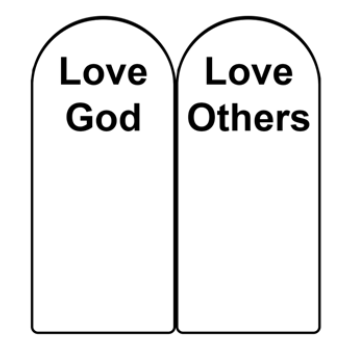
Gather the class back to the table. Lay the poster on the table. Draw two stone tablets on the poster. At the top of the left tablet write the words “Love God.” At the top of the right tablet, write the words “Love Others.” Tell the children to work together as a class to separate all the Ten Commandments cards into those two categories. Once completed correctly, tape or clue the cards in place and hang the poster somewhere visible in the learning space.
Point out the pattern in the Moses story: the Israelites (Hebrew people) complain; Moses prays; God provides something for the Israelites so they rejoice; then the Israelites begin complaining again, so Moses prays again…and so on.
Ask:
- Does anyone remember how the story ended today? (answer: Israelites are thanking God for giving them the Ten Commandments)
- Can anyone predict, based on the pattern, what will happen next? (answer: the Israelites will begin complaining and break one of the rules)
- Which of the Ten Commandments are the most difficult for you to follow?
Bless
Once everyone has chosen the commandment that will be most difficult to follow, form a circle with everyone in the class standing, holding hands, facing the center. Explain that they will each be asking God to help them with their most difficult commandment by saying the following:
“Please help me to __________ (fill in the blank with the commandment), so I can live as you want me to live.”
Each child around the circle will share. Begin and end with you as the leader. Begin the circle prayer by saying:
“Wonderful and loving God, we want to thank you for providing everything we need.
You provide for us just like you have provided for so many people for thousands of years.
We are your children, and we want to live like you command.
Please help me to __________, so I can live as you want me to live.”
Continue with the child on your right. End with the statement
“God, we want to serve you in everything we do. Thank you so much for your loving presence here today. Amen.”