

Worship Tools
Worship Outline 1
Additional Scriptures
Psalm 22:25–31; Acts 8:26–40; 1 John 4:7–21
Preparation
Create a worship center that encourages focus and contemplation on the scripture throughout the service. Items for the worship center could include a vine-like plant or a variety of plants with branches, a candle, or products of plants—fruits, vegetables, flowers.
Prelude
Welcome
Call to Worship
Reader 1: Let us love one another, because love is from God.
Reader 2: God sent his only Son into the world so that we might live through him.
Reader 1: If we love one another, God lives in us, and God’s love is perfected in us.
Reader 2: God is love, and those who abide in love abide in God, and God abides in them.
Reader 1: There is no fear in love, but perfect love casts out fear.
Reader 2: The commandment we have is this: those who love God must love God’s children also.
—1 John 4:7–21, adapted
Our Hearts Are Grateful
“How Can We Name a Love” CCS 2
OR “Come, Thou Fount of Every Blessing” CCS 87
Encourage participants to sing in languages other than their own.
Community Mission Prayer
Print or project this prayer so all can see
God, where will your Spirit lead today?
Help me be fully awake and ready to respond.
Grant me courage to risk something new and
become a blessing of your love and peace. Amen.
Response
Pursue Peace on Earth
Prayer for Peace
Scripture Reading: Doctrine and Covenants 163:1–2a
Light the peace candle
Prayer in Song
“My Peace” sing twice CCS 149
Add an Amen at the end.
Experience Congregations in Mission
We Center Our Hearts
This can be a vocal or instrumental ministry of music, perhaps playing the accompaniment track from Community of Christ Sings Audio Recordings available from Herald House.
“Come and Find the Quiet Center” CCS 151
OR “Be Still” CCS 156
Ask participants to focus on the worship center.
Develop Disciples to Serve
Dwelling in the Word: John 15:1–8
Project or print the reflective questions. Read the scripture, then pause for a minute and ask these questions:
- What images do you see or sense as the scripture is read?
- What does the vine in your mind look like?
- Is it green or some other color, healthy or unhealthy, moist or dry, producing fruit or barren? If there is fruit, what does it look like?
- Are there colors, fragrances, temperatures, sounds, or other awarenesses that come to you as you enter the scripture with your senses?
Read the scripture a second time.
Ask participants to turn to someone near them and share a response to these questions:
- What images did you see or sense as the scripture was read?
- What does the vine look like in your mind?
- How do you feel about the vine and branches you see?
Allow 3–5 minutes for people to share with a partner, then bring the group back together with singing.
We Listen with Intention
“Listen in the Silence” CCS 153
OR “Come, Holy Spirit, Come” CCS 154
Sing three or four times. If you notice some people are still sharing, continue leading the song—or ask accompanist to—until everyone is centered again as a group.
Time of Prayer and Reflection with God
During this time, depending on typical practices in your group, you could choose to play soft meditative music (instrumental music without words). This music could either be provided by an instrumentalist or be recorded music.
Ask participants to prayerfully converse with God about feelings, questions, or insights that came to them from their meditation images. Allow 2–5 minutes, depending on your group’s level of comfort, for this time of silent prayer. Again, bring the group back together through song.
We Open Our Hearts
“Spirit Fill Us” CCS 160
OR “Listen in the Silence” CCS 153
Intersperse singing with the questions and meditation time.
Pose the questions below:
- See and feel yourselves as part of the vine. Where are you located in the maze of branches and leaves?
- How do you feel about the connection between yourself and Jesus?
What Is My Invitation?
Read John 15:1–8 one last time. This time ask participants to let go of the images that came to their minds and be open to God’s call to them through this scripture.
Take time to allow people to share their insights through interaction with this scripture.
Use the questions below to prompt sharing. Project or print these questions for people to see.
- What does this scripture say to you about your relationship with Christ? With God? With the world around you?
- What is your invitation as you reflect on your experience with this scripture?
Close the time of sharing with the next song.
Our Hearts Are Called
“According to the Gifts” CCS 591
OR “If by Your Grace I Choose to Be” CCS 587
Abolish Poverty, End Suffering
Disciples’ Generous Response
Be a Moon
One night on my way home, I was summoned by the bold intensity of an almost-full moon which was demanding my attention. I pulled my car over and rolled the window down sensing the need to regard this sight with a contemplative heart.
Although the sun’s light was being overshadowed by the position of the earth, the moon was reflecting that light from 93 million miles away and casting a glow that allowed me to see the outline of the quiet world around me.
There are many times when things of the earth can overshadow the light. And yet, there is a moon. It reflects the sun when the light cannot be seen.
The moon reflects the sun.
Be a moon.
Reflect the Son.
—Nina Warriner
We are called to reflect the light of the Son:
to be the hands and feet and beating heart of Christ in the world,
to bring light where there is darkness,
to bear the fruits of hope, peace, and love.
May our offering today be a representation of our reflection of the light of Christ in our world.
Blessing and Receiving of Local and Worldwide Mission Tithes
Invite People to Christ
Hymn of Commitment
“I, the Lord of Sea and Sky” CCS 640
OR “Your Cause Be Mine” CCS 639
Sending Forth Scripture Reading: Doctrine and Covenants 165:1c
Benediction
Share the Mission Prayer in unison. Print or project the words for all to see.
God, where will your Spirit lead today?
Help me be fully awake and ready to respond.
Grant me courage to risk something new and
become a blessing of your love and peace. Amen.
Postlude
Worship Outline 2
Additional Scriptures
Psalm 22:25-31; Acts 8:26-40; 1 John 4:7-21
Preparation
On this Sunday of the vine and branches focus scripture, place a variety of vines or vine-like plants in front of the communion table.
Prelude
Welcome, Sharing and Caring
Today’s focus scripture is from the book of John in the New Testament. Jesus shares the image of a vine and its branches in a parable to help his listeners understand the interconnectedness between God, Jesus, and the people. Jesus is the vine and we, his disciples, are the branches that grow from that vine.
“For, behold, I will bless all those who labor in my vineyard, with a mighty blessing.”
—Doctrine and Covenants 19:3a
Invite participants to share their joys and concerns.
Pastoral Prayer
There are many needs specifically within your group and their extended families. Offer a prayer that lifts the needs of those to whom you minister and the needs in the hearts of your participants.
Call to Worship and Moment of Meditation
Pause for a moment of meditation following this reading. Consider printing or projecting this text.
That roots of our souls
Shall draw from deep, life-giving soil,
That we shall reach together
For surer footing in God.
This day we make covenant
With one another
And with God.
—“Meditation,” Worship Resources for the Sacraments, Herald House, 1989, edited by Judy Judd, adapted
Hymn of Joy
“Who Is This Jesus” CCS 38
OR “A Man of Ancient Time and Place” CCS 30
OR “O Young and Fearless Prophet” CCS 36
Invocation
Response
Scripture Reading: John 15:1-8
Print or project the text. Invite several readers to share the focus scripture. Divide the verses among them.
Hymn of Creation
“Touch the Earth Lightly” CCS 137
OR “Creation Flows Unceasingly” CCS 107
OR “Learn from All the Songs of Earth” CCS 141
Prayer for Peace
Light the peace candle
Prayer
Creator God, we come before you today to renew our commitment. In light of our promise, we know that we have not cared for the children of the Earth and the Earth itself in a way pleasing to you. We see the sickness that has devastated our entire planet. We know that we are truly one family and we are called to care for that family sacrificially. We have learned painful lessons, God, that if we do not protect each other, we all suffer. The suffering of one, is the suffering of each of us. Teach us to touch our Earth gently and teach us how to live on this planet as family, not as humans on different sides of a divide. Grant us this prayer in your Son’s holy name. Amen.
Sermon
Based on John 15:1-8
Sharing
Allow time for the participants to consider the homily and then ask them to share a sentence or two about when they first became disciples of Jesus.
Disciples’ Generous Response
Focus Moment of Generosity
Invite the participants to prayerfully consider where they gave of themselves (time, treasure, talents, and testimony) over the last week. Ask them to form small groups of three or four and discuss these questions or invite each person to silently reflect on the questions. Print or project the questions for all to see.
- How does your giving reflect your beliefs and what matters most to you?
- How might an observer describe your beliefs and what matters most to you based on your giving?
Blessing of Local and Worldwide Mission Tithes
Our Heavenly Parent,
We are grateful that you have given us our daily bread in so many ways and shared by so many different people throughout the world. We want to offer to you a portion of this gift. We do this in part to remind ourselves that we are dependent on your loving care. You are the source of all life. Help us to remember, God, that all ordinary things are made holy when they are offered to you. Our bread, our wine, our money, and our lives become sacred as our offering. Use us God. Create in us a vision of how we may best respond to your generosity. Amen.
Receiving of Local and Worldwide Mission Tithes
Hymn of Discipleship
“God, Bless Your Church with Strength!” CCS 638
OR “May the God of Hope/Dios de la esperanza” CCS 652
Encourage participants to sing in a language other than their own.
OR “Mighty God Who Called Creation” CCS 641
Benediction
Sending Forth
Children of God, remember that all great gifts of life and spirit are directly from God. The gifts are varied but each is powerful and special.
—Moroni 10:8-13, adapted
Remember as you go through your week, to use them for the benefit of others. Go into the world as disciples of Jesus Christ.
Postlude
Worship Outline 3
Additional Scriptures
Psalm 22:25–31; Acts 8:26–40; 1 John 4:7–21
Worship Setting
Read John 15:1–8to form an idea for artwork for a worship setting. Create vines with branches. You can do this with paint, chalk, construction paper, or in other creative ways. Have places for construction paper fruit to be hung from the vines.
We Gather in Praise
Prelude
Scripture Reading
Four people are scattered throughout the sanctuary or standing at the four corners of the room. As each one reads, the reader stands and walks to the center.
Reader 1: Collectively and individually, you are loved with an everlasting love that delights in each faithful step taken.
Reader 2: God yearns to draw you close so that wounds may be healed, emptiness filled, and hope strengthened.
Reader 3: Do not turn away in pride, fear, or guilt from the One who seeks only the best for you and your loved ones.
Reader 4: Come before your Eternal Creator with open minds and hearts and discover the blessings of the gospel anew.
All Readers: Be vulnerable to divine grace.
—Doctrine and Covenants 163:10a–b
Centering Hymn
“In the Quiet of This Day” CCS 161
OR “Searcher of Hearts” CCS 178
All: Stanza 1
High voices: Stanza 2
Low voices: Stanza 3
All: Stanzas 4–5
Welcome
Call to Worship: Psalm 22:27
Hymn of Praise
“Praise God from Whom All Blessings Flow” CCS 54
Sing twice; encourage participants to sing in languages other than their own.
OR “Praise with Joy the World’s Creator” CCS 57
Invocation
Response
Reflections and Confession
Disciples’ Generous Response
Statement
God provides “enough and to spare” (Doctrine and Covenants 101:2f). God shares in abundance “good measure, pressed down, shaken together, running over” (Luke 6:38). The struggle in the world is not the lack of resources for everyone. The struggle is in how we distribute the resources of the world. Economic justice is about solving the distribution problem in ways that honor the worth of all.
President Emeritus Steve Veazey described the challenge:
The world is living a nightmare of pain and despair. God is calling for a massive exodus of people from poverty and related suffering.
Will we be the prophets standing before crafty politicians and predatory hoarders of wealth, saying with conviction, ‘You had better let God’s people go’? God sees a church that doesn’t just speak and sing of Zion. God sees one that lives, loves, and shares as Zion: those who strive to be visibly one in Christ, among whom there are no poor or oppressed (inspired by Doctrine and Covenants 165:6a).
The only way there will be no poor or oppressed is for the rest of us to change our ways. Zion is the divine vision that awakens our nobler natures and potential for sharing in community. -2016 World Conference closing worship message: “Live, Love, Share…”
As we seek to bring about God’s vision of shalom, whole-life stewardship means we must use our opportunities as citizens of our various nations to engage in the difficult questions of our time. God invites us to use our individual resources to bring about solutions that help provide economic justice. Jesus’ example motivates us to get involved. Jesus led the way in standing up for the peace and justice issues of his time and nation.
Blessing of Local and Worldwide Mission Tithes
God of love,
You are the giver of every good gift. Everything we have comes from your loving hands.
Today we ask that you teach us to share with generosity, to have a willing, joyful heart that is sensitive to the needs of others. Remove from us selfishness, fear, and greed. Help us see our blessings as opportunities to bless.
Teach us to give as You give: expecting nothing in return, with sincere love and open hands. May your Holy Spirit transform our hearts so they look more like yours—compassionate, generous, and just.
Thank you, Lord, for your immense generosity toward us. Make us instruments of your goodness. Amen. -Maria Ramirez of Santa Domingo, Dominican Republic
Receiving of Local and Worldwide Mission Tithes
Ministry of Music or Community Song
to be sung as the offering is received
“We Lift Our Voices” CCS 618
OR “Can We Calculate Our Giving” CCS 617
Prayer for Peace
Light the peace candle
Prayer
Lord of life, our creator,
We praise you with thanksgiving, for you are peace. Your peace is all around us, present in all your creation.
We look at the fluttering butterfly amid the flowers, and we see peace.
We listen to the song of the meadowlark, and we hear peace.
We cup a fragrant rose in our hands, and we smell peace.
We bite into a vine-ripened tomato, and we taste peace.
We hold a baby in our arms, lay our cheek on that soft, sweet cheek, and we feel peace.
All our senses experience peace, and they tell us that you are peace.
We would know your peace, O Lord, not only with our senses but with our minds and our hearts and our souls. With this knowing may we express your peace, promote your peace, embody your peace, be your peace in our world that needs your peace so desperately.
We pray in the name of Jesus Christ. Amen.
—Shirley Remmenga
Scripture Reading: John 15:1-8
Meditations of a Gardener
See after the service outline
Sermon
Based on John 15:1–8
Prayer Confessing Our Need
Begin the prayer with the statement, “Come, Holy Spirit, come.” Then read stanza 2 of “Like the Murmur of the Dove’s Song” CCS 50, followed by the statement, “Come, Holy Spirit, come.” Read stanza 3 of the hymn, followed by: “Come, Holy Spirit, come. Amen.”
Blessings for the Journey
Hymn
“God, Bless Your Church with Strength!” CCS 638
OR “Bwana Awabariki /May God Grant You a Blessing” CCS 660
Sing through several times; try languages other than your own.
Benediction
Response
Sending Forth
Read stanza 2 of “God, Bless Your Church with Strength” CCS 638.
Postlude
Meditations of a Gardener
A dramatic interpretation of John 15:1–8
Dramatist could dress like a gardener (in overalls, hold some gardening gloves, etc.) Hold a Bible or have one close by.
I started digging in the dirt this morning. It felt so good to get grit under my fingernails again! As I started turning the soil, I stopped in awe of the mysterious way in which tiny little seeds turn into such bounty by the end of the summer—how tomato and zucchini and bell pepper “vines” generously weave in and out of each other. What is now just a patch of dirt will soon be overwhelmed by branches, little yellow flowers, and then “fruit.” I’ll have to go searching for all those tomatoes playing hide and seek with me.
And it’s inevitable—one pesky zucchini wins that game of hide and seek—and I eventually end up walking away from the garden with what looks like a green baseball bat—knowing full well it will not be tasty. That’s when I know I must prune. If I am to truly care for my garden, I must get rid of some branches so the plants can focus on producing the best, most delicious fruit.
I imagine Jesus meditated and prayed in gardens throughout his life. The writers in the Bible told of Jesus comparing his love for God with the same kind of vines I envision in my own garden.
Right here in John 15:1–2, Jesus says, “I am the true vine, and my Father is the vine grower. He removes every branch in me that bears no fruit. Every branch that bears fruit he prunes to make it bear more fruit.”
He says, “Abide in me as I abide in you. Just as the branch cannot bear fruit by itself unless it abides in the vine, neither can you unless you abide in me. I am the vine, you are the branches. Those who abide in me and I in them bear much fruit, because apart from me you can do nothing” (vv. 4–5).
You see, if we are to become true disciples, if we are to bear the most delicious of fruit, we must have a strong, stable connection to the vine—we must have a strong, stable relationship with Jesus.
Jesus says, “Whoever does not abide in me is thrown away like a branch and withers; such branches are gathered, thrown into the fire, and burned. If you abide in me, and my words abide in you, ask for whatever you wish, and it will be done for you. My Father is glorified by this, that you bear much fruit and become my disciples” (vv. 6–8).
Sacred Space: Small-Group Worship Outline
Gathering
Welcome
Prayer for Peace
Ring bell or chime three times slowly.
Light Peace Candle
Lord God
Creator of all
Giver of all gifts
Lover of all:
We pray to you on behalf of our troubled world,
Fraught with conflict, injustice, and misunderstanding.
The peace that we seek often seems so unreachable,
so far from possibility.
We yearn for things to be different than they are—for the
old world to become new.
We acknowledge our own participation in the difficulties of
your times, and so we pledge our intent and resources
to the cause of peace.
May we accept your presence in our lives that calls us to be
peacemakers.
May we unite with others to make our world a better place to live.
We pray in the name of Christ our Lord. Amen.
—Peter Judd
Spiritual Practice
Dwelling in the Word
I will read a scripture aloud. As you hear the scripture allow words, images, or phrases to come to mind. Try not to focus on them. Let them rest with you.
After a brief moment of silence I will read the scripture a send time. As you hear the scripture again listen for how God’s spirit is nudging you or catching your attention.
Read scripture:
Beloved, let us love one another, because love is from God; everyone who loves is born of God and knows God. Whoever does not love does not know God, for God is love. God’s love was revealed among us in this way: God sent his only Son into the world so that we might live through him. In this is love, not that we loved God but that he loved us and sent his Son to be the atoning sacrifice for our sins.
Beloved, since God loved us so much, we also ought to love one another.
—1 John 4:7-21 NRSV
Pause.
Read scripture a second time.
Invite group members to share responses to these questions:
- What words, phrases or images came to mind?
- How is God’s spirit nudging you to share God’s love?
Sharing Around the Table
John 15:1-8 NRSVue
15 “I am the true vine, and my Father is the vinegrower. 2 He removes every branch in me that bears no fruit. Every branch that bears fruit he prunes[a] to make it bear more fruit. 3 You have already been cleansed[b] by the word that I have spoken to you. 4 Abide in me as I abide in you. Just as the branch cannot bear fruit by itself unless it abides in the vine, neither can you unless you abide in me. 5 I am the vine; you are the branches. Those who abide in me and I in them bear much fruit, because apart from me you can do nothing. 6 Whoever does not abide in me is thrown away like a branch and withers; such branches are gathered, thrown into the fire, and burned. 7 If you abide in me and my words abide in you, ask for whatever you wish, and it will be done for you. 8 My Father is glorified by this, that you bear much fruit and become[c] my disciples.
—John 15:1-8 NRSVue
Israel was pictured as the vine or vineyard of God. Jesus calls himself the true vine as a way of explaining that faith in him, not one’s heritage, race, or bloodline, was the way to God’s salvation. Jesus is the vine and we are called to be united with, and unified in Christ (to be the branches of the vine).
When we are the vine, one in Christ, we are no longer simply individuals, we see ourselves as part of the whole body of Christ. We begin to more fully understand that we are all intimately connected. What we do affects others. When we act in the loving and compassionate ways of Christ our influence spreads out and blesses the entire human community.
According to Nelson Mandela, the late president of South Africa, people should not look out only for themselves. Rather, the accompanying questions to their motives should be: “Am I going to do this to enable the community around me to improve? Will my goals and motives help create an economically and environmentally sustainable future in my village?”
Being one in Christ helps us realize that our welfare depends on the welfare of others. Because we are one, Christ uses our availability and vulnerability to transform lives and communities where we live. Living as one in Christ means making choices and engaging in actions that challenge injustice, foster healing, and bear hope into our neighborhoods, communities, and around the globe.
Questions:
- When have you been affected by the choices or actions of others?
- What are some everyday things we do that have far-reaching consequences?
- What are ways you can work with others to challenge injustice and share blessing and hope??
Sending
Generosity Statement
“Sharing for the common good is the spirit of Zion” (Doctrine and Covenants 165:2f).
We receive God’s grace and generosity. The offering basket is available if you would like to support ongoing small-group ministries as part of your generous response.
This offering prayer is adapted from A Disciple’s Generous Response:
God of rejoicing, We share our gifts joyfully and with thanksgiving in response to the generous gifts you have given us. May the offerings we share bring joy, hope, love, and peace into the lives of others that they might experience your mercy and grace. Amen
Invitation to Next Meeting
Closing Hymn
CCS 210, “The Love of God.”
Closing Prayer
Optional Additions Depending on Group
Sacrament of the Lord’s Supper
For I received from the Lord what I also handed on to you, that the Lord Jesus on the night when he was betrayed took a loaf of bread, and when he had given thanks, he broke it and said, “This is my body that is for you. Do this in remembrance of me.” In the same way he took the cup also, after supper, saying, “This cup is the new covenant in my blood. Do this, as often as you drink it, in remembrance of me.” For as often as you eat this bread and drink the cup, you proclaim the Lord’s death until he comes.
—1 Corinthians 11:23–26 NRSV
Communion Statement
All are welcome at Christ’s table. The Lord’s Supper, or Communion, is a sacrament in which we remember the life, death, resurrection, and continuing presence of Jesus Christ. In Community of Christ, we also experience Communion as an opportunity to renew our baptismal covenant and to be formed as disciples who live Christ’s mission. Others may have different or added understandings within their faith traditions. We invite all who participate in the Lord’s Supper to do so in the love and peace of Jesus Christ.
We share in Communion as an expression of blessing, healing, peace, and community.
In preparation let’s sing from Community of Christ Sings (select one):
515 “In these Moments We Remember”
516 “Coming Together for Wine and for Bread”
521 “Let Us Break Bread Together”
525 “Small Is the Table”
528 “Eat This Bread”
Blessing and serving the bread and wine.
Thoughts for Children
Materials Needed: A plate or bowl of fruit cut into bite size pieces (be sure to cut grapes in half for small children), napkins, cups or small plates.
- What do I have in this bowl?
- Can you name all the different fruits in the bowl?
- Do you have a favorite fruit? Does your favorite fruit grow on a vine or on a tree (explain the difference for young children)?
- Can apples grow on a blackberry vine?
- What about strawberries, can they grow on a peach tree?
- So if I have a grape vine, I can expect it to produce grapes, right?
Jesus was explaining to his friends that he was like a vine, and his friends were the fruit of the vine.
The vine, (Jesus) grows good fruit of love, kindness, and generosity. This means the friends who follow Jesus are loving, kind, and generous.
We are fruit on Jesus’ vine too! We show that we are good fruit when we are loving and kind to others, and when we share with others.
Give each child a cup and napkin and allow them to choose some fruit to take back to their seat.
Thank the children for participating.
Sermon Helps
Exploring the Scripture
Ubuntu, a Swahili expression, is one of those words you cannot translate into a single word in another language. South African Archbishop Desmond Tutu offers this definition: A person with Ubuntu is open and available to others, affirms others, and does not feel threatened that others are capable and good. Ubuntu is based in a confident self-assurance that comes from knowing one belongs to a greater whole. It helps us realize we are lessened when others are humiliated, tortured, or oppressed.
Tutu further described Ubuntu as the essence of being human. Ubuntu relates especially to the idea that one cannot exist as a human being alone. It speaks to our interconnectedness and interdependency. We think of ourselves far too often as mere individuals, separated from one another. On the contrary, we are all intimately connected. What we do affects the whole world. When we do well, our influence spreads out and blesses the entire human community.
According to Nelson Mandela, the late president of South Africa, Ubuntu means people should not look out only for themselves. Rather, the accompanying questions to their motives should be: “Am I going to do this to enable the community around me to improve? Will my goals and motives help create an economically and environmentally sustainable future in my village?”
Like Ubuntu, our passage today says much about being one and abiding in Christ. The text affirms there is and should be a mystical sense in which the Christian is in Christ and Christ is in the Christian. Jesus worked with familiar pictures and ideas that were part of the lives and culture of the Jewish people.
Israel was pictured as the vine or vineyard of God. The vineyard of the Lord was the house of Israel (Isaiah 5:1–7). The vine had become the symbol of the nation of Israel. Jesus called himself the true vine. The point of Israel’s picture was the vineyard had run wild.
Jesus was telling the Jews to abide in him because the nation was a degenerate vine. Simply being a Jew would not save a Jew. All that could save a Jew was to have intimate living companionship with Jesus, for Jesus is the true vine of God and Israel must be the branches joined to Jesus. Jesus was explaining that faith in him, not Jewish blood, was the way to God’s salvation. No external qualification can set a person right with God; only belief in Jesus Christ can do that.
Therefore, we are called to be one with Christ because we are chosen for joy and love. Jesus called us to be his friends, partners, and ambassadors. When we are one with Jesus, we experience an important source for living life well despite the environment in which we live. If there are strained or broken relationships between individuals or communities, it aids everyone in finding mutually acceptable cures that strengthen lives and relationships. Being one in Christ helps us realize that our welfare depends on the welfare of others. This way of life will shape, form, and guide our behavior and character.
When we are one with Christ, this deeply influences our experience in Community of Christ culture and expresses a relevant and non-negotiable Ubuntu commitment that calls us to be involved in Christ’s mission of changing lives and communities. Because we are one, Christ uses our availability and vulnerability to transform lives and communities where we live and we discover how to be human beings in community. Our individual and corporate welfare lives in one another. We are brothers and sisters blessing one another. Our salvation—the world’s salvation—is necessarily and essentially communal. We cannot be human alone.
Disciples in Community of Christ have been counseled that God is calling for a prophetic community to emerge. The community is to be drawn from the nations of the world and characterized by an uncommon devotion to the passion, compassion, and peace of God as revealed in Jesus Christ (Doctrine and Covenants 163:11a, adapted). We are one. We are made for interdependence. We are made for family. Together, we can begin to narrow the huge gap between the rich and the poor. We can provide powerful and strengthening opportunities for effective, strategic human development on behalf of the weak and poor. Our initiative to Abolish Poverty, End Suffering helps create relationships of mutual respect much like those within Ubuntu.
Central Ideas
- Ubuntu reminds us we are interconnected in a global community; when something happens to some, it happens to all.
- Jesus helps us understand we are not only connected with one another, we are one in him.
- As members of Community of Christ, we are called to be passionate about sharing the peace of Jesus Christ because when we do, we can change the world through our connectedness—through Ubuntu.
Questions for the Speaker
- Have there been times when Ubuntu has been made real to you? How have you seen this in your life?
- How can you help your congregation members feel connected to the idea that when one struggles, we struggle; when one rejoices, we rejoice?
- Can you think of another modern-day analogy related to Jesus as the vine and us as the branches?
- What are ways you and your congregation can share the peace of Jesus Christ?
Lessons
Adult Lesson
Focus Scripture Passage
John 15:1–8
Lesson Focus
We are interconnected with one another and with God. This connection helps us leave behind things that are harmful to ourselves and others while at the same time growing stronger in love, compassion, and community.
Objectives
The learners will…
- engage in the scripture text.
- examine their connection to God and others.
- discuss how their actions affect others.
Supplies
- Bible
- Community of Christ Sings (CCS)
Note to Teacher
In preparation for this lesson, read “Exploring the Scripture” for John 15:1–8 in Sermon & Class Helps, Year B: New Testament, pp. 73–74, available through Herald House.
Gather
Use Doctrine and Covenants 163:4a (below) as a Dwelling in the Word spiritual practice. Share in small groups the answers to the following questions:
- Is there a place I feel drawn to dwell or explore?
- What words, images, or phrases are speaking to me in this text?
- What is God’s invitation to me in this passage?
- What is God’s invitation to my congregation in this passage?
Doctrine and Covenants 163:4a
God, the Eternal Creator, weeps for the poor, displaced, mistreated, and diseased of the world because of their unnecessary suffering. Such conditions are not God’s will. Open your ears to hear the pleading of mothers and fathers in all nations who desperately seek a future of hope for their children. Do not turn away from them. For in their welfare resides your welfare.
Engage
Read the following and discuss the questions in small groups or as a whole.
Today’s text is Jesus’ final “I am” saying and is part of his farewell discourses, meant to give his followers strength for the days after his death. All these sayings point to relationships—with God, with Jesus, and with each other. Modern culture lifts up individualism in such a way that the church seems to be something we join, removed from the rest of our daily lives. Jesus, in this imagery, emphasizes the importance of abiding, living, remaining in God and Christ and that God abides in us as well.
- How do we sometimes separate our lives into categories?
- How can we remove these lines of separation, making sure that abiding in Christ is part of all we do?
The branches cannot live if they are separated from the vine (Jesus,) and the vinegrower (God) is steadfast and reliable, caring for the community of branches (us).
God’s care is constant, and whatever pain or suffering results from God’s pruning and cleansing is redemptive rather than arbitrary…When God is doing the maintenance, we are assured that new life and new growth will result…its connection to the vine renders it [the plant] alive and not dead.
—Barbara J. Essex in Homiletical Perspective, Feasting on the Word: Year B, Volume 2, edited by David L. Bartlett and Barbara Brown Taylor (Louisville: Westminster John Knox Press, 2008), p. 475
Discuss:
- When has God helped you prune distractions or harmful things from your life?
- What needs pruning today?
- How do you remain connected to the vine so that you can survive the pruning?
Verse 8 speaks of God being glorified by the joint effort of abiding in one another, bearing fruit, and becoming disciples. God has gifted us with the vine and rejoices when we respond in love.
The branches that do not yield fruit are the ones in the community who profess faith but do not engage in acts of love. This does not mean that one can earn salvation; rather, those who see and hear Jesus are moved to respond to the gift of salvation through their own acts of love. In other words, a sign of discipleship is doing good works for the right reasons. Thus, Jesus takes the common everyday image of the vine and transforms it into a symbol of community, mission, and love. This community is characterized by interdependence, mutual respect, and the ongoing presence of Christ.
—Essex, p. 477
Discuss:
- In what ways is my community connected to or disconnected from the true vine?
- Is my community fruitful or not? What fruit does it produce?
- Since this imagery is about “abiding” over the long haul, what needs to happen for our church community to produce a bountiful harvest?
Respond
Today’s scripture passage recalls covenant relationship and discipleship. Doctrine and Covenants 164:3a, b reminds us,
All church members are urged to examine the depth of your baptismal commitment. Having been baptized and confirmed, become fully immersed in the servant life of Christ. Live the meaning of your baptism daily as you grow in the skills and qualities of discipleship. Actively and generously support the ministries of the church, which was divinely established to restore Christ’s covenant of peace, even the Zion of your hopes.
- How does this recent revelation compare to Jesus’ admonition to abide in him?
One of our Enduring Principles is Blessings of Community. The vine and branches imagery helps us picture how we are all connected and that we must stay connected to survive. By staying connected we realize that “in their welfare resides your welfare” (Doctrine and Covenants 163:4a). Being in community, the family of God, we take turns giving and receiving. It is all about what it means to live the Christian life. We must go beyond the surface of the basic truths of the faith. Many times in history, Christians have challenged the status quo. Paul shocked some in the church by baptizing Gentiles without circumcision. St. Francis challenged materialism in the church by living a propertyless way of life. Martin Luther dared to suggest changes that were needed. Christians formed abolitionist groups to rid the world of slavery. Joseph Smith dared to announce that God still speaks today, challenging us to live a life comparable to the New Testament church in Acts (Stephen A. Cooper in Theological Perspective, Feasting on the Word: Year B, Volume 2, edited by David Bartlett and Barbara Brown Taylor [Louisville: Westminster John Knox Press, 2008], p. 476).
- What paradigms need to be changed today if we are to live the Christian life fully?
- Whose welfare are we called to pay attention to and do something about?
- How can our Mission Initiative Abolish Poverty, End Suffering give us vision for the way ahead?
Send
Jesus is the vine and we are the branches, abiding in community, yet reaching out to others that they might also be grafted in, receiving and giving love and life. Spend time in prayer, perhaps journaling steps you can take to care for others in the community who may be barely hanging on to the vine.
Bless
Close this time together by reading or singing “Draw the Circle Wide” CCS 273.
Youth Lesson
Focus Scripture Passage
John 15:1–8
Lesson Focus
Bear fruit and share it with the world!
Objectives
The learners will…
- understand as disciples we are not only connected to each other, but to Christ.
- see how Zion, God’s kingdom on earth here and now, can be fulfilled.
- be challenged to bear fruit, act In love.
Supplies
- Bible
- String or yarn (green for the vine, various colors for branches)
- Scissors
- One-hole paper punch
- Pens or pencils
- Board or large pad of paper and markers
- Printed images of fruit (end of lesson)
Note to Teacher
In preparation for this lesson, read “Exploring the Scripture” for John 15:1–8 in Sermon & Class Helps, Year B: New Testament, pp. 73–74, available through Herald House.
Gather
Have the students huddle in a tight circle but ensure there is space to move around. Have them join hands with someone across from them in the circle until all students have joined hands. Make sure they overlap other hands and arms to make it more of a challenge. Inform the class that their goal is to untangle themselves without letting go of each other. Feel free to play several times if you have a small group who solves the problem more quickly. With a large class size, you may want to form smaller groups.
Today’s activity required our class community to work together to solve a tangled mess. Our arms were linked together similar to vines in a vineyard. Through hard work, problem solving, and maybe a little help from the leaders, we were able to work together as community.
Note: Even if the group was unable to solve the puzzle, still affirm to them that sometimes in community we cannot accomplish our goals, but through love and support we can work together to discern what may not have worked, striving for a better outcome next time.
Engage
Before reading the scripture passage, ask the class the following questions.
- What communities embrace and accept you?
- What does that community do to make you feel welcomed and loved?
- Have you been empowered to give back to others from your experiences?
Share a story with the class of a time you felt a deep connection to a community you are part of. Share with them why it was a meaningful community to be involved in and how the community made you who you are today. You may answer the questions above to inspire a student to share.
Read John 15:1–8.
Ask the class their initial thoughts about this scripture passage. Does this passage make sense to them? Does a word or phrase stick out, and why? Give them time to initially process the verses. Invite a student to read the passage a second time.
This text is meant to show its readers the deep, intimate relationship between God, Jesus, and the community. The gardener, vine, and branches are all important elements for the production of fruit. If God is the gardener and we, the community, are the branches, then Jesus connects us. Jesus is the middle ground.
This passage introduces the principal metaphor of the vine and its branches. Jesus explains he is the vine and God is the vine grower or gardener. We, as the disciples, are branches of the vine. When we abide in Jesus, the vine, we can bear much fruit.
- What do you think Jesus means when he is talking about “bearing fruit”?
Bearing fruit can be simply interpreted as works of love, which are required to follow Christ. Bearing fruit is providing acts of love to those around you.
- What are some simple but meaningful acts of love you see around you?
While the pruning (or cleansing) of the branches that do not produce fruit seems harsh, there is a communal importance. We already know that to bear fruit is to love others and God. The concern is to be in relationship with Jesus and his word. When we are showing love to others, we are in relationship with Jesus, God, and the community. As long as we are loving, then we are bearing fruit that will grow into something beautiful, bringing joy to all those who experience it.
Respond
Prior to class print the handout at the end of the lesson. Have one long piece of string or yarn at least 5 ft/1.5 m, precut and displayed in class. If supplies are limited, have each fruit precut. Print out one extra fruit for a lesson point explained later.
Make sure every student in class has a handout. God is the vine grower. Jesus is the vine. We are the branches of the vine who are called to bear fruit. Give the class a chance to think about the statement:
- I will show love by…
Have students complete their statements on their fruit and cut them out if they are not precut. Give each student a piece of yarn. Have them hole-punch the top of their fruit and loop their piece of yarn through the hole.
Explain: Jesus represents the long strand of yarn as the vine. The small pieces of yarn represent you as a branch, and the fruit you bear is how you show love. This could mean calling your grandparent once a week, sitting with someone new at school, or volunteering for an organization. This visual reminds us that we as a community are called to share love as members of God’s sacred garden. We are called to bear fruit!
Invite students to attach their yarn and fruit to the large strand of yarn representing Christ.
After everyone’s branch and fruit are added to the vine, ask:
- What does it mean for our church community to live as a branch?
It is important to note that Community of Christ and other Christian denominations are also called to live as branches that bear fruit. If we look at the church as a branch that can lead to radical corporate love, then God’s global garden could bloom the best of fruit. Imagine if churches and denominations could set their differences aside and act in love. Human problems such as poverty, war, and political tensions could cease to exist. To live as branches of the vine is to live in a community of pure love. The concept of Zion, God’s kingdom here and now on Earth, could be a reality:
The Reign of God is the coming triumph of love, justice, mercy, and peace that one day will embrace all of creation. Jesus’ life and ministry were the living expression of this promise. He taught his disciples to pray for the kingdom’s full coming and sent them out into the world to be living emblems of that new creation. “Zion” expresses our commitment to herald God’s peaceable kingdom on Earth by forming Christ-centered communities in families, congregations, neighborhoods, cities, and throughout the world.
—Sharing in Community of Christ, 4th Edition, pp. 37–38
Brainstorm ways your congregation or church community can live love. How can we create Zion, God’s kingdom here and now? Feel free to write student responses on a whiteboard or large pad of paper. When the class is done reflecting together, fill out the blank space of the fruit with the heading “Our church will live love by…” Add it to the vine.
Send
Have each student share what they wrote on their fruit. If students did not write something specific, encourage them to share a specific example. With permission from a pastor or congregational leader, find a place to hang your vine project in your church building or worship space. As disciples we are called to share the fruit!
Bless
Read or have a student read the following prayer:
Steward of the garden,
We praise you for the opportunity to be part of your sacred garden.
Help us hold tight to the vine so we can be the branches and bear fruit of love.
May we feel your life-giving presence in our communities, empowering us to share
your love and peace.For when we share our love with others, the garden can only grow and flourish.
Let it be so. Amen.
Children’s Lesson
Focus Scripture Passage
John 15:1–8
Lesson Focus
Jesus, the True Vine
Objectives
The learners will…
- discover what it means for Jesus to be the True Vine.
- describe how they can “bear fruit” in the world.
Supplies
- Bible or Lectionary Story Bible, Year B, by Ralph Milton, illustrated by Margaret Kyle (Wood Lake Publishing, 2008, ISBN 9781551455648)
- Grapes
- Spoons and bowls
- White paper for each child
- Empty toilet paper tubes or tubes made from sturdy paper
- Purple paint
- Green crayons or markers
Note to Teacher
In preparation for this lesson, read “Exploring the Scripture” for John 15:1–8 in Sermon & Class Helps, Year B: New Testament, pp. 73–74, available through Herald House.
Gather
Challenge children to work together in pairs or small groups to do a relay race. They need to carry grapes on a spoon, one at a time, from a bowl at one end of the room to a bowl at the other end of the room. They must stay connected to their partners; each person needs to be touching the spoon as they carry the grapes.
Tell children that today’s scripture story is about grapes and staying connected.
Engage
Read John 15:1–8 or “Big, Juicy Grapes” from the Lectionary Story Bible: Year B, pp. 113–114.
- What happens to a branch when it is cut off the grapevine? (It withers or dies.)
- What happens when a branch stays on the vine? (It produces fruit.)
God is like the grapevine: God wants us to be near God, or connected to God, just like the branches on the grapevine. God wants us to “bear fruit.”
- What does it mean for us to bear fruit in our lives? (It could mean we are living God’s way—being kind to others and taking care of God’s Earth.)
The good things we do in life are like the grapes on the vine. Allow each child to taste a grape. Discuss how the sweetness of the grape is like the good things we do in the world.
Respond
Bear Fruit
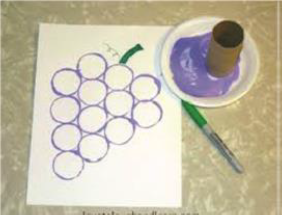
Create a painting of a bunch of grapes. Use a cardboard tube or rolled piece of sturdy paper for each child. Children dip the tube in purple paint and stamp circles on paper to make individual grapes. Then children can use a green crayon or marker to make stems and vines on the bunch of grapes. As children work, continue to discuss the things in their lives that are the “fruit” of living a life with God. You might create one before class as an example.
Send
Blessings of Community is one of the Enduring Principles of Community of Christ. Our church believes:
- the gospel of Jesus Christ is expressed best in community life.
- true community includes helping and including the poor and needy.
- true community upholds the worth of persons.
- sacred community provides nurture and growth opportunities for all people, especially those who cannot fully care for themselves.
- we value our connections and share a strong sense of trust in and belonging with one another—even if we never have met.
- we are called to create communities of Christ’s peace in our families and congregations and across villages, tribes, nations, and throughout creation.
—adapted from Sharing in Community of Christ, 4th Edition, pp. 31–32
Jesus is the True Vine who connects us to each other and to other people around the world. Invite each child to name something they can do to be a blessing to others in their church family, local community, or to the world. Discuss how the grapes on a vine are all connected just as we are all connected to each other. Allow children to eat another grape.
Bless
End with a prayer: “Thank you, God, for being the True Vine. Thank you for supporting us so we can bring good things to the world through you. Help us to stay connected to you always. Amen.”