

Worship Tools
Worship Outline
Additional Scriptures
Psalm 51:1–12; Jeremiah 31:31–34; Hebrews 5:5–10
Preparation
For the Prayer for Peace create several origami peace cranes. Directions can be found online.
Prelude
Spiritual Practice
Prayerfully consider the following statement from “We Proclaim Jesus Christ” found in Sharing in Community of Christ. How does this statement help you conclude your Lenten journey and lead you into Holy Week? print or project for all to see
We live and serve in hope that God’s kingdom of justice and peace will indeed come, bringing healing to the whole, groaning creation. Putting our trust in the Risen Christ, present among us by the Holy Spirit, we press on together, giving blessing, honor, and glory to God, now and forever more.
—Sharing in Community of Christ, 4th Edition,(Herald Publishing House, 2018), 60.
OR use the Lenten Examen later in the service
Welcome
Responsive Call to Worship
Leader: Have mercy on us, O God, according to your steadfast love;
People: according to your abundant mercy, blot out our transgressions.
Leader: Wash us thoroughly from our iniquity, and cleanse us from our sin.
People: For we know our transgressions, and our sin is ever before us.
Leader: Create in us clean hearts, O God,
People: and put a new and right spirit within us.
Leader: Do not cast us away from your presence,
People: and do not take your holy spirit from us.
All: Have mercy on all of us, O God.
—based on Psalm 51:1-3 10-11
Hymn of Praise
Encourage participants to sing in languages other than their own.
“All Creatures of Our God and King” CCS 98
OR “Louez le Seigneur!/Praise, Praise, Praise the Lord!” CCS 106
OR “God, Whose Grace Redeems Our Story” CCS 570
Translations into Spanish and French for this hymn can be found at: Herald House
Morning Prayer
Response
Prayer for Peace
Light the peace candle
Before the service, create several origami peace cranes. Directions can be found online.
Statement
In our 40-day observance of Lent, we have experienced Jesus’ journey toward Jerusalem and in a few days we will reflect on the unjust violence done to him. Many in our world experience injustice, hate, discrimination, and violence. We have received counsel in Doctrine and Covenants 165:1d to “Undertake compassionate and just actions to abolish poverty and end needless suffering. Pursue peace on and for the Earth.” Let us act on this counsel each day. As we sing the next song, I invite you to pass the peace cranes from person to person until all have handled one and then bring them to the front and place them in the worship setting.
Peace cranes are considered by many to be tangible prayers for peace. While the people sing “Put Peace into Each Other’s Hands”CCS 309, pass the cranes from person to person and ask the last ones who receive them to bring them to the front to be placed on the altar or worship setting.
Prayer
Invite participants to offer silent prayers for peace reflecting their hopes for a peaceful world.
OR ask participants for short verbal prayers for peace.
Reading of the Gospel Text: John 12:20–33
Music Ministry OR Community Hymn
“A Man of Ancient Time and Place” CCS 30
OR “In the Bulb There Is a Flower” CCS 561
OR “What Wondrous Love Is This” CCS 454
Lenten Sermon
Based on John 12:20–33
Lenten Examen: Meeting Challenges in New Ways
Lent invites us to slow down, and pay attention, making room for transformation. The Examen is a simple prayer practice reviewing the day or week with God, noticing what brought life, what was difficult, and where we might meet the challenges of life in new ways.
We trust that the Spirit is present in our joys and our challenges.
I invite you to pause for a moment, and take a few deep breaths, turning your attention inward as I ask these reflective questions:
What are you grateful for today? Notice the people, moments, and gifts that brought you life.
Invite God to help you look back on your day or week with honesty, compassion, and curiosity.
What moments were difficult, challenging, uncomfortable, or unexpected? What did they stir in you?
Where did you experience love, connection, courage, peace, or hope? Where did you see the Spirit at work?
Where might you have responded differently? What new way of meeting a challenge might be possible?
Release what you need to let go of: hurt, regret, fear, or old patterns. Allow grace in and the possibility of beginning again.
Offer the day ahead to God. Ask for openness to new possibilities and courage to meet whatever comes with love, compassion, and hope.
Prayer
God of new possibilities,
Help us see our lives with compassion and honesty.
Show us where new ways of responding are possible.
Help us release what no longer gives life and open us to your peace.
Give us courage to meet tomorrow with love, hope, and imagination.
Amen.
Disciples’ Generous Response
Scripture: Doctrine and Covenants 165:2f
Statement
Briefly explore this scripture as an invitation to generosity.
Question for Reflection: Are you extending your love to create a better tomorrow?
Unison Scripture Reading
print or project for all to see
Come to Christ, the Holy One of Israel, and partake of his salvation and the power of his redemption. Come to him and bring your whole soul as an offering. Continue fasting and praying and endure to the end; and as the Lord lives, we will be saved.
—Omni 1:46–47, adapted
Blessing and Receiving of Local and Worldwide Mission Tithes
Hymn of Commission
“Mighty God Who Called Creation” CCS 641
OR “When We Are Living/Pues si vivimos” CCS 242/243
Encourage participants to sing in a language other than their own.
OR “Lord, Whose Love” CCS 346
Benediction
Response
Postlude
Sacred Space: Small-Group Worship Outline
Gathering
Welcome
Today is the fifth Sunday of Lent. We join with other Christians who for many centuries have observed it as the 40 days between Ash Wednesday and Easter, not counting Sundays.
During Lent, we are helped to center our attention on Jesus as we remember his life and ministry. Lent provides a means to also sharpen our focus on our own lives in relationship to Jesus. The Lenten season also encourages us to turn away from whatever distracts or blocks our commitment to discipleship.
May the season of Lent help us walk with Jesus even though the path leads to the cross.
Prayer for Peace
Ring bell or chime three times slowly.
Light Peace Candle
Loving God,
We ask your spirit and guidance to all human beings to bring peace and justice to the nations of the earth.
Give your strength, clear wisdom and right motive and attitude to help us stop poverty, war, violence and all kinds of discrimination toward humankind facing great conflicts and issues throughout the whole world.
Inspire every human to work together to face the challenges and issues that occur. Let everyone consciously unite to deal with such global issues as poverty, war, violence, racism, sexism, cast, nationalism and global warming.
Enable us all to share unconditional love and resources delightfully and willingly, and treat everyone equally with dignity in every aspect of their life.
We invite your spirit and presence to bless the peacemakers of every nation as they bring love, peace, joy, hope, reconciliation, and healing of the spirit to all of your children. We ask this prayer in the name of the Prince of Peace, our Savior, Jesus Christ. Amen
—Nanda Malla
Spiritual Practice
Personal Reflection: Lent
Prayerfully consider the following statement from “We Proclaim Jesus Christ” found in Sharing in Community of Christ. How does this statement help you conclude your Lenten journey and lead you into Holy Week? Print or project the reading.
We live and serve in hope that God’s kingdom of justice and peace will indeed come, bringing healing to the whole, groaning creation. Putting our trust in the Risen Christ, present among us by the Holy Spirit, we press on together, giving blessing, honor, and glory to God, now and forever more.
—Sharing in Community of Christ, 3rd ed., (Herald Publishing House, 2012,
ISBN 9780830915736), 23.
End the reflection time by sounding a chime or bell.
Sharing Around the Table
John 12:20-33 NRSVue
20 Now among those who went up to worship at the festival were some Greeks. 21 They came to Philip, who was from Bethsaida in Galilee, and said to him, “Sir, we wish to see Jesus.” 22 Philip went and told Andrew, then Andrew and Philip went and told Jesus. 23 Jesus answered them, “The hour has come for the Son of Man to be glorified. 24 Very truly, I tell you, unless a grain of wheat falls into the earth and dies, it remains just a single grain, but if it dies it bears much fruit. 25 Those who love their life lose it, and those who hate their life in this world will keep it for eternal life.26 Whoever serves me must follow me, and where I am, there will my servant be also. Whoever serves me, the Father will honor.
27 “Now my soul is troubled. And what should I say: ‘Father, save me from this hour’? No, it is for this reason that I have come to this hour. 28 Father, glorify your name.” Then a voice came from heaven, “I have glorified it, and I will glorify it again.” 29 The crowd standing there heard it and said that it was thunder. Others said, “An angel has spoken to him.” 30 Jesus answered, “This voice has come for your sake, not for mine. 31 Now is the judgment of this world; now the ruler of this world will be driven out. 32 And I, when I am lifted up from the earth, will draw all people[a] to myself.” 33 He said this to indicate the kind of death he was to die.
—John 12:20-33 NRSVue
Jesus tells his disciples what is about to happen. He desperately wants them to understand his purpose, his mission, and what it means— that his death will be an act of love and the culminating moment of his life. He speaks in tones of fear and anxiety, yet in contrast to other gospel accounts, he flatly states he will not ask to be spared. “…It is for this reason that I have come….”
Some interpret Jesus’ act on the cross as an atoning sacrifice of innocent blood required by a God who demands ransom for justice. However, that interpretation is out of harmony with the nature of God revealed in the life and ministry of Jesus. The God revealed in Jesus is one of boundless love and grace, healing mercy and peace. God’s action of healing love reaches out through Jesus Christ to reconcile all the creation to God. Not in anger, but in radical selfless love.
Second, through his act, Jesus teaches the powerful pattern of life as a disciple and what is required to follow in the way of the Christ. Jesus speaks to the heart of suffering love, dying to self, transformation, and new life. It is not needless suffering, but suffering for the sake of others in acts of love that reflect the image of God seen in the face of Christ. In this way, we can stand in solidarity with those who suffer needlessly because of poverty and other forms of systematic injustice.
Jesus goes on to underscore that what God does through him is for the sake of the world. It is for all nations and people of the Earth. “…And I, when I am lifted from the Earth, will draw all people to myself.”
As we die to self and follow Jesus without reservation all the way to the cross, we embody the personality and love of Jesus Christ. In him, we realize the transformation, healing, and reconciling of humanity. Extravagant love affects every relationship, as we become one in community and one in Christ.
Questions
- How have you experienced suffering love, transformation, and new life?
- How does the “way of the world” hold us captive and lead to “death” individually and collectively?
- How have you experienced the extravagant love of God made real in Jesus Christ?
Sending
Generosity Statement
“Sharing for the common good is the spirit of Zion” (Doctrine and Covenants 165:2f).
We receive God’s grace and generosity. The offering basket is available if you would like to support ongoing small-group ministries as part of your generous response.
This month’s offering prayer is adapted from A Disciple’s Generous Response:
Constant God, May we be dependable disciples. Your unconditional love for each of us is expressed through the life and ministry of Jesus Christ. May we faithfully respond to that ministry as we are accountable to one another, to you, and ourselves. Amen.
Invitation to Next Meeting
Closing Hymn
Community of Christ Sings 450, “Lead Me, Lord” (sing twice)
Closing Prayer
Optional Additions Depending on Group
Sacrament of the Lord’s Supper
For I received from the Lord what I also handed on to you, that the Lord Jesus on the night when he was betrayed took a loaf of bread, and when he had given thanks, he broke it and said, “This is my body that is for you. Do this in remembrance of me.” In the same way he took the cup also, after supper, saying, “This cup is the new covenant in my blood. Do this, as often as you drink it, in remembrance of me.” For as often as you eat this bread and drink the cup, you proclaim the Lord’s death until he comes.
—1 Corinthians 11:23–26 NRSV
Communion Statement
All are welcome at Christ’s table. The Lord’s Supper, or Communion, is a sacrament in which we remember the life, death, resurrection, and continuing presence of Jesus Christ. In Community of Christ, we also experience Communion as an opportunity to renew our baptismal covenant and to be formed as disciples who live Christ’s mission. Others may have different or added understandings within their faith traditions. We invite all who participate in the Lord’s Supper to do so in the love and peace of Jesus Christ.
During this Lenten Season let us share in Communion as an expression of blessing, healing, peace, and community.
In preparation let’s sing from Community of Christ Sings 527, “Bread of the World.”
Blessing and serving the bread and wine.
Thoughts for Children
Materials: Small flashlight
Cards with this prayer:
Lord, We pray that we might shine with the love of Jesus for all to see. Amen.
Today is the last Sunday of Lent. During the season of Lent we spent time preparing for Easter. Many people observe Lent by fasting, or giving something up from Ash Wednesday until Easter. Others pray read scripture, or do things that help them be better disciples.
Each Sunday during Lent we are talking about something we can do to prepare for Easter.
Show the flashlight to the group.
- What is this?
- What is it used for?
Talk to the children about light:
- Light helps us see, it makes us feel safe, and it helps us find our way.
When we talk about Jesus we often say Jesus is the light of the world. Like a light, Jesus helps us feel safe and helps us find our way in life.
As disciples we can share the light of Jesus. We can be a friend to someone who is alone, we can share our belongings, or we can invite our friends to church.
Today we have a prayer that reminds us to share the light of Jesus.
Hand out prayer cards.
- Place the prayer by your bed and say the prayer each morning when you get up.
Let’s all read the prayer aloud together.
Lord, We pray that we might shine with the love of Jesus for all to see. Amen.
Sermon Helps
Exploring the Scripture
It is the festival of the Passover. Just before Jesus’ triumphal entry into Jerusalem, he raises Lazarus from the dead and receives Mary’s anointing of costly perfume. Greeks, disciples, supporters, detractors, and those conspiring against him are among those who surround him. The “hour” of his death draws near.
Jesus tells his disciples what is about to happen. He desperately wants them to understand his purpose, his mission, and what it means—that it will be an act of love and the culminating moment of his life. He speaks in tones of fear and anxiety, yet in contrast to other gospel accounts, he flatly states he will not ask to be spared. “…It is for this reason that I have come….”
We learn two ideas in this exchange. First, some interpret Jesus’ act on the cross as an atoning sacrifice of innocent blood required by a God who demands ransom for justice. However, to many that interpretation is out of harmony with the nature of God revealed in the life and ministry of Jesus. The God revealed in Jesus is one of boundless love and grace, healing mercy and peace. God’s action of healing love reaches out through Jesus Christ to reconcile all the creation to God. Not in anger, but in radical selfless love.
Second, through his act, Jesus teaches the powerful pattern of life as a disciple and what is required to follow in the way of the Christ. “Very truly, I tell you, unless a grain of wheat falls into the earth and dies, it remains just a single grain; but if it dies, it bears much fruit.” Using familiar agricultural imagery, Jesus speaks to the heart of suffering love, dying to self, transformation, and new life. It is not needless suffering, but suffering for the sake of others in acts of love that reflect the image of God seen in the face of Christ. In this way, we can stand in solidarity with those who suffer needlessly because of poverty and other forms of systematic injustice.
Jesus goes on to clarify the difference between a deep constant relation with God and self-love, smitten with the ways of the world. The first claims the connectedness of all creation through life-giving, transforming acts of love, strengthening each member of the whole. The second focuses on world systems of power over others, a fallen world of winners and losers, which eventually chokes out life and holds the world captive to systematic injustice filled with poverty, violence, fear, and “isms” of all kinds.
Such is final death, in contrast to death that leads to new life. “Those who love their life lose it, and those who hate their life in this world will keep it for eternal life.” Jesus reveals God’s nature and purposes in our world. Jesus offers poignant commentary on the abuse of power and resulting disconnect from a loving God who yearns to draw the world close in the wide circle of transforming love.
Jesus goes on to underscore that what God does through him is for the sake of the world. It is for all nations and people of the Earth, represented by the presence of Greeks in the pressing crowd as well as the words he shares. “This voice has come for your sake, not for mine…And I, when I am lifted from the Earth, will draw all people to myself’” (v. 30, 32).
As we die to self and follow Jesus without reservation all the way to the cross, we embody the personality and love of Jesus Christ. In him, we realize the transformation, healing, and reconciling of humanity. Extravagant love affects every relationship, as we become one in community and one in Christ.
Central Ideas
- Through the selfless act of Jesus Christ, we see and experience the extravagant nature of God’s love and wish to bring healing and reconciliation to all humanity.
- To follow Jesus with our whole lives means letting go of self and loving God and others without reservation. It calls us to suffering love for and with others for the sake of our world, binding our hearts and lives together in sacred healing community.
- Through Jesus, God’s boundless love and grace invite all into the circle of peace, reconciliation.
Questions for the Speaker
- How have you or your congregation experienced suffering love, dying to self, transformation, and new life?
- How does the “way of the world” hold us captive and lead to “death” individually and collectively?
- How can we (disciples, congregations, Community of Christ) be signals of the suffering love that bear fruit, bringing transformation and new life?
Lessons
Adult Lesson
Focus Scripture Passage
John 12:20–33
Lesson Focus
Suffering Love
Objectives
The learners will…
- explore the concept of suffering love.
- discuss what is expected of disciples.
- discover personal and collective responses to God’s love.
Supplies
- Bibles
- Community of Christ Sings (CCS)
Note to Teacher
In preparation for this lesson, read “Exploring the Scripture” for John 12:20–33 in Sermon & Class Helps, Year B: New Testament, pp. 55–56, available through Herald House.
Gather
Read aloud John 12:24–26 (below) and discuss the questions that follow each verse.
Very truly, I tell you, unless a grain of wheat falls into the earth and dies, it remains just a single grain; but if it dies, it bears much fruit (v. 24).
- What images stand out to you?
- What associations do you have with grain, wheat, earth, and fruit?
Those who love their life lose it, and those who hate their life in this world will keep it for eternal life (v. 25).
- How does this speak to your life?
Whoever serves me must follow me, and where I am, there will my servant be also (v. 26).
- What does the Lord require of you?
Engage
As the Lenten journey nears an end, the challenges of discipleship intensify. Earlier chapters in John tell of the raising of Lazarus from the dead, Mary anointing Jesus’ feet with expensive oil, and Jesus’ processional into Jerusalem. Set in the context of the Passover, Jesus directly focuses on death and life.
The passage begins with the arrival of Greeks seeking Jesus. While it is unclear whether they actually speak with Jesus, it is symbolic that Jesus’ message will reach far beyond the Jewish nation now and in future generations. It is timeless, and it is for everyone. The discourse gives a glimpse of what seekers will need to understand if they wish to “see” Jesus.
Grains of wheat must die if they are to become fruitful. Jesus foretells his death and expresses that his very soul is troubled. Even so he will not ask to be spared, as this is his purpose for coming to Earth. Jesus is willing to empty himself out in order to reveal the ultimate mercy and love of God. Through the Resurrection humankind can be reconciled to God whose love is boundless.
The challenge before disciples is to follow Jesus’ example. The twelve would be tested and maligned by forces intending to destroy their faith and witness. They, too, must remain faithful to the call in their lives. This challenge continues today as we die to selfish desires of security, power, and wealth. We are called more deeply into kingdom building through love for, service to, and sacrifice on behalf of those in our world who suffer needlessly.
- How might the hearers of this passage have understood it in Jesus’ time?
- How might it be heard today?
- What must “die” in order to be fruitful? In our life? In our congregation?
Respond
In “From a Trinitarian Approach to World Religions,” Anthony Chvala-Smith writes:
“God” as Christians use it is given its unique shape and texture, its meaning, from the person and work of Jesus of Nazareth; his birth, his Jewishness, his message about God’s kingdom, his mighty works, his befriending of sinners, his suffering under Pontius Pilate, his death for us, his risen and exalted life. When I say “God” I mean none other than the One revealed through Jesus Christ.
Jesus’ person and work [is] not a “back then” but a “here and now.” This same power is slowly, invisibly, transforming those who believe into creatures who can truly live for others and who can love God with the totality of our being, which is the purpose of human existence.
To say that “God is love” means that God is not a lonely, solitary self. Rather, it is to say that there is giving and receiving within the very life of God: in order for there to be true giving and receiving—the essences of love—there must be true others. Let me quote Milgliore: “[The doctrine of the Trinity wants to state that] God is self-expending, other-affirming, community building love.”
—Restoration Studies VIII, 2000
To know Jesus is to know the heart of God. We are invited to mirror the heart of God understanding the cost.
Community of Christ proclaims:
He [Jesus] taught his followers to love God, to love their neighbors, and to love their enemies. By eating with sinners, serving the poor, healing the unclean, blessing children, and welcoming women and men as equals among his disciples, Jesus declared that all persons are of worth in the sight of God.
—Sharing in Community of Christ, 4th Edition, p. 59
- What does Jesus’ life inform you about the essence of God?
- How is Jesus at work “here” and “now”?
- How have you or your congregation experienced suffering love, dying to self, transformation, and new life?
Send
Doctrine and Covenants 165:1b, d, 2f
As a spiritual venture, boldly follow the initiatives into the heart of God’s vision for the church and creation. Then, in response to growing insight about God’s nature and will, continue to shape communities that live Christ’s love and mission.
Undertake compassionate and just actions to abolish poverty and end needless suffering. Pursue peace on and for the Earth.
Sharing for the common good is the spirit of Zion.
- In response to this counsel, identify specific actions God may be calling you or your congregation to address.
- What might you or the congregation need to “die” to in order to be signals of suffering love that bear fruit?
- Spend time between now and Easter reflecting on the challenge of loving others as God loves us.
Bless
Sing or read the words of “Make Us, O God, a Church That Shares” CCS 657. Amen.
Youth Lesson
Focus Scripture Passage
John 12:20–33
Lesson Focus
Disciples are called to love as Jesus loves and to serve as Jesus serves in response to Jesus’ ultimate service of love, giving his life.
Objectives
The learners will…
- participate in the spiritual practice of Lectio Divina.
- evaluate how Jesus’ death is an act of love.
- create a plan to serve others.
Supplies
- Bibles
- Paper
- Chart paper or whiteboard
- Markers
- Pens
- Community of Christ Sings (CCS)
Note to Teacher
In preparation for this lesson, read “Exploring the Scripture” for John 12:20–33 in Sermon & Class Helps, Year B: New Testament, pp. 55–56, available through Herald House.
Gather
Today is the Fifth Sunday of Lent. Lent is a season of repentance, self-examination, reflection, and preparation for the coming of Easter. In the early church, Lent was a time to prepare new converts for baptism. Today, Christians focus on deepening their relationship with God. We will spend a few moments of class during Lent to engage in spiritual practices.
In recent years, the practice of Lectio Divina (Latin for “sacred reading”), sometimes called Dwelling in the Word, has become a more prominent spiritual practice in the life of Community of Christ. It provides opportunity for encountering God using sacred text. Listening deeply to the words opens us to an awareness of God’s invitation to us through a particular scripture passage or hymn text.
- Ask the class to sit comfortably or lie on the floor and enter a time of prayerful reflection. Invite them to relax their bodies and their breathing.
- Offer a prayer for guidance as you interact with the text.
- Using today’s scripture passage John 12:20–33, read the text four times to the class, each time with a different focus.
Lectio—Get a sense of the story or setting. Imagine the scene, senses, emotions, and tensions involved in the text. What do you see, hear, smell, or feel? (Allow time for prayer and reflection.)
Meditatio—Focus on meaning and understanding. What are the surface and underlying meanings? What does the text tell you about God? How do you relate to the text? (Allow time for prayer and reflection.)
Oratio—Focus on your emotional response. Do you feel joy, sorrow, fear, anger, or guilt? Share your feelings with God in prayer. Ask for help in listening deeply to these emotions and meanings. (Allow time for prayer and reflection.)
Contemplatio—Breathe deeply and calmly, entering a deep silent state of listening. Wait for whatever God may bring to you in the quietness. (Allow time for prayer and reflection.)
- When you feel your prayer and meditation have ended, offer a word of thanks to God to close your time with this practice.
- Ask students to share their experiences and understandings.
Engage
The scripture passage we are exploring with Lectio Divina has multiple layers of understanding for us to consider. The story begins with the festival of Passover, prior to Jesus’ triumphal entry into Jerusalem. He has raised Lazarus from the dead. Mary has anointed Jesus with perfume. All kinds of people are surrounding Jesus in the crowd. The tension in the story is beginning to heighten.
The arrival of the Greeks marks John’s intent to underscore that these non-Jewish individuals are seeking out Jesus. The words of the Greeks to Philip and Andrew, “Sir, we wish to see Jesus,” parallel the words of Jesus’ invitation to Philip and Andrew to “come and see.” Some commentaries say this similarity indicates the Greeks’ desire to become disciples.
Jesus responds to this inquiry by telling his disciples what is about to happen. He wants to be sure they understand the meaning of his purpose and mission—that his death will be an act of love. In the Gospel of John, Jesus flatly states he will not ask to be spared: “It is for this reason I have come…”
Verse 25, “Those who love their life lose it, and those who hate their life in this world will keep it for eternal life,” is one of the best-attested sayings of Jesus. Some form of this saying appears five other times in the other three Gospels. To love one’s life is the opposite of Jesus’ own actions. To love one’s life places that person outside of the community created by Jesus’ gift of his life, and leads to the loss of that life. To hate one’s life in this world is to declare your commitment to Jesus. Disciples are called to love as Jesus loves and to serve as Jesus serves in response to Jesus’ ultimate service of love, giving his life. This is not an act of needless suffering but suffering for the sake of others in acts of love.
The predictions of his death contain a play on words that we have seen before. Jesus says, “And I, when I am lifted up from the earth, will draw all people to myself,” again using the double meaning of “lifted up” to indicate the Crucifixion and his exaltation.
- Describe how Jesus’ death was an act of love.
- How would you explain the saying of Jesus, “Those who love their life lose it, and those who hate their life in this world will keep it for eternal life,” to friends or family?
- To love as Jesus loves. To serve as Jesus serves. What examples have you seen of this?
Respond
The call for disciples “to love as Jesus loves” and “to serve as Jesus serves” is important for our lives. In Community of Christ we express the mission of Jesus through five Mission Initiatives listed below. One of the initiatives Develop Disciples to Serve, responds to this call to be like Jesus. Those who respond to Jesus’ call make up the church. It is in community that God intends Christian faith to be lived in companionship with Jesus Christ and with other disciples in service to the world.
Invite People to Christ—Christ’s mission of evangelism
Abolish Poverty, End Suffering—Christ’s mission of compassion
Pursue Peace on Earth—Christ’s mission of justice and peace
Develop Disciples to Serve—Equip individuals for Christ’s mission
Experience Congregations in Mission—Equip congregations for Christ’s mission
Create a plan to serve together with a younger Sunday school class and experience the call for disciples to love as Jesus loves and to serve as Jesus serves.
- Speak with the pastor or other congregational leaders about a small project the youth can do with the children to meet the needs in the congregation (for example, straighten the sanctuary or entry, help with decorations for Easter, help with a small repair).
- Speak with the other class teachers to see if this can be done during class time or another time.
- Write down what you think will be important to share with the younger class about serving like Jesus.
Send
On a piece of paper, make two columns. Title the first column “Someone I Can Serve This Week” and the second column “How I Can Serve This Person.” Identify three people and ways to serve.
During the coming week, complete the service ideas you have identified.
Bless
Close class by reading together “The City Is Alive, O God” CCS 365.
Children’s Lesson
Focus Scripture Passage
John 12:20–33
Lesson Focus
God, Jesus Christ, and the Holy Spirit make up a loving, eternal community known as the Trinity. Jesus planted the seed to let the love of God and grow through all of creation.
Objectives
The learners will…
- examine the scripture passage.
- explore the concept of the Trinity.
- discuss ways to spread the love of God.
Supplies
- Bible or Lectionary Story Bible, Year B, by Ralph Milton, illustrated by Margaret Kyle (Wood Lake Publishing, 2008, ISBN 9781551455648)
- Apple and knife (you may use one apple to demonstrate or several apples to pass out as snacks afterward)
- (Optional) craft sticks (three per child), glue, and string or ribbon
- (Optional) Trinity shamrock, included with lesson
- World map
- Poster paper for each student
- Brown and green paint
- (Optional) plant template, included with lesson
- Markers or crayons
- Pens or pencils
- Community of Christ Sings (CCS)
Note to Teacher
In preparation for this lesson, read “Exploring the Scripture” for John 12:20–33 in Sermon & Class Helps, Year B: New Testament, pp. 55–56, available through Herald House.
Gather
Ask children to form a circle. Invite them to sing “Flower Garden” (lyrics included with lesson) to the tune of “The Farmer in the Dell.”
Take the children on a mini field trip outdoors to find various plants. Examine the plants to find roots and seeds.
Discuss how each seed found its resting place, grew into a plant, and then produced more seeds to make more plants. For more information about how seeds are dispersed, visit theseedsite.co.uk. Alternatively you can show pictures of plants or discuss familiar plants.
Engage
In today’s scripture passage, Jesus compared himself to a seed that must be planted to grow. He told the disciples he was going to die so that bigger, more amazing things could happen.
Read together John 12:20–33 or “A Seed Planted in the Ground” from the Lectionary Story Bible, Year B, pp. 90–91.
- What are some things that must change or end for something new to begin? Allow time for children to respond. (Ideas include caterpillars, school years, an exciting game, vacation, or other experience.) Sometimes the end of one thing only means it’s time for the beginning of something else. Jesus used the metaphor of a seed because people at that time were very familiar with farming and plants.
- When Jesus compared himself to a seed that must be planted, what was he trying to say? (he would die to rise again, he would be planted so his message could spread)
Jesus came to Earth to teach us more about God. Through Jesus we see that God is full of love, grace, mercy, and peace. Jesus’ suffering on the cross is not needless suffering, but suffering done in love for the sake of others. Jesus died on the cross not because God needs to literally replace our mistakes with a punishment. Instead Jesus gave himself out of love so that God could “reconcile all Creation, …to draw the world close in the wide circle of transforming love” (Sermon and Class Helps, p. 55). This is one example how Jesus and God interact, but we are also blessed with the Holy Spirit.
- Have you heard of the Trinity? What do you think that it means?
- In what ways do you experience God? In what ways do you experience Jesus Christ? In what ways do you experience Holy Spirit?
Cut an apple in half and let the children view the different parts of the fruit.
An apple has a core (including seeds), meaty flesh, and skin. They are all separate parts, but they are still part of the whole apple. This is like the loving community of the Trinity: God, Jesus Christ, and Holy Spirit.
Give each child three craft sticks. Write “God” on one stick, “Jesus Christ” on another, and “Holy Spirit” on the third. Glue the sticks together at the ends to form a triangle. When the glue dries, tie a string or ribbon through the triangle to serve as a hanger. Alternatively, have the children color the Trinity shamrock at the end of the lesson.
Have the children create a class description for the word “Trinity.” Children can share and write what Trinity means to them. Alternatively, write the list on a board or chart paper.
Respond
Show the children a map of the world. Locate Jerusalem and other places mentioned in the Bible story. Talk about the relatively small geographic area that Jesus traveled. Locate your home on the map and measure how far it is from Jerusalem.
Jesus’ message spread all the way over here! Where else do you think Jesus’ message has traveled? Community of Christ has 250,000 members in nearly 60 nations. Jesus’ message has spread around the world.
Though Jesus’ message of love and teachings about God started small like a seed, over time they grew and spread so that many more people knew about God’s love. It can be overwhelming to think about all the people in the world who need to know about God, or all the problems in the world that need to be solved. Afterall, you are just one person. However, remember that Jesus was one person and he was able to talk about God to a few people, who talked to a few more people, who talked to a few more people. And that is how God’s message of love spreads! It spreads through many individuals each doing a few small things to change the world.
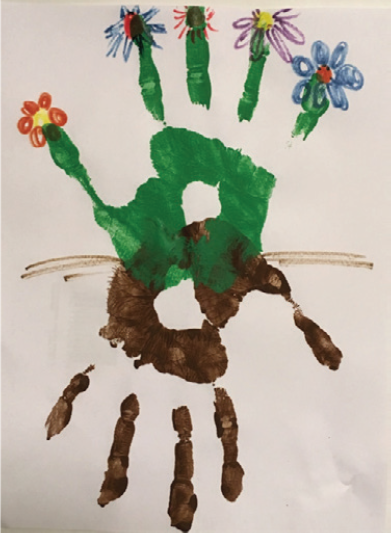
Give each child poster paper. Have them create a handprint plant. To make a plant, paint the palm of one hand brown and place it on the paper pointing down with fingers spread. Paint the other hand green and place it fingers pointing up and spread apart on the paper so the palms of each hand overlap slightly. Embellish as desired with crayons or markers. Alternatively, you can print out the plant template at the end of this lesson for children to color.
Send
Read Doctrine and Covenants 162:7a.
There are many lives waiting to hear the redeeming words of the gospel, or to be lifted from hopelessness by the hands of loving servants. But they will be lost to you without the generous response of disciples who share from their own bounty that others may know the joys of the kingdom.
Have each student brainstorm someone with whom they can spread the news of Jesus this week. Each can write and complete the following sentence under his or her plant: “This week I will tell _______ about Jesus.”
Bless
Have the children say the name of someone they want to tell about Jesus. Offer a prayer of blessing for those who were mentioned.
Invite children to sing “In the Bulb There Is a Flower” CCS 561, thinking about how God’s love can spread if we respond wholeheartedly.