

Worship Tools
Worship Outline
Communion included
Additional Scriptures
Genesis 12:1-9; Psalm 33:1-12; Matthew 9:9-13, 18-26
Preparation
Distribute 3×5 cards and something to write with to each person as they enter to be used during the Disciples’ Generous Response Activity. Provide a plate to receive the offerings and a basket to receive the cards.
Prelude
Joys and Concerns
Gathering Song: Trust
“The God of Abraham Praise” CCS 94
OR “Breathe on Me, Breath of God” CCS 190
Encourage participants to sing in languages other than their own.
Welcome and Scripture of Invitation
Doctrine and Covenants 157:16b, 17
Call to Worship Response Reading
Leader: Can we trust you, God? When we’re surrounded by deceit and corruption?
Everyone: We can trust you, God. You love us, although we can’t really understand it.
Leader: Can we trust in your grace, God?
Everyone: Out trust in your grace leads to hope.
Leader: How can we have hope when living is difficult?
Everyone: Our faith bridges this uncertain world with you.
Leader: What can we do to really know your grace, God?
Everyone: We will try to grow strong in faith to really know your grace.
Leader: We have hope in you, God, because of your righteousness made known in the faith of Jesus, his life, his sacrifice, and his resurrection.
Opening Hymn: Faith
“Praise the Source of Faith of Learning” CCS 174
OR “Tenderly, Tenderly, Lead Thou Me On” CCS 256
Prayer for Peace
Light the peace candle
Prayer of Examen
The prayer of Examen is a prayer form developed by St. Ignatius of Loyola (1491–1556). It is often a prayer for the end of the day but may be used any time as a way of reviewing with God. The intent is to recognize where we need forgiveness and healing, reconciliation and recommitment. The following is an adapted prayer of Examen. Lead the group through the prayer line by line. Take your time, inviting them to pray and meditate with each statement.
Thank you, God, for the gifts of life and this day.
Allow us to see the day as we have lived it and in light of Your will.
Let us reflect on the events, interactions, and emotions of the day.
Give us insight into the ways our responses were good, life giving, or healing.
Give us insight into the ways our responses may have been insensitive, unloving or damaging to others, creation, or self.
May we find in your grace and mercy: forgiveness, healing, reconciliation, and release.
God, we give our tomorrow to you. May you be present in our thoughts, actions, and relationships as we move on to live a new day in the presence of Christ.
Everyone: Christ be our peace. Amen.
Response
Scripture Reading: Romans 4:13-25
Ministry of Music OR Community Hymn of Faith
“God of the Ages” CCS 7
OR “How Firm a Foundation” CCS 250
Homily
Based on Romans 4:13-25
Disciples’ Generous Response
Activity
Invite participants to write on cards about a time when their faith led to hope. Play meditative music during the Activity.
Blessing and Receiving of Local and Worldwide Mission Tithes
As they put their offerings in the plate, have them leave the cards in a basket to signify God’s promise of generosity and love.
Reflection Poem: A Moment Apart
Alone, yet never alone
All….all this…this stuff.
This existence, each of these
monuments speaking of, showing
anew, the kingdom created
by and for the glory of God.
Why don’t they get it.
When will they begin to see,
to grasp, to understand that there
is everything they need right here
in their midst.
Father, I will do what is required.
I will be the body and blood of
the covenant that was established
with these your children.
My hope is for them to awaken from
this sleep of indifference, of following
after the gods of tradition, of choosing
that easy path that avoids responsibility
for acknowledging you in each, in all,
in everything that has been given.
Time to go. Thanks for listening…Again
—Dean L. Robinson, used with permission
Sacrament of the Lord’s Supper
Communion Scripture: Matthew 26:26-30
Communion Talk
Invitation to Communion
See the Invitation to Communion script.
Hymn of Preparation: Grace
“Come Thou Fount of Every Blessing” CCS 87
Encourage participants to sing in languages other than their own.
OR “Here at Thy Table, Lord” CCS 517
Blessing and Serving of the Bread and Wine
Pastoral Prayer
Hymn: Hope
“God is Calling” CCS 172
OR “There’s an Old, Old Path” CCS 244/245
Sending Forth
Let us go into the world, trusting in God with new faith and hope. Go with God.
Postlude
Sacred Space: Small-Group Worship Outline
Gathering
Welcome
Ordinary Time is the Christian calendar period from Pentecost to Advent. This part of the Christian calendar is without major festivals or holy days. During Ordinary Time we focus on our discipleship as individuals and as a faith community.
Prayer for Peace
Ring a bell or chime three times slowly.
Light the peace candle.
Today’s Prayer for Peace is inspired by hymn 212, “God Weeps,” from Community of Christ Sings. Shirley Erena Murray is the writer, and Mark A. Miller is the composer: “…and till we change the way we love, God weeps.”
God of weeping, we ask forgiveness for our failure as humanity to care for all. Our hearts break for the abused and hungry, the betrayed and bleeding, and the crying.
We are grateful that you weep, bleed, and cry with the oppressed. We pray that we would have the courage to do the same. May we open our hearts to the pain of the world, and in doing so may we help heal the world.
Help us listen so our nervous, certainty-craving minds would be open to new understandings of Christ. In the name of Jesus, the Way of peace. Amen.
Spiritual Practice
Body Prayer
Read the following to the group:
Today we are focusing on the Enduring Principle of Sacredness of Creation.
Our bodies are an amazing gift. Sometimes we don’t feel fully connected to our bodies. Our bodies often know things before we allow our mind to think them. When we pray with the movement of our whole body, we can receive a different insight than when in our normal prayer stance.
Read the following to the group:
I will show you the movements with some explanations. Then we will repeat the movements three times silently together.
We start with our hands in a prayer pose (hands pressed together in front of you). This centers us.
We raise our arms high. This opens us to the all-encompassing love of God.
We put our hands on our hearts. This reminds us to listen to the voice within.
We open our hands in front of our bodies. This offers our love to others.
We lift our hands to the sky. This reminds us to open ourselves to all.
We bring our hands down. This helps us gather and bring all to our heart.
We bring our hands back to the prayer pose. This brings us back to stillness and peace.
Repeat the movements three times. Read the following to the group:
Bow to one another and say, “Namaste” (I bow to you).
Sharing Around the Table
Romans 4:13–25 NRSVue
3 For the promise that he would inherit the world did not come to Abraham or to his descendants through the law but through the righteousness of faith. 14 For if it is the adherents of the law who are to be the heirs, faith is null and the promise is void. 15 For the law brings wrath, but where there is no law, neither is there transgression.
16 For this reason the promise depends on faith, in order that it may rest on grace, so that it may be guaranteed to all his descendants, not only to the adherents of the law but also to those who share the faith of Abraham (who is the father of all of us, 17 as it is written, “I have made you the father of many nations”), in the presence of the God in whom he believed, who gives life to the dead and calls into existence the things that do not exist. 18 Hoping against hope, he believed that he would become “the father of many nations,” according to what was said, “So shall your descendants be.” 19 He did not weaken in faith when he considered his own body, which was already as good as dead (for he was about a hundred years old), and the barrenness of Sarah’s womb. 20 No distrust made him waver concerning the promise of God, but he grew strong in his faith as he gave glory to God, 21 being fully convinced that God was able to do what he had promised. 22 Therefore “it was reckoned to him as righteousness.” 23 Now the words, “it was reckoned to him,” were written not for his sake alone24 but for ours also. It will be reckoned to us who believe in him who raised Jesus our Lord from the dead, 25 who was handed over for our trespasses and was raised for our justification.
—Romans 4:13–25 NRSVue
This passage hearkens us to when God made a covenant with Abraham. In this passage an infertile woman is promised children based on the parent’s “righteousness of faith” and continues with the story of just how those children are conceived. While some aspects of the story can make us uncomfortable, we find deep meaning as we explore the passage as an expression of faith in the divine/human encounter.
To be “reckoned as righteousness” means the relationship was made right with God. That was from no physical action, but Abraham’s trust and awareness with God. While our faith does not beget grace, grace begets faith. It is birthed and nurtured in this place of divine mystery.
As believers we acknowledge a God with knowledge greater than our own. Our faith is exercised as we step into the dark, as we trust, as we search for greater knowledge and understanding. We often find we must rest in the unknown as our faith develops and grows in our relationship with God.
We experience a sense of liberation and nervousness when we relinquish the direction we want to go and open our eyes to the mystery of God and the sacred path. We do not know where it will lead exactly, but we trust a deepening of the divine relationship will happen—likely in a way we least expect.
Questions
- How has your faith deepened or grown?
- When have you experienced divine mystery in your spiritual journey?
- What examples do you see today of God reconciling relationships or “reckoning people for righteousness?”
Sending
Generosity Statement
Beloved Community of Christ, do not just speak and sing of Zion. Live, love, and share as Zion: those who strive to be visibly one in Christ, among whom there are no poor or oppressed.
—Doctrine and Covenants 165:6a
The offering basket is available if you would like to support ongoing, small-group ministries as part of your generous response.
This offering prayer is adapted from A Disciple’s Generous Response:
Discipling God, as we navigate our world of debt and consumerism, help us to save wisely, spend responsibly, and give generously. In this way may we prepare for the future and create a better tomorrow for our families, friends, the mission of Christ, and the world. Amen.
Invitation to Next Meeting
Closing Hymn
Community of Christ Sings 172, “God Is Calling”
Closing Prayer
Optional Additions Depending on Group
- Sacrament of the Lord’s Supper
- Thoughts for Children
Sacrament of the Lord’s Supper
Communion Scripture
Choose one scripture to read from this selection: 1 Corinthians 11:23–26; Matthew 26:17–30; Mark 14:12–26; Luke 22:7–39.
Invitation to Communion
All are welcome at Christ’s table. The Lord’s Supper, or Communion, is a sacrament in which we remember the life, death, resurrection, and continuing presence of Jesus Christ. In Community of Christ, we also experience Communion as an opportunity to renew our baptismal covenant and to be formed as disciples who live Christ’s mission. Others may have different or added understandings within their faith traditions. We invite all who participate in the Lord’s Supper to do so in the love and peace of Jesus Christ.
We share in Communion as an expression of blessing, healing, peace, and community. In preparation let’s sing from Community of Christ Sings (select one):
- 515, “In These Moments We Remember”
- 516, “Coming Together for Wine and for Bread”
- 521, “Let Us Break Bread Together”
- 525, “Small Is the Table”
- 528, “Eat This Bread”
Bless and serve bread and wine.
Thoughts for Children
You will need:
- coloring supplies
- paper
In today’s scripture, the writer refers to a story that had been told in this community for years and years to remind those reading his words about an important lesson.
Our stories are important. Today, we are going to use a spiritual practice to help us connect with our story.
Let’s take three deep, peaceful breaths together.
Think about your own story, who you are, and how you are wonderfully created.
Think about an event, a day, or a time that was important or special to you and helped you be who YOU are.
Draw a picture about that time. Use your colors or markers to write some words about that time. If you need to, ask for help writing words that describe that time.
Now let’s share our stories and our pictures.
This week, let’s celebrate our stories and be confident in who we are.
Resource: Sharing My Story spiritual practice from “All Things Are Spiritual,” www.allthingsarespiritual.org.
Sermon Helps
Exploring the Scripture
Last week began a 15-week series from Paul’s letter to the Romans. The letter was Paul’s effort to introduce himself and summarize his perspective on the nature of God, Christ, the church, and life as a disciple. The Christian faith was still new. Neither Paul nor his contemporaries had answers to the questions and controversies that would later divide Christianity. Paradox, simple reasoning, and obscure explanations mix with clear, straightforward affirmations—fertile ground for later theological exploration and digression.
Paul uses the religious history of the Jews to summarize God’s long-ranging plan for salvation. His purpose was to convince the Romans that faith, rather than Law, is the gauge for claiming God’s promise and grace. Today’s passage focuses on Abraham, a faith model and the “father of many nations” (v. 17).
In a culture that believed both human and divine beings were ruled by an unchangeable cycle of life and death, Abraham heard God calling him to do a something new. In faith, he left his home in Ur to travel to a new land. In return, God promised that he would father a great nation, despite his age. Through him, “all the families of the earth shall be blessed” (Genesis 12:3). Abraham was a Chaldean, not a Jew. God’s promise came before any wandering Hebrews before “Jews” were a people before there was Moses-the Law-Giver. Abraham “believed the Lord, and the Lord reckoned it to him as righteousness” (Genesis 15:6). “Righteousness” meant being in a right relationship with God.
Paul’s interpretation affirms Abraham as the father of both Jews and Gentiles—all who trust God and act on faith. Trying to win God’s approval by obeying the Law is doomed. No one can obey the Torah one hundred percent of the time. Therefore, God’s wrath (holy judgment) is certain. The promise becomes a threat. Besides, using the Law as the gauge for righteousness is futile for Gentiles who do not know the Law (v. 15). Instead, the gauge for being right with God must be faith, given by God through grace.
Only a God of surprises, who “gives life to the dead and calls into existence the things that do not exist” (v. 17), can turn an elderly, childless man with a barren wife into the “father of many nations.” Abraham’s faith in a life-giving Creator put him into the right relationship with God. The faith of those who believe that God raised Jesus from death into life is also “reckoned to them as righteousness.” In other words, they, too, have built the right relationship with this God of the Impossible. Faith counts as fulfilling all the Law. Christ’s resurrection is proof of God’s ability to bring life out of nothingness.
Twenty-first-century believers doubt miracles, rely on reason, and scoff at the impossible. Or, we act as though we have the power to make the impossible happen if our faith is strong enough. Paul reminds us 1) that with God, all things are possible, and 2) faith is a gift, not a weapon with which to blackmail God into doing what we want. God gives faith to all those with open hearts and then counts it as righteousness.
Central Ideas
- Rather than adherence to Jewish Law, faith is the gauge for claiming God’s promise and grace.
- Look for the acts of God in the strange and unexpected—and then respond in faith.
- Jews, Gentiles, all humankind are called to covenant with God in right relationships. There are no exceptions.
- Faith is a gift given by grace from a God for whom all things are possible.
Questions for the Speaker
- How has Christianity continued to promote Law, rather than faith, as the test of righteousness?
- What journey into the unknown is God calling you to undertake?
- How has God displayed restorative and creative power within your congregation or community?
- When has someone surprised you by being in right relationship with God? What does that say about grace and judgment?
- If faith is a God-given gift, why doesn’t everyone show unwavering faith in Christ?
Lessons
Adult Lesson
Focus Scripture Passage
Romans 4:13–25
Lesson Focus
Faith is God’s Blessing.
Objectives
The learners will…
- explore the text of Romans 4:13–25.
- discuss Paul’s counsel about faith.
- review Abraham’s faithful responses.
- create a plan to bring people into the fellowship to help them recognize the faith that God implanted in them.
Supplies
- Self-Survey questions (end of lesson)
- Pens or pencils
- Bibles or printed handouts of Romans 4:13–25 for each class member
- Community of Christ Sings (CCS)
Note to Teacher
In preparation for this lesson, read “Exploring the Scripture” for Romans 4:13–25 in Sermon & Class Helps, Year B: New Testament (with focus on the Letters), pp. 53–54, available through Herald House.
Gather
After welcoming attendees, distribute copies of the self-survey (end of the lesson) and pencils or pens as needed. Inform them that this is only for themselves and won’t be shared. Invite them to keep and use the survey page to make notes of anything explored today they want to remember. Allow 2–3 minutes to complete the self-survey.
Distribute Bibles or printed copies of the Romans text. Invite class members to consider their responses to the survey, listening for insights related to survey questions as you read Romans 4:13–25. Invite them to follow along silently as you read.
Engage
A common brainteaser asks the question: Which came first, the chicken or the egg? Reading this text from Romans looks at a similar type of brainteaser but instead of posing it as a question, states it as an answer or fact.
Several years before Paul penned this letter, Jews had been ordered to leave Rome. By the time Paul wrote, there is evidence that the edict that banned the Jews from Rome had been lifted. During the intervening years, Gentile Christians would have become more prominent in the newly forming church community. This may have led to tensions and conflicts as Jews returned to rejoin the fellowship.
In this letter, Paul laid out the case that both groups of believers—Jews and Gentiles—were heirs of Abraham: the one by being physical descendants, and the other by being “children” of Abraham in a metaphorical way.
- According to the text in Romans, which came first to Abraham, the law or faith? (The promise about Abraham’s descendants is in Genesis chapter 15; the law comes in chapter 17.)
- Why might Paul have stressed this point?
- If the law had come first, what difference would that have made to Gentile Christians?
- Ian S. Markham stated that Paul, in reflecting on Abraham’s experience, declares: “…faith in the promise is God’s primary expectation of humanity” (Feasting on the Word, Year B, Volume 2). What might that imply today?
Respond
We often remember Abraham’s story thinking that his belief in God’s promise—that he would be the father of many nations (not a single nation)—was a bit shaky. After all, he knew how old he was. He knew Sarah was long past the age to conceive. He had even tried to create an heir by a slave to bear him a child. That may not seem like the actions of someone who had faith that God would accomplish what had been promised. Paul wrote in verses 19–20 “He did not weaken in faith…No distrust made him waver.”
Scholar Jeff Paschal asks: “Could it be that Paul is looking at Abraham’s faith…as strong and unwavering, not because he never doubts, not because he never tries to take matters into his own hands, but because Abraham actually does trust in God’s promises enough to take risks and step out in faith.” (David L. Bartlett and Barbara Brown Taylor, eds. Feasting on the Word, Year B, Volume 2, 2008), 67)
Discuss
- How might this interpretation help us see that:
- “God is calling forth a courageous church that takes risks and trusts, rather than living the spiritually immobile life of simply trying not to make any mistakes.” (Jeff Paschal) and that
- “The challenges and opportunities are momentous. Will you remain hesitant in the shadows of your fears, insecurities, and competing loyalties? Or will you move forward in the light of your divinely instilled call and vision?” (Doctrine and Covenants 164:9e)
- It has been said that only God can create faith because it is a gift. Do you agree or disagree? Why?
- What opportunities might the church community have to nurture the stirrings of faith in seekers and newly baptized or confirmed believers?
Invite class members to revisit the self-survey, editing their answers based on today’s discussions. (If they ask, the answers are 1-F, 2-T, 3-T, 4-F, 5-T.
Send
Encourage participants to form groups of two or three.
- Ask them to formulate one idea about how to invite others into the fellowship of the congregation. Remind them of this part of the mission prayer: “Grant me courage to risk something new.”
- Ask them to envision what that might be in the context of your congregation. Provide enough time so that each group can share their ideas.
Bless
Sing or read together “With a Steadfast Faith” CCS 649.
Read the Enduring Principle: Developing Disciples to Serve from Sharing in Community of Christ, 4th Edition, 2018, p 23.
Develop Disciples to Serve—Equip individuals for Christ’s mission
We are poised to equip men, women, and children to be true and living expressions of the life, ministry, and continuing presence of Christ in the world.
Self-Survey
True or False:
- In the book of Genesis, the people were given the covenantal law before God revealed a promise to Abram (Abraham) about descendants.
- The “law” makes our agency central.
- Faith precedes and shapes our obedience.
- Going out on our own to plan new ways of “being the church” shows a lack of faith.
For the Apostle Paul, the object of faith is the God who has the power to conquer death.
Youth Lesson
Focus Scripture Passage
Romans 4:13–25
Lesson Focus
Have faith in God’s promises.
Objectives
The learners will…
- explore what it means to have faith by remembering the story of God’s covenant with Abraham and Sarah as it relates to today’s scripture passage.
- contemplate their faith in statements that are hard to believe.
- consider praying the Mission Prayer as a personal act of courage and faith.
Supplies
- Blindfold
- Small treat
- Bible, International Children’s Bible, if available
- Paper and pens or pencils
Note to Teacher
In preparation for this lesson, read “Exploring the Scripture” for Romans 4:13–25 in Sermon & Class Helps, Year B: New Testament (with focus on the Letters), pp. 53–54, available through Herald House.
Gather
Ask for a brave volunteer to join you at the front of the room. Place a blindfold over the student’s eyes. Ask the volunteer: Are you nervous? Ask the rest of the class: Do you think they are nervous? How can you tell? Next, tell the volunteer to open their mouth wide. Again ask: Are you nervous now? Then place the treat on their tongue. Allow them to take the blindfold off and ask the following discussion questions:
- How did it feel to blindly follow directions?
- Would you have followed the same directions if a stranger was giving the commands?
- How do you know when it’s safe to follow someone’s directions and when you shouldn’t?
- What does it mean to have faith?
Today’s lesson is about having faith in God despite what seemed like ridiculous instructions from God.
Engage
The scripture text for today is in the book of Romans; it references a story that was written hundreds of years earlier in the Old Testament. To understand today’s scripture passage, we need to understand the story of Abraham and Sarah.
Invite the students to talk about what they know about Abraham and Sarah. Then, provide missing details in this synopsis:
The story of God’s promise to Abram and Sarai (God later changed their names to Abraham and Sarah) is found in Genesis chapters 15 to 17. God made a covenant with Abram saying that he and Sarai would become the father and mother of many nations and their descendants would number more than all the stars in the sky. Then God changed their names. God’s agreement with them would extend to all their descendants. The problem was that Abraham and Sarah were very old (in their late 90s) and were childless. Trusting God’s promise would be difficult. The agreement made was that every male would be circumcised as a sign of this trust in God’s promise. Abraham believed God and did as he had promised having all the males in his household circumcised, including himself.
Abraham and Sarah had a son, Isaac, born to them the following year. Through Isaac’s descendants God’s promise to Abraham and Sarah was fulfilled. In fact, the descendants of Abraham include those who belong to Judaism, Christianity, and Islam. Jesus is a descendant of Abraham.
Read Romans 4:13–25 from the International Children’s Bible, if available.
- It was not through the law that Abraham and Sarah received the promise that they’d be parents of an entire nation. It was through what?
- What is God’s promise to us?
- How might we show faith in God?
Several years before Paul wrote this letter, the Jewish people had been ordered to leave Rome. By the time Paul wrote, there is evidence that the edict that banned the Jewish community from Rome had been lifted. During the intervening years, Gentile Christians would have become more prominent in the newly forming church community. This may have led to tensions and conflicts as Jews returned to rejoin the fellowship.
In this letter, Paul laid out the case that both groups of believers—Jews and Gentiles—were heirs of Abraham: the one by being physical descendants, and the other by being “children” of Abraham in a metaphorical way.
Respond
Begin a discussion about what it means to believe something that seems difficult to believe by sharing some of these “Hard to Believe Facts.” Invite the students to share some that they have heard. Discuss which ones they have trouble believing and why believing in some things can be difficult.
- Squirrels cause the most power outages in the United States. May to June and October to November are prime times of year for “squirrel attacks” on power lines.
- You can tell the outside temperature by counting a cricket’s chirps. If you count how many times a cricket chirps in 15 seconds and then add 37, you’ll get the approximate current temperature in degrees Fahrenheit.
- Children of identical twins are genetic siblings (half siblings), not cousins.
- Costco sells enough toilet paper per year (about one billion rolls) to wrap around the world 1,200 times.
- The tiniest snail ever discovered can fit through a needle’s eye. The Angustopila dominikae snail, discovered in 2014, are just 0.03 inches (or 0.86 millimeters) tall. Ten of them could fit in the eye of a needle at one time.
- The fastest growing plant on Earth grows so fast, it’s measured in miles per hour. Bamboo can shoot up 35 inches every day at a rate of 0.00002 miles per hour, according to Guinness World Records.
—Adapted from bestlifeonline.com
Verses 19–20 state: “Abraham thought about all this. But his faith in God did not become weak. He never doubted that God would keep [God’s] promise. Abraham never stopped believing. He grew stronger in his faith and gave praise to God.”
- Why do you think Abraham believed God?
- How much of believing depends on who is telling us or where the information originates? Why does that matter?
Send
Praying the Mission Prayer is a prayer of faith. When we pray, we’re asking God to guide us where God’s Spirit is at work so we can become part of that work. It’s a prayer asking for courage to risk and act for God. While we can easily slip into a memorized repeat of this prayer, it is primarily a prayer of courage and faith.
Imagine Abraham and Sarah also praying a version of the Mission Prayer. It might go something like this:
God, where is your Spirit leading today?
Help us be alert and ready to respond.
Give us courage to trust you and give us faith to respond.
Help us become a blessing of your love and peace for the descendants which you’ve promised us.
Amen.
Spend a couple of minutes composing a mission prayer for your life. What would your prayer be?
Bless
For those who are comfortable, invite class members to share their created mission prayers to end the class time.
Children’s Lesson
Focus Scripture Passage
Romans 4:13–25
Lesson Focus
Have faith—like Abraham and Sarah—in God’s promise.
Objectives
The learners will…
- read and learn about the story of Abraham and Sarah.
- participate in a faith simulation.
- create praying hands with faith prayers.
Supplies
- Small treat
- Blindfolds (enough for half the class)
- Bible or Lectionary Story Bible, Year B, by Ralph Milton, illustrated by Margaret Kyle (Wood Lake Publishing, 2008, ISBN 9781551455648); and Lectionary Story Bible, Year A, by Ralph Milton, illustrated by Margaret Kyle (Wood Lake Publishing, 2007, ISBN 9781551455471)
- Chairs (enough for half the class)
- Colored construction paper (1 paper per child)
- Markers
- Bible
Notes to Teacher
In preparation for this lesson, read “Exploring the Scripture” for Romans 4:13-25 in Sermon & Class Helps, Year B: New Testament (with focus on the Letters), pp. 54–54, available through Herald House.
Gather
Ask for a brave volunteer to join you at the front of the room. Place a blindfold over the child’s eyes. Ask the child: Are you nervous? Ask the rest of the class: Do you think they are nervous? How can you tell? Then tell the child to stick out their tongue. Again ask: Are you nervous? Place the treat in their hand and invite them to taste it. (Note: Be sensitive to any food allergies.) Allow them to take the blindfold off and ask the following discussion questions:
- How did it feel to blindly follow directions?
- Would you have followed the same directions if a stranger—instead of me—was giving the commands?
- How do you know when it’s safe to follow someone’s directions and when you shouldn’t?
Today’s lesson is about having faith in God despite what seemed like ridiculous instructions from God.
Engage
The scripture for today is in the book of Romans, which is in the New Testament. However, it refers to a story that was written hundreds of years earlier in the Old Testament. To understand today’s passage, we need to understand the story of Abraham and Sarah from the Old Testament.
Note: The story of Abraham and Sarah is found in Genesis chapters 15 to 17. You can also find it in the Lectionary Story Bible as follows:
Year A: pp. 80–81, 128–12, 133–134, and 142–144
Year B: pp. 80–81
Alternatively, you can provide a short synopsis filling in details as appropriate:
The story of God’s promise to Abram and Sarai (God later changed their names to Abraham and Sarah) is found in Genesis chapters 15 to 17. God made a covenant with Abram saying that he and Sarai would become the father and mother of many nations and their descendants would number more than all the stars in the sky. Then God changed their names. God’s agreement with them would extend to all their descendants. The problem was that Abraham and Sarah were very old (in their late 90s) and were childless. Trusting God’s promise would be difficult.
Abraham and Sarah had a son, Isaac, born to them the following year. Through Isaac’s descendants God’s promise to Abraham and Sarah was fulfilled. In fact, the descendants of Abraham include those who belong to Judaism, Christianity, and Islam. Jesus is a descendant of Abraham.
Tell the story of Abraham and Sarah. Discuss the following questions as you progress through the story:
- How did Abram and Sarai show faith in God?
- Is it easy to just pack up your things and leave without knowing where you’re going?
- Have you ever followed someone without knowing where you were going?
- Why was it so unbelievable that Sarah and Abraham would have a baby at their age?
- How did Abraham and Sarah show faith in God?
Respond
Abraham and Sarah had to trust that God’s promises would eventually come true. They had to put all their faith in God and listen to the commands they’d been given, even when things seemed unrealistic or too difficult.
Note: This segment of the lesson may work better in a room other than your normal meeting space; someplace where the children are less familiar.
Faith Walk
Form partners. One partner gets blind folded and spun around several times. The other partner moves to the other end of the room; they must give their partner instructions about where to walk around the room ensuring the blindfolded partner doesn’t run into anything. As the blindfolded partners near the other side of the room, tell them that when you give the command, they should sit down. As you are explaining this, quickly and quietly invite the other partner to bring out a chair and position it so that the blindfolded partners will be able to sit in it. When ready, give the command to sit down. Once safely seated, remove the blindfold.
- To the blindfolded partners: How did it feel to not know where you are going or what was going to happen?
- To the other partners: Was it difficult to explain where to navigate? Did your partner always listen intently and follow your instructions?
- When the blindfolded partner was told to sit, they had to have faith that there was a chair. Faith is believing in something we cannot see. When do you trust or believe something you can’t see?
Just like some of you had to listen to instructions to know what to do and where to go, we must listen to God. We must have faith and trust that God knows what is best. Faith is not being able to see but trusting the One who can.
—adapted from betterbibleteachers.com
The scripture for today references Abraham and Sarah’s faith in God. Read Romans 4:13-19 from the Lectionary Story Bible, Year B.
- What is God’s promise to us?
- How might we show faith in God?
Send
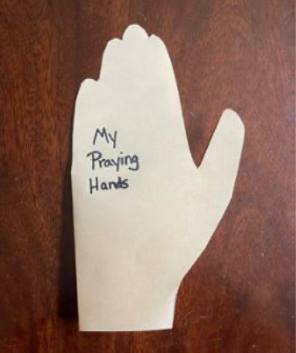
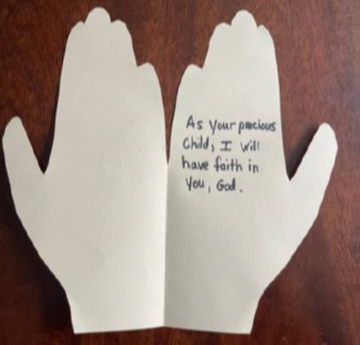
Fold a piece of construction paper in half hamburger style. Place the child’s left hand with the pinkie on the folded edge, fingers together facing up. Trace around their hand with a marker. Cut out their hand, ensuring that where their pinkie meets the folded edge doesn’t get cut. It should create praying hands that fold like the picture.
On the front of the hands, write “My Praying Hands.” On the inside have older children write their own prayer of faith. For younger children, have them draw a prayer picture, write prayer statements for them, or have pre-printed statements for them to glue inside their praying hands. For example: As your precious child, I will have faith in you, God.
Bless
Ask the children to repeat after you: “I will have faith in you, God.” Explain that they should repeat that phrase every time you point at them. Read the following prayer:
God, thank you for all the beautiful blessings in this world. I am truly amazed and do not understand the intricacies of your creation.
(Point) I will have faith in you, God.
Sometimes I get overwhelmed with everything I am supposed to be doing. There’s only so much I can do.
(Point) I will have faith in you, God.
Sometimes I am distraught. Bad things happen. It feels like nothing is going right.
(Point) I will have faith in you, God.
Sometimes I don’t understand what I’m supposed to do or which choice to make. Life can be so confusing.
(Point) I will have faith in you, God.
Like Abraham and Sarah, I am trying to listen to you. I know that I am your precious child, so…
(Point) I will have faith in you, God.
Amen.