

Worship Tools
Worship Outline
Additional Scriptures
Psalm 139:1-12, 23-24; Matthew 13:24-30, 36-43; Romans 8:12-25
Preparation
For the Focus Activity, create and display posters with photos or illustrations of physical locations significant for your participants, labeled 1, 2, 3. Examples: reunion grounds, the church sanctuary, a church-in-the-wild setting. Also create a poster with a large question mark, labeled 4. Place a stack of sticky notes by each poster.
If displaying pictures electronically, create four slides with similar pictures as mentioned above. Label them 1-4. During the Focus Activity, rotate through the electronic pictures more than once.
Ahead of time, invite three people of any age to be the voices of the Scripture Dialog.
Prelude
Welcome
Sung Call to Worship
“Santo, santo, santo/Holy, Holy, Holy” repeat several times CCS 159
Encourage participants to sing in languages other than their own.
OR “Praise God from Whom All Blessings Flow” sing twice CCS 53
Encourage participants to sing in languages other than their own.
OR “God Within God Around” repeat several times CCS 20
Encourage participants to sing in languages other than their own.
Translations into Spanish and French for this hymn can be found at: www.heraldhouse.org
Praying the Psalm: Psalm 139:1-12, 23-24
This can be:
one reader;
several readers placed around the worship space;
the whole group, divided into sections of the scripture;
a speech choir; or
something you create unique to your group.
Read slowly, allowing time for reflection. Add an “Amen” to the final verse.
Sung Response
“Dios está aqui/God Is Here Today” CCS 150
Encourage participants to sing in languages other than their own.
OR “Herr, du mein Gott/You Are My God” CCS 12
Encourage participants to sing in languages other than their own.
OR “O Lord Hear My Prayer” CCS 192
Scripture Dialog: based on Genesis 28:10-19a
A Reading for Three Voices at the end of the service outline
Focus Activity
Invite people to look at the pictures displayed in front or on the screen and think about whether they had a personal experience sensing God at one of the places pictured (1-3) or in some other setting (the question mark). Ask them to place a blank sticky note on the best match. Invite those joining electronically to write down their number choice.
Community Sharing
When people have returned to their seats ask them to pause for a few quiet minutes to remember the experience they had when encountering God in the place they identified with their sticky note or had written down. Ask them to think about the following:
Was this unexpected, or were you seeking God?
In what way did this experience influence your life?
Invite two or three to share their reflections with those gathered.
Prayer for Peace
Light the peace candle
Statement
No matter where we live or what our circumstances are in life, there are times most of us feel lost and uncertain. Peace may seem out of reach. But if we have been able to attend church family camps (reunions) or youth camps or retreats or other gatherings, we may have for a short period of time experienced the blessing of peace. Sometimes that comes from the fellowship, sometimes from worship experiences, or sometimes from being in a place that fosters renewal.
If you have ever felt the divine presence blessing you with peace when you needed it most, remember that feeling and vow to help create opportunities for others to experience it too.
Prayer
Divine One,
We are very grateful for the times we have felt or glimpsed what your peaceable kingdom might be and for the times you blessed us personally with sensing your love and concern. Today we pray for the people of the world that the feelings of being lost, alone, hopeless, and fearful will be tempered by sensing you walking with each one into peaceful living. Help guide us toward the future you would have for all humankind and other kind. Help us sense that you are in all places with all people. Amen.
Morning Message
Based on Genesis 28:10-19a
Some suggestions:
Tell about the history of how the Genesis text came to be written. The Oxford Annotated New Revised Standard Version has a detailed description that prefaces Genesis.
Relate the saga in Genesis to Community of Christ’s basic belief about God. “We believe in one living God who meets us in the testimony of Israel, is revealed in Jesus Christ, and moves through all creation as the Holy Spirit. –Sharing in Community of Christ Exploring Identity, Mission, Message, and Beliefs, fourth edition, (Herald Publishing House: Independence, MO), 2018, 33.
Remind people of the Community of Christ statement about scripture See: Sharing in Community of Christ Exploring Identity, Mission, Message, and Beliefs, fourth edition, (Herald Publishing House: Independence, MO), 2018, 63-65.
Explore how this text might have been significant for its first hearers in the oral tradition.
Explore how this text might be meaningful in today’s world and our own discipleship journeys.
Disciples’ Generous Response
Statement
God is present with us even when we are often unaware like Jacob. Those times when we do sense God help us better understand that God’s presence is a universal truth. Another such truth is that God is generous with unmerited love and mercy for us and all others, even those who seem like enemies.
We can never equal God’s generosity toward us, but we can be generous toward others in love, in respect, in compassion, and in giving of our resources and time in whatever way we are able to support the mission of the church which is Christ’s mission.
Blessing and Receiving of Local and Worldwide Mission Tithes
Closing Hymn
“I Know Not What the Future Hath” CCS 246
OR “Into My Heart” sing several times CCS 573
Encourage participants to sing in languages other than their own.
OR “Sizohamba Naye/We Will Walk with God” sing several times CCS 377
Encourage participants to sing in languages other than their own.
Benediction
Sending Forth
Know that I am with you and will keep you wherever you go, and will not
leave you until I have done what I have promised you.
—Genesis 28:15, adapted
Postlude
Scripture Dialog: based on Genesis 28:10-19a
A Reading for Three Voices
Narrator: Jacob left Beer-sheba and went toward Haran. He came to a certain place and stayed there for the night, because the sun had set. Taking one of the stones of the place, he put it under his head and lay down in that place. And he dreamed that there was a stairway set up on the earth, the top of it reaching to heaven; and the angels of God were ascending and descending on it. And the Lord stood beside him and said,
The Lord: I am the Lord, the God of Abraham your father and the God of Isaac; the land on which you lie I will give to you and to your offspring; and your offspring shall be like the dust of the earth, and you shall spread abroad to the west and to the east and to the north and to the south; and all the families of the earth shall be blessed in you and in your offspring. Know that I am with you and will keep you wherever you go and will bring you back to this land; for I will not leave you until I have done what I have promised you.
Narrator: Then Jacob woke from his sleep and said,
Jacob: Surely the Lord is in this place – and I did not know it!
Narrator: And he was afraid, and said,
Jacob: How awesome is this place? This is none other than the house of God, and this is the gate of heaven.
Narrator: So, Jacob rose early in the morning, and he took the stone that he had put under his head and set it up for a pillar and poured oil on the top of it. He called that place Bethel.
Sacred Space: Small-Group Worship Outline
Gathering
Welcome
Ordinary Time runs from Pentecost to Advent. This part of the Christian calendar is without major festivals or holy days. During Ordinary Time we focus on our discipleship as individuals and a faith community.
Prayer for Peace
Ring a bell or chime three times slowly.
Light the peace candle.
Lord of language,
The word LOVE is present in VIOLENCE,
Just as love is present in the world of violence.
You have to search for it; it is not inherently apparent, but it lives within.
A scrambling of characters brings holiness; the dropping of letters brings peace.
Violence is anti-love,
anti-progress,
anti-diversity,
anti-Christ;
anti-your Word:
“As I have loved you…love one another” (John 13:34 NRSV).
God of all peoples, you’ve given commandments of peace to each community attacked as of late:
“O You Who Believe, Enter into Peace” (Holy Quran, 2:208),
and
“Peace, peace to the far and the near” (Isaiah 57:19).
The children of Abraham cry out from the four corners of the Earth,
asking heart-wrenching questions:
“Why violence in my holy space?”
“Why us?”
“Where were you?”
“Where is PEACE?”
And just like the mystery of you—peace is everywhere, even in violence.
Introspectively we search, down and across for the meaning in our hearts to the simple Word given,
Shalom, Salaam,
the wholeness that is God, who dwells in each of us.
And when we finally find the Light in the dark within, whether it be a noun or a verb,
we will use our tears and then our clumsy words to grant peace unto our brothers and sisters:
“Peace be with you.”
“Salaam alaikum.”
“Shalom aleichem.”
We outstretch our arms, embrace the others, and make them our own.
This is Peace.
May we find you.
Amen.
—Michael Wright
Spiritual Practice
Holding in the Light
Read the following to the group:
Our Enduring Principle focus this week is on Blessings of Community. We are taught to create communities of peace in our families, neighborhoods, congregations, nations, tribes, and around the world. A spiritual practice that helps us feel connected to our communities is called holding in the light. It is a form of intercessory prayer/meditation adapted from the Quaker movement.
Share the following instructions:
We will stand in a circle. I will light the candle I hold. The rest of you will hold your hands in front of you as if you are helping me hold the light.
Allow time for the group to get situated.
Look at the candlelight and become aware of your own breathing. Begin to center yourself with breath prayer. Breathe in the word love. Breathe out the word light. Repeat three times.
Call to mind names of those loved ones, communities, or countries you wish to pray for as we hold the light. You may name them aloud or hold them silently in your heart.
Pause to allow time for people to share names aloud as they desire.
Now imagine those whom you have named being surrounded by light as bright as the candle. Continue breathing and meditating on the names of those you hold in the light in our circle.
After three minutes of silent meditation and holding in the light, share the following:
Offer a moment of gratitude for your loved ones, your communities, and this experience of holding in the light. Next time you see the light of a sunset or sunrise, may it remind you to pause and prayerfully hold someone you love in the light. Amen.
Sharing Around the Table
Genesis 28: 10-19a NRSVue
10 Jacob left Beer-sheba and went toward Haran. 11 He came to a certain place and stayed there for the night, because the sun had set. Taking one of the stones of the place, he put it under his head and lay down in that place. 12 And he dreamed that there was a stairway set up on the earth, the top of it reaching to heaven, and the angels of God were ascending and descending on it. 13 And the Lord stood beside him and said, “I am the Lord, the God of Abraham your father and the God of Isaac; the land on which you lie I will give to you and to your offspring,14 and your offspring shall be like the dust of the earth, and you shall spread abroad to the west and to the east and to the north and to the south, and all the families of the earth shall be blessed in you and in your offspring. 15 Know that I am with you and will keep you wherever you go and will bring you back to this land, for I will not leave you until I have done what I have promised you.” 16 Then Jacob woke from his sleep and said, “Surely the Lord is in this place—and I did not know it!” 17 And he was afraid and said, “How awesome is this place! This is none other than the house of God, and this is the gate of heaven.”
18 So Jacob rose early in the morning, and he took the stone that he had put under his head and set it up for a pillar and poured oil on the top of it.19 He called that place Bethel.
—Genesis 28: 10-19a NRSVue
In the text leading up to our scripture today, we find Jacob in a position of having to leave his home fearing for his life. Jacob had deceived his father, Isaac and received the blessing that rightfully belonged to his brother, Esau, as the first born. Esau was so angry, he threatened to kill Jacob. As Jacob journeys to an uncertain future, he encounters God and God’s blessing on him, his family, and his future generations.
This meeting with the divine happens in a dream. Jacob’s wakeful world is filled with fear, loneliness, and perhaps guilt. God reaches out to Jacob in his peaceful time. The dream does not look at Jacob’s failings but instead points Jacob to an alternative future with God. God impresses on Jacob that there is a connection between heaven and earth. Jacob was concerned with his own journey, now God asks to be an active part in that journey.
God’s promise is expressed in three areas. The first is the promise “I am with you always.” Despite any choices made to this point in life, God continues to dwell with us, not looking at us from the heavens, but walking with us. If the first promise is presence, the second is action, “I will keep you.” God promises protection as a shepherd watches their sheep. The third element of the blessing is the promise of homecoming. At some point, Jacob, you will return to his land. The presence, protection, and homecoming all come together for Jacob, and he awakens with the knowledge, that this is a holy place.
Questions
- How have you even been in a place of despair and felt God reach out to you?
- Why do you think God wants to have a personal relationship with us?
- Where is your holy place, the place where you know “surely the Lord is in this place?”
Sending
Generosity Statement
Faithful disciples respond to an increasing awareness of the abundant generosity of God by sharing according to the desires of their hearts; not by commandment or constraint.
—Doctrine and Covenants 163:9
The offering basket is available if you would like to support ongoing, small-group ministries as part of your generous response. This offering prayer is adapted from A Disciple’s Generous Response:
God of our discipleship, As we navigate our world of debt and consumerism, help us to save wisely, spend responsibly, and give generously. In these ways may we prepare for the future and create a better tomorrow for our families, friends, the mission of Christ, and the world. Amen.
Invitation to Next Meeting
Closing Hymn
CCS 586, “The Summons”
Closing Prayer
Optional Additions Depending on the Group
- Communion
- Thoughts for Children
Sacrament of the Lord’s Supper
Communion Scripture
Choose one scripture to read from this selection: 1 Corinthians 11:23–26; Matthew 26:17–30; Mark 14:12–26; Luke 22:7–39.
Invitation to Communion
All are welcome at Christ’s table. The Lord’s Supper, or Communion, is a sacrament in which we remember the life, death, resurrection, and continuing presence of Jesus Christ. In Community of Christ, we also experience Communion as an opportunity to renew our baptismal covenant and to be formed as disciples who live Christ’s mission. Others may have different or added understandings within their faith traditions. We invite all who participate in the Lord’s Supper to do so in the love and peace of Jesus Christ.
We share in Communion as an expression of blessing, healing, peace, and community. In preparation let’s sing from Community of Christ Sings (select one):
- 515, “In These Moments We Remember”
- 516, “Coming Together for Wine and for Bread”
- 521, “Let Us Break Bread Together”
- 525, “Small Is the Table”
- 528, “Eat This Bread”
Bless and serve bread and wine.
Thoughts for Children
A Stone to Remember
(Genesis 28:10–19a)
Materials needed: small stones for each child to keep
Invite the children forward and give each one a small stone to hold.
Today we’re hearing a story about Jacob. He was traveling far from home, and when night came he was so tired that he stopped to sleep outdoors. He found a stone—just a regular stone—and used it as a pillow!
While Jacob slept, he had a dream. He saw a ladder stretching from the ground all the way to heaven, with angels going up and down. And Jacob heard God say, “I am with you. I will keep you wherever you go.”
When Jacob woke up, he looked around and said, “God was here, and I didn’t even know it!”
Hold up your stone and invite the kids to do the same.
Say: Jacob used a stone to remember that God had spoken to him. Today, I want you to take this small stone with you. When you feel it in your pocket, or see it on a shelf, let it remind you of one thing from Jacob’s story.
What could this stone remind you of? Some things Jacob learned might be helpful for you to remember, too. (Share the list and ask if any of those sound good, or perhaps they thought of something they want the rock to remind them.)
- That God is with me.
- That even ordinary places can be holy.
- That God watches over us wherever we go.
- That I can talk to God anytime.
(Allow time for kids to share what they want the rock to help them remember.)
Take this little stone with you and let it remind you all week long that God is close to you—on your best days, your hard days, and all the days in between.
Offer a brief prayer:
Dear God, help us remember that you are always with us. Thank you for loving us wherever we go. Amen.
Sermon Helps
Exploring the Scripture
The scripture text tells the story of Jacob, who must leave his home and family as a refugee, fleeing for his life toward an uncertain future. He is in this predicament because of his bad motive in stealing his brother Esau’s blessing from their father, Isaac. Esau is angry and vows to kill Jacob. On his journey, he encounters God and God’s blessing on him, his family, and future generations.
Before he leaves, his father gives Jacob a blessing. This parting blessing advises him to go to Paddan-aram and take as a wife of one of Laban’s daughters. Isaac gives him a blessing that was also given to his father (Isaac) and grandfather (Abraham). Isaac tells Jacob that God would bless him, make him fruitful and many, and that his descendants would possess many lands (Genesis 28:1–3).
On his journey, he stops for the night at an unexpected place and has a dream that changes his life. In his dream, he sees a stairway that reaches from Earth to heaven with angels climbing and descending. The Lord stands beside him and says, “I am the Lord, the God of Abraham your father and the God of Isaac” (v. 13). God then blesses him and his descendants. As Jacob awakes, he says, “Surely the Lord is in this place—and I did not know it!” (v. 16). He then takes the stone that he used a pillow and makes a pillar. He pours oil on it and calls the place Bethel—house of God. In so doing he names what will become the northern kingdom of Israel’s major shrine of Bethel.
This story shows God wants to bless us despite where we find ourselves; regardless of our bad decisions. We can encounter God in the middle of our most desperate times. In Jacob’s darkest moment, when fleeing for his life, God comes and stands with him. He is assured that God will be with him and bless him on his uncertain journey.
This message is powerful for us today. God wants to pour blessings on us. We are always worthy of an encounter with God and to receive a blessing. In our lowest points of life, God is with us. God wants to engage with us—sometimes disrupting our lives—and help us get to a better place.
Central Ideas
- God is always seeking ways for us to encounter the Divine Presence.
- We may have made some bad choices that put us in a difficult place, but God wants to have a relationship with us.
- We are worthy of God’s presence and blessing. God is standing with us.
- When our future is uncertain, God wants to bless us.
Questions for the Speaker
- Why does God want to have such a relationship with us?
- Who in your congregation and neighborhood does God want to stand with and bless?
- Where is your holy place where you know that “surely the Lord is in this place”?
- Where is your holy place that you are invited to experience and say, “Surely the Lord is in this place—and I did not know it” (Genesis 28:16)?
Lessons
Adult Lesson
Focus Scripture Passage
Genesis 28:10–19a
Lesson Focus
God can be encountered everywhere.
Objectives
The learners will…
- review the biblical story of Jacob’s dream.
- compare their own dream experiences with the biblical account.
- examine the biblical story for universal truths.
- practice ways to be open to an awareness of God’s presence.
Supplies
- Print an image or find a picture of an artist’s representation of Jacob dreaming about a stairway or ladder. For example: sunday-schoollessons.blogspot.com
- Print a handout for each person with the three suggestions listed in the Send section
- Bibles or printed copies of Genesis 28:10–19a for each attendee
- Pens or pencils
- Community of Christ Sings (CCS) for class leader
Note to Teacher
In preparation for this lesson, read “Exploring the Scripture” for Genesis 28:10-19a in Sermon & Class Helps, Year A: Old Testament, p. 97, available through Herald House.
Gather
Think for a few minutes about a personal dream that you remember. Was it connected to an event or experience, something causing you anxiety, or some future event that you anticipated? What did you feel like when you awoke with the dream fresh in your mind?
The scripture passage (from Genesis 28) that we will explore today involves a dream. The story is probably familiar, particularly if you ever attended campfires at a youth camp or family camp when participants sang “We Are Climbing Jacob’s Ladder.” Display the picture.
What do you remember about the story? Invite participants to share.
Engage
We are going to compare what we remember about the Jacob ladder story with the words of scripture. But first we need to understand more about the background of the story.
The book of Genesis, as it is currently known, was shared in the oral tradition for centuries before being written. In that tradition stories were shared about formational experiences of the Hebrew people. These root experiences helped them develop “a basic understanding of their own identity and of the identity and character of God.” [The New Oxford Annotated Bible, New Revised Standard Version, (Oxford University Press: New York) 1991, xxxv.]
Three promises are woven into the story of not only Genesis, but also the next four books: Exodus, Leviticus, Numbers, and Deuteronomy. Those promises occur repeatedly: that God (or Yahweh or Elohim) would bless them with numerous progenies, a land, and a relationship with God.
In the early part of the saga, Isaac is born to Abraham and Sarah very late in their lives. Isaac was the father of twins Esau and Jacob. Esau was the eldest, but the story told says that Jacob was born holding on to Esau’s foot. You may know other stories of the uncanny connections between twins, so this point could have been that kind of story. But it was a foretelling of the many ways Jacob became what some have called a trickster, to gain privilege and power for himself in his quest to erase being born a few minutes later than Esau.
Before today’s text, Jacob had persuaded his brother to give him his first-born birth-rite, in exchange for a little food, legally making Jacob the first-born son. Esau had been hunting for food for the family all day and was famished; we can understand why he unwisely accepted the offer. But the price he paid was high.
Isaac instructed Jacob to look for a wife among their own people, but he would need to travel to another place to find someone who wasn’t a Canaanite. It was on the way to this place where today’s scripture text picks up the story.
Hand out Bibles or copies of Genesis 28:10–19a. Read it aloud round-robin style: ask one person to read verse 10, then the next person read 11, continuing in this way through verse 19a (skipping any who choose not to read).
- Thinking back to your own experience with dreams, what might have been the trigger for Jacob’s dream?
- Some translations use the word ladder, and others read steps or stairway. What might the image of a physical connection between earth and what was imagined as where God dwelled have meant to Jacob? How do you interpret this image today?
- What might be a contemporary way of designating a location where a spiritual encounter took place such as Jacob using a stone and consecrating it? Explain why it may or may not be wise or meaningful to do so.
Respond
In the scripture story, Jacob may have felt that being ordered to leave the settlement to seek a wife elsewhere meant he would be leaving God behind. This part of the saga helps cement the idea that God was not a local deity that could be left behind. God was present everywhere.
We too often are blind to perceiving God in unexpected places. In the saga, Jacob encountered God’s revelation through a dream. Think again about a time or times when you became aware of God’s presence.
Discuss: In what way or ways did you become aware of it? What insight did you gain? What impact did it have on your life?
Paul Klein writing in the July 12, 2011, edition of the periodical Christian Century offered this reflection on the scripture. “Religion makes its home in the church sanctuary. To cross its threshold is to enter a domain of limitless possibilities. To the believer in us it’s a second home. To the seeker in us it’s a place of refuge. To the doubter and the worrier and the loser it’s the reception hall of the redeemed…We expect God to be in that place.”
Discuss: Tell why you agree or disagree with Klein’s statement.
Klein added this: “Often the church has turned this gateway to heaven into a bulwark of exclusion. Often we mistake the shrine for what is enshrined there, or desecrate the foundations of the sacred in our midst.”
Discuss: What do you think he means by that statement?
Jacob was surprised to experience God in an unexpected place. Are we like that? Are we surprised to encounter God outside the sanctuary, or reunion grounds, or church-in-the-wild? The saga leads us to understand with Jacob that God is not confined to any one place, and that no matter where we are physically or spiritually, God is in search of us and will meet us there.
- How might believing that God is in search of you—and me and others unknown to us—affect the way we view God?
- In what way might that help us become more willing and able to share the sacred story about God’s grace and generosity for all people?
Send
Distribute handouts of the following three suggestions and pens or pencils. Ask for additional ideas to add to the first one.
During this coming week try to do the following:
- Be deliberate about creating space to open yourself to God. Ideas: read scripture or another good book; offer community service; engage in prayer, meditation, or conversations.
- Make a note on your phone, a note card, or journal about your experience(s).
- Share with one other trusted person what you encountered when you did these things.
Bless
Lead the class in a closing litany based on “God Within God Around” CCS 20. Invite them to repeat what you say phrase by phrase. If time permits, repeat it at least twice. If the melody is familiar, sing rather than speak the phrases.
Leader: God within (class members repeat)
Leader: God around (class members repeat)
Leader: In all creation (class members repeat)
Leader: God is found (class members repeat)
Youth Lesson
Focus Scripture Passage
Genesis 28:10-19a
Lesson Focus
Jacob’s encounter with God
Objectives
The learners will…
- discover examples of encounters with God.
- learn that God’s promises are for Jacob and us.
- explore the Basic Belief: Revelation.
Supplies
- Community of Christ Sings (CCS)
- Bible
- For Craft Project: maps to cut up, scissors, yarn (or string, twine), glue, black markers
Note to Teacher
In preparation for this lesson, read “Exploring the Scripture” for Genesis 28:10-19a in Sermon & Class Helps, Year A: Old Testament, p. 97, available through Herald House.
Gather
Read these words from Thomas H. Troeger’s hymn, “How Many Times We Start Again” CCS 560 (found in the Pilgrimage section of the hymnal) and discuss the questions that follow.
“…but then a dream, a voice, a light disturbs our peace and rest and sets before our straining sight new stages on our quest (stanza 1).”
- Describe the longest quest you have ever taken. (Quest=a long or arduous search for something)
- When have you had a dream, a voice, or a light to guide your way?
“…In you we live and move and dwell. As close as breath and prayer, you are our home: Emmanuel, God-with-us everywhere (stanza 4).”
- Can we ever get away from God? Why do you think that?
- How do you recognize God’s presence?
- How have you encountered God?
Engage
Before reading today scripture story, provide some context (below).
Who: Jacob, the son of Isaac and grandson of Abraham
When: The trip to Haran happened after Jacob stole his twin brother Esau’s birth-rite blessing. Esau began planning to kill Jacob. To prevent Jacob’s murder, their mother Rebekah tells Isaac (Jacob’s and Esau’s father) to send Jacob away to find a wife. (Read about it in Genesis chapter 27.) Isaac sends Jacob away.
Where: Along the way to Haran. Jacob stopped for the night. He put a stone under his head to rest.
What: Jacob had an encounter with God in the form of a dream. In his dream, Jacob receives his own promise from God; he did not need to rely on the promise God made with his father (Isaac) and grandfather (Abraham).
Why: So Jacob would know that God was with him in that place and all places.
Read Genesis 28:10–19a.
Discuss:
- What stands out to you in this story?
- God spoke to Jacob in a dream. Notice that the stairway connected the heavens to the earth. Angels traveled up and down the stairway. This is an image showing that the Divine and our world are connected, not separate. When have you felt connected to God or God’s Spirit?
- What promise did Jacob receive from God? (promise of a land inheritance; many offspring to bless the earth; God is with Jacob wherever he goes; will bring him back to the land; and will not leave Jacob)
- Do you believe the promise that God is always with Jacob applies to us today? to you? Why do you think that?
- Jacob awakened and wanted to remember God’s promises. He took the ordinary rock he used as a pillow and poured oil on it. Rocks are ordinary, everyday parts of the world. Oil is a symbol of God’s Spirit. Covering the stone with oil is a way of showing that God’s Spirit covers everything in the world, even the ordinary or uncomfortable or unfamiliar things.
Oil is used in Community of Christ to symbolize that God is with us and is flowing through our lives. We use “consecrated oil” in our sacrament of the Laying on of Hands for the Sick to show that God is with the person who needs prayer. It also symbolizes that God’s Spirit is like a healing ointment for a sick person. Invite anyone in the class who has experienced or witnessed the sacrament of Laying on of Hand for the Sick to share their experience, if desired.
Respond
Map Craft
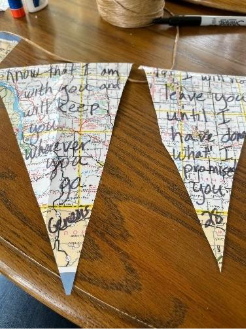
Find maps of roads and cities (printed off the internet or free from tourism centers) that can be cut apart. Provide maps and scissors for each student. Cut triangle pennants out of the maps. Write Genesis 28:15 onto the pennant:
Know that I am with you and will keep you wherever you go, …I will not leave you until I have done what I have promised you. “
Cut yarn/string/twine long enough to hang the pennant, then fold over the edge of the triangle and glue yarn in the fold. Depending on the size of the triangles, they may want more than one triangle per person. Pennants may be strung together. When finished, invite the class to take these home and to hang somewhere as a reminder that God is always with them. The group may also choose to make a large garland to hang at the church.
As they are working, discuss these questions:
- In this story, God is revealed to Jacob. What qualities do we learn about God from this encounter?
- In what way does God let Jacob know he is loved?
- Did Jacob deserve this promise? Why do you think that?
- What does this promise mean to you?
Explore the Community of Christ Basic Belief: Revelation
We affirm the Living God is ever self-revealing. God is revealed to the world in the testimony of Isreal, and above all in Jesus Christ. By the Holy Spirit we continue to hear God speaking today. The church is called to listen together for what the Spirit is saying and then faithfully respond.
—Sharing in Community of Christ, 4th Edition, p. 36
- Where have you encountered God?
- What has God revealed to you through these encounters?
Send
Jacob’s dream—this ancient testimony of God’s self-revelation—is a starting point to understanding God’s unconditional love today. Consider the affirmation found in Doctrine and Covenants 163:10a. Hear it as a promise for you.
Collectively and individually, you are loved with an everlasting love that delights in each faithful step taken. God yearns to draw you close so that wounds may be healed, emptiness filled, and hope strengthened.
Bless
Read or singing “O God We Call” CCS 195 as a closing prayer.
Reader 1: O God we call
Reader 2: O God we call
Reader 3: From deep inside we yearn
Reader 4: From deep inside we yearn
All: From deep inside we yearn for you.
Children’s Lesson
Focus Scripture Passage
Genesis 28:10–19a
Lesson Focus
We can discover God in the unfamiliar and in the ordinary. Sacredness of Creation.
Objectives
The learners will…
- be introduced to the story of Jacob’s dream.
- learn that the Divine is found all around. “Surely, God is in this place.”
- learn that God promises to be with us wherever we go.
- learn symbolism of oil in the faith community.
Supplies
- A variety of unpolished stones, preferably fist-sized, smooth, several colors
- Clear mineral oil or baby oil
- Rimmed trays to contain mess
- Towels to wipe messy hands
- Smocks or aprons
- Bible
- Community of Christ Sings (CCS)
Notes to Teacher
In preparation for this lesson, read “Exploring the Scripture” for Genesis 28:10–19a in Sermon & Class Helps, Year A: Old Testament, p. 97, available through Herald House.
This lesson includes verses 10–22 of Genesis 28.
Gather
The Wonder of Rocks!
After greeting each child, gather for sharing. Engage them in a conversation to discover the wonder of Creation found in Earth’s rocks. Some questions and facts to share:
- “What do you think, kids? Rocks: boring or interesting?” Allow children to respond.
- “Does anyone like to collect rocks? Why?”
- “I wonder if there’s a difference between “rocks” and “stones”? What do you think?”
Facts:
- There are over 5,000 kinds of rock on Earth. Each type is different from all the others.
- Some rocks, called igneous rocks, are created from lava that has cooled. It can look like shiny, black glass that is sharper than a steel knife!
- Some rocks on Earth are over 4 billion years old! That’s older than any of the dinosaurs and even older than the oceans.
- There are rocks flying through outer space. Sometimes they crash down to Earth. These are called meteorites. Some even contain tiny diamonds!
- Gemstones like diamonds, emeralds, and opals are rocks that have been cut and polished.
- Crystals are a kind of rock. The world’s largest crystal is 36-feet (10.97 meters) long. That’s as long as a school bus!
- Rocks can never ever “die” – they are just recycled repeatedly into various kinds of rock.
Engage
Encounter the Story
Read together the story of “Jacob’s Dream at Bethel,” Genesis 28:10–22 NRSVue.
Next, imaginatively retell the story in your own words, highlighting the key points:
- Jacob was travelling in an unfamiliar place, and it became dark.
- the stone pillow
- the dream stairway connecting heaven and earth
- God’s promise to be with Jacob wherever he goes
- the phrase “Surely, the Lord is in this place”
- Jacob’s stone monument, poured with oil
- Jacob’s promise to give God at tenth of his wealth.
Imagine the Story Together
Ask children to share what the story looked and felt like in their minds. What did the new land look like where Jacob was travelling? Was the night stormy or were there stars? Was it scary? What did his stone pillow look like? How did you imagine Jacob’s big dream about angels going up and down stairs to heaven?
Connect to the Story
Discuss: When have you done something like Jacob?
- When have you travelled to some place new to you, far from home? How did that feel?
- Have you ever been walking out at nighttime all alone?
- Have you made a pillow out of something unusual?
- Tell (briefly!) about a special dream you have had.
- When have you kept a souvenir or left a reminder of something special that happened?
- When have you seen someone use oil at church or during prayers?
Unpack the Story
Jacob was travelling away from what was familiar to him. He wasn’t sure if God could be found any place but his home. He felt uncomfortable. Even his sleep was uncomfortable with a rock pillow!
God spoke to Jacob in a dream. Notice that the stairway connected God in Heaven to Jacob on Earth, even in this new unfamiliar land. Angels went up and down. This is an image showing that the Divine and our world are connected, not separate!
God promised Jacob that God is everywhere he goes. God will never leave him–or us. All the world is connected to God, like stairs with angels going back and forth. All of creation is sacred.
Jacob woke up and wanted to remember these special promises. He took the ordinary rock he used as a pillow and poured oil on it. Rocks are ordinary, everyday parts of the world. Oil is a symbol of God’s Spirit. Covering the stone with oil is a way of showing that God’s Spirit covers everything in the world, even the ordinary or uncomfortable or unfamiliar things.
Oil is used in in Community of Christ to symbolize that God is with us and is flowing through our lives. We use “consecrated oil” in our sacrament of the Laying on of Hands for the Sick to show that God is with the person who needs prayer. It also symbolizes that God’s Spirit is like a healing ointment for a sick person.
Jacob’s generous response: Jacob left the special rock in that place as a reminder of what he experienced with God and of God’s promises. A funny word for this kind of reminder monument is an “ebenezer.” Jacob responded to God’s promise by building an ebenezer and making his own promise to give back one tenth of all he received from God.
Respond
Sensory Ebenezers
Give each child a smock or apron to wear.
Allow children to select a smooth stone that they like best.
Invite them to examine the stone and identify its unique characteristics. Imagine where on or in the Earth this stone might have come.
Place stones on the rimmed tray(s). Help each child pour a bit of oil to coat their stone.
Examine the stone again. How does it look different? Perhaps it may seem to shine, new colors are enhanced, interesting textures are accentuated. How do they seem different?
Allow some time for children to explore with their senses together.
Gently mention again the symbolism of oil, the Sacredness of Creation, God’s promise to be everywhere they go, and the power of recognizing God’s Spirit in the ordinary.
Wipe oily hands dry with towels and wash with soap.
Send
Our Unfamiliar Lands and Ordinary Rocks
Recite Jacob’s phrase: “Surely, the Lord is in this place!” Ask children to repeat the phrase with you.
Ask the children to consider one place in their lives that is new or feels uncomfortable. Maybe visiting a new friend’s house for the first time or being in a big crowd at a sports game? Was it easy or hard to remember that God was in that place with you? Why?
Jacob gives us an easy little prayer to help us remember that God is right there with us when we are somewhere new or uncomfortable. “Surely, the Lord is in this place!” Ask children to repeat the phrase with you again. You can whisper this reminder prayer to yourself or say it silently in your heart.
Next ask the children to consider one ordinary place they go to every day. Is it easy or hard to remember that God is in that place with you? Why? Sometimes life feels so ordinary—like a boring old rock—that we forget to see God is in it all.
Again, Jacob gives us an easy little prayer to help us remember that God is right there with us in ordinary places. “Surely, the Lord is in this place!” Ask children to repeat the phrase with you again. You can whisper this reminder prayer to yourself or say it silently in your heart.
Bless
Blessing Our Next Places
One at a time, invite each child to tell about places they will be going in the next week or so. Are there any special new places? Any ordinary places?
Offer a quick, informal blessing aloud for each child after they share. For example: “God, thank you for being with Caleb as at Grandma’s house next week! Surely, you are in that place!”
Thank each child for their special presence to you and the other children as they go.